
News · September 18, 2026
OpenAI Has Turned the Ad Click Into a Separate Conversation
Sponsored Agents make a paid placement an optional, labeled conversation with a business. The immediate marketing question is whether product knowledge and attribution are ready for that surface.
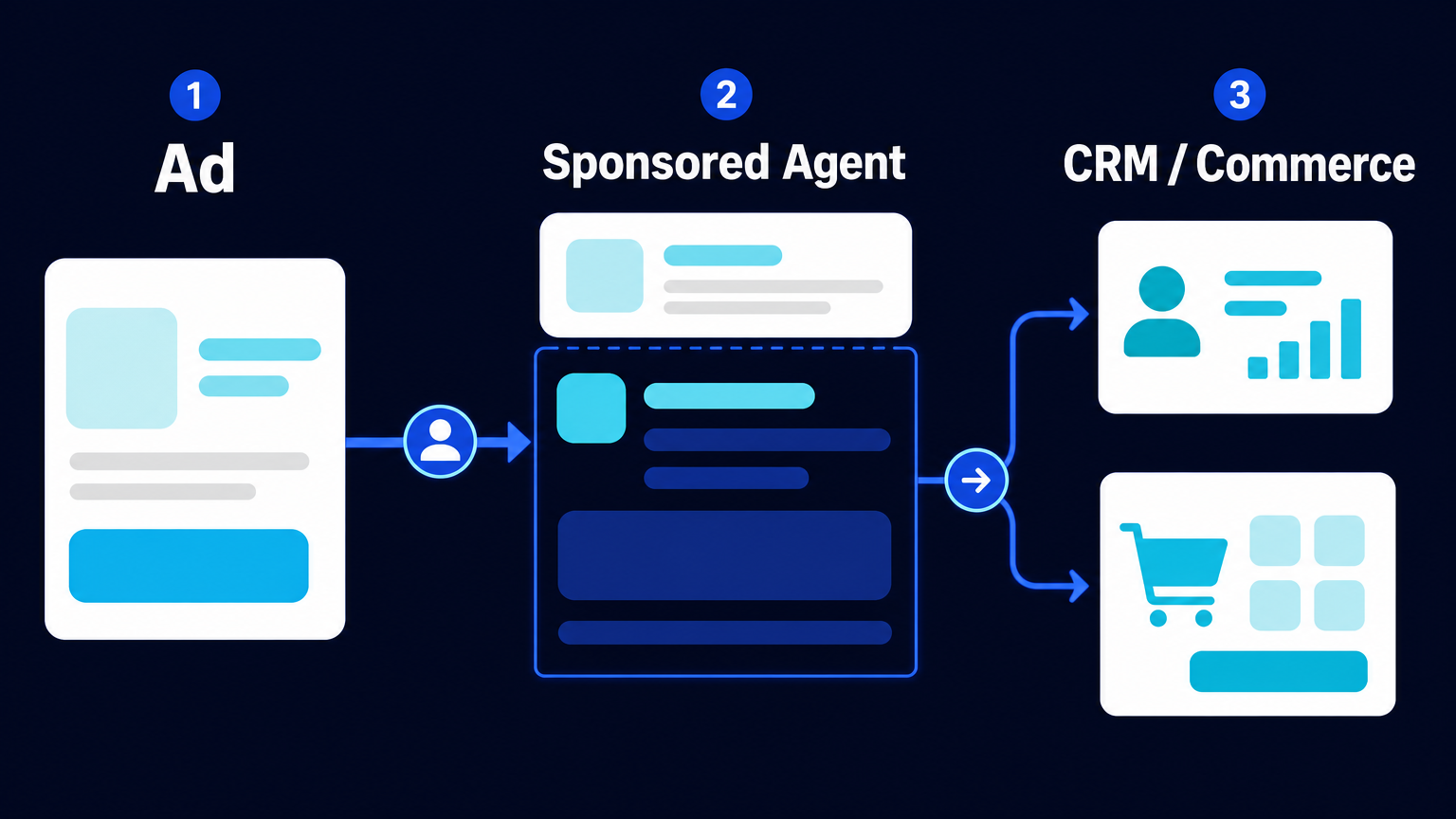
A paid ad in ChatGPT can now open into something more substantial than a landing page. On September 16, OpenAI announced Sponsored Agents: a test with select advertisers in the United States in which a user who sees an ad may choose to enter a distinct conversation with a business-sponsored agent.
That is the material change. Advertising creative, product explanation and the first stage of lead qualification can now occupy one interactive surface. The placement does not simply point away from ChatGPT; it can invite a user into a labeled business conversation that answers product or service questions and can send the user to the advertiser’s website.
For marketing and commerce teams, the implication is practical. The campaign decision is no longer only which message to buy and which landing page to build. It is whether the business has accurate enough catalog, product, policy and service information to sustain a useful conversation after the click—and whether the resulting activity can be connected to existing commercial measurement.
What OpenAI changed
Sponsored Agents are not described as a replacement for ChatGPT’s ordinary response. OpenAI says the sponsored conversation is clearly labeled, separate from the user’s original conversation, and distinct from ChatGPT’s independent answers. A user elects to enter it after encountering an ad.
This separation is central to the new format. The company’s published advertising principles state that ads do not influence independent ChatGPT answers and that ordinary ChatGPT conversations are not sold to advertisers. Those principles predate this announcement, but they define the boundary OpenAI says Sponsored Agents preserve: an independent answer on one side, an explicitly business-sponsored conversation on the other.
The announced advertiser tooling also reaches beyond the new unit itself. Through an Ads Manager plugin in ChatGPT, advertisers can use natural-language prompts to create, update and analyse campaigns. OpenAI announced suggested copy and imagery, plus an optional feature that adapts existing text to conversational context or translates it.
The more consequential integrations sit behind campaign operations. HubSpot is the first announced CRM integration. Its public-beta documentation says customers can create campaigns, compare performance with other ad networks, append tracking parameters, and attribute contacts and deals to ChatGPT ad spend. Shopify is the first announced ecommerce integration, with catalog synchronisation, campaign creation, conversion measurement and performance tracking available within Shopify.
There is a small but important chronology point: Shopify’s App Store listing records a September 3 launch date for the app. September 16 is therefore best understood as OpenAI’s formal integration announcement or availability update, not necessarily the app’s first appearance.
What did not change
The announcement does not give Sponsored Agents authority to buy products, complete transactions, negotiate terms or execute actions on a user’s behalf. The documented experience is conversational: it can answer questions and direct a user to the advertiser’s website. The transaction boundary remains with the advertiser’s own site or another destination outside that sponsored conversation.
Nor did OpenAI announce general availability. Sponsored Agents are being tested with select U.S. advertisers. There are no published results on conversion, revenue, return on ad spend or customer satisfaction. It is too early to infer that an interactive ad will outperform a conventional placement, or that every product category benefits from a conversational pre-sale layer.
Most importantly, the format does not make a business part of ChatGPT’s independent answer. It does not imply that an advertiser sees the user’s original conversation, and OpenAI’s statement that ordinary conversations are not sold to advertisers remains relevant. The sponsored exchange is a separate, labeled destination selected by the user.
The landing page is becoming a knowledge operation
A conventional campaign can tolerate a thin handoff. An ad makes a promise; a landing page narrows the offer; a form or checkout collects the next signal. Weak product information is costly, but it can remain partially hidden behind navigation, sales assistance and delayed follow-up.
A Sponsored Agent changes the exposure. It places the product explanation immediately after the paid placement and lets a prospective customer ask the next question. That makes contradictory specifications, stale availability information, unclear eligibility rules, incomplete service boundaries and unsupported marketing claims operational liabilities in the acquisition channel rather than merely documentation defects.
The new creative unit is not just the ad. It is the quality of the answer that follows it.
This does not require every company to build a broad autonomous sales system. It requires a narrower discipline: identify which questions the sponsored conversation should credibly handle, establish a maintained source for the answers, and define the point at which the conversation should direct the user to the website, a specialist or another established channel.
Three implementation questions for marketers
- Can the business state its offer consistently? Test the catalog, pricing context, availability, eligibility, exclusions, service terms and product comparisons that a buyer is likely to ask about. A conversational surface exposes disagreement between campaign copy and operational reality quickly.
- Where does the conversation end? Since OpenAI announced redirection to the advertiser’s website rather than transaction execution, design the handoff deliberately. The site should receive a user who has already asked questions, not a generic click that must start the explanation again.
- Can the journey be measured in the systems that already run the business? HubSpot’s announced attribution of contacts and deals, and Shopify’s catalog and conversion capabilities, make integration design part of campaign design. Confirm tracking parameters, campaign taxonomy and the definitions used for a conversion before comparing this channel with other ad networks.
A new acquisition surface, still at an early stage
OpenAI has not made advertising invisible inside ordinary answers. It has introduced a separate path: a conventional ad, followed—only if the user chooses—by a clearly labeled sponsored conversation. That distinction is what makes the format legible to users and actionable for advertisers.
The strategic consequence is not that every marketer should rush to conversational ads. The test is limited, and its performance is unproven. The consequence is that product knowledge is moving closer to paid distribution. Companies that treat the post-click experience as a maintained information product, connected to CRM or commerce measurement, will be able to evaluate this format on operational terms when access expands. Companies that treat it as another copy-generation feature will discover that the weak point is not the prompt. It is the business information behind the answer.

