
AI infrastructure
Google’s Power Deal Buys More Than Electricity: It Buys a Grid Response
Google and Constellation’s 20-year agreement links AI-capacity procurement to two deliverables: incremental generation and the ability to curtail non-critical load when the PJM grid is under stress.
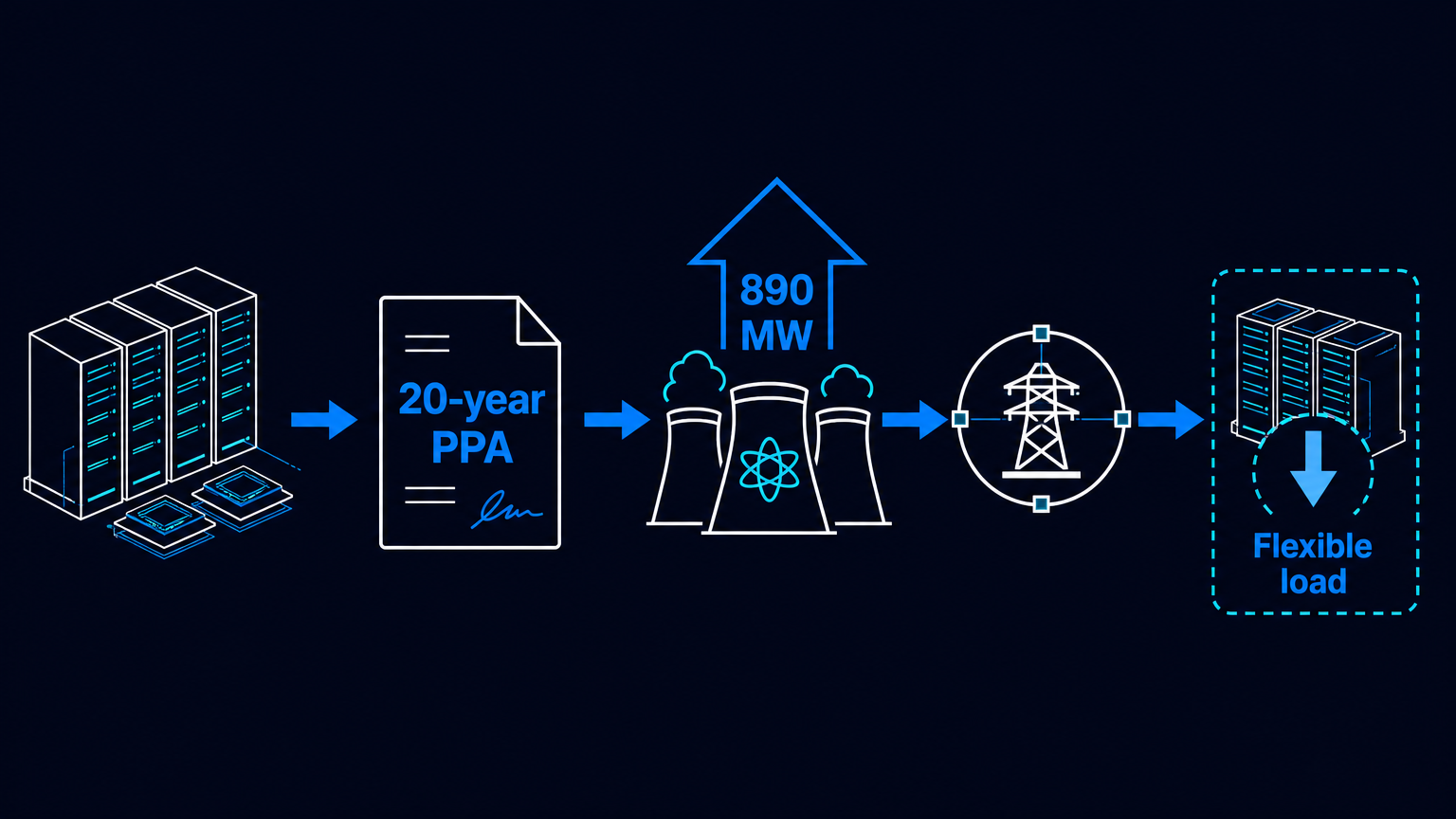
Google’s agreement with Constellation changes the shape of a large technology company’s power procurement. It is not simply a contract to buy nuclear electricity. It pairs a 20-year commitment intended to support 890 MW of incremental output from existing nuclear units with provisions to reshape Google’s own non-critical electricity use when the PJM grid is under stress.
That pairing matters because it treats new compute demand as a system commitment, not only a customer load. A buyer seeking more AI capacity is helping finance additional supply while accepting an obligation to be flexible at difficult moments for the grid.
The arrangement, announced on October 6, is still a plan with important conditions. The additional output is not online. It will come from equipment and technology investments, including power uprates, at 11 Constellation-owned nuclear units in Illinois, Pennsylvania and New Jersey. The Nuclear Regulatory Commission must approve changes to a reactor’s licensed maximum power level. Constellation expects the first uprate in 2028, and the NRC’s current schedule lists multiple expected Constellation uprate applications through 2030.
Two power quantities, with different meanings
The announcement contains two figures that should not be merged. The 20-year power purchase agreement is intended to enable 890 MW of incremental capacity for the PJM grid. Constellation says it expects to make more than $4.3 billion in new investment to achieve that outcome. The companies also signed a separate 15-year supply arrangement for 2,700 MW from Constellation’s existing PJM fleet.
The 2,700 MW is not new generation. Its stated role is to provide revenue certainty for operating assets. The 890 MW is the proposed additional capacity, subject to investment, engineering work and regulatory approval. Adding the two numbers together would obscure the commercial structure and overstate what the deal adds to the grid.
Nor is the 890 MW a private power plant for Google’s data centers. The announced additional capacity is intended to enter the PJM grid. That distinction is central. This is not a claim that one buyer has secured exclusive physical access to a new block of electricity. It is a long-duration arrangement designed to help make incremental generation financeable within a shared regional system.
What changed: flexibility joins the purchase
The consequential feature is not nuclear power alone. Google and Constellation have included load-shaping and demand-response provisions that allow non-critical consumption to be curtailed during high-stress grid events. In practical terms, the buyer is not only contracting for electricity over time. It is also making some portion of its demand available as a grid-management resource.
This is a more demanding model of capacity procurement than buying clean-energy attributes or securing a supply contract against an existing fleet. It connects three elements that are often planned separately: the buyer’s growing compute load, investment in additional generation, and an operating mechanism for reducing selected load when system conditions require it.
The model does not imply that every AI buyer should finance generation or can offer meaningful demand response. Workloads differ. Some services are safety-critical, latency-sensitive or contractually required to run continuously. A company also cannot declare its load flexible by policy alone. It needs an actual way to identify non-critical work, reduce it safely, and restore it without creating a larger operational failure.
The operating consequence is workload classification
For infrastructure leaders, the immediate lesson is narrower and more useful than “AI needs more power.” Capacity planning may increasingly require an explicit distinction between critical and deferrable compute. That is an application and platform design question before it becomes an energy-procurement question.
A credible load-shaping commitment needs a defined operating model. Teams need to know which jobs can be paused, slowed, moved or rescheduled; who can make that call; what service-level consequences are acceptable; and how the system returns to normal operation. Batch training, asynchronous data processing and some internal analytics may have different options from real-time inference serving or essential business systems. The classification cannot remain a spreadsheet label disconnected from runtime controls.
This does not require turning every workload into a demand-response asset. It requires knowing whether the capacity portfolio contains work that can absorb a constraint without violating a business promise. Where it does, the ability to shape load can become part of the commercial value of the infrastructure estate. Where it does not, the limitation should be explicit before a procurement team commits to flexibility.
What did not change
The agreement does not create a new nuclear reactor, and it does not mean 890 MW is available today. It concerns upgrades and uprates at existing units, with licensing still required. It also does not establish published operating results for the five-year technology agreement under which Constellation plans to build Gemini Enterprise workflows for planning, asset optimization and critical-infrastructure protection. Those are announced implementation plans, not demonstrated plant or grid outcomes.
The companies say Constellation’s investment would create approximately 7,200 construction jobs and sustain roughly 4,400 existing jobs. Those figures describe the announced investment case, not completed employment effects. The agreement also does not demonstrate that residential electricity prices will fall or settle questions about ratepayer impacts. Those outcomes cannot be inferred from a commercial announcement.
A procurement pattern worth watching
The Department of Energy’s UPRISE program similarly focuses on uprates and other uses of existing nuclear infrastructure to add generation in the nearer term. Google and Constellation’s agreement gives that direction a concrete commercial form: a large electricity buyer offers a long-duration commitment that can support investment in existing assets, while also agreeing to manage some demand during grid stress.
Whether this becomes a repeatable pattern will depend on approvals, delivery, grid conditions and the economics of future agreements. One contract does not establish a market standard. But it makes a credible procurement model visible. Under constrained grid conditions, the most serious AI-capacity buyers may be asked not merely where they want power from, but what new supply their demand helps enable—and what load they can safely give back when the system needs it.

