
Workforce design
AI Skills Are Moving Up the Stack While Career Paths Stay Closed
Workday’s new workforce report finds rising demand for people who can build AI tools and automate workflows, alongside weaker internal mobility. The data does not establish causation, but it exposes a practical implementation gap: training alone cannot staff redesigned work.
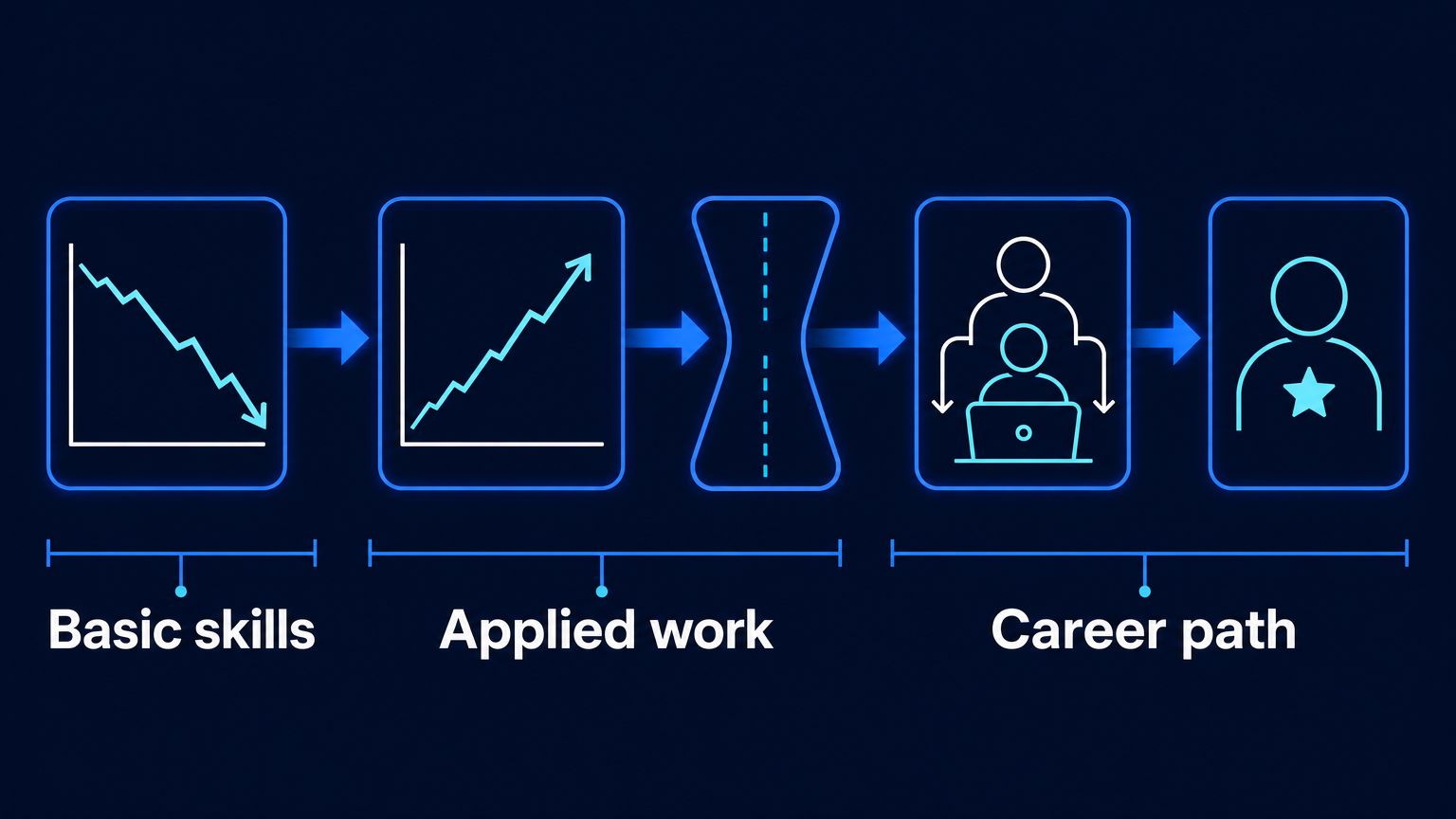
Workday’s Global Workforce Report, published on October 5, identifies an awkward enterprise condition: companies are changing what they ask of people faster than they are creating credible routes into the changed work.
Within roughly 550 employers using Workday Recruiting, demand in job requisitions for basic AI skills such as simple prompting peaked in January 2026 and then declined 25%. Over a different period, from September 2025 to July 2026, demand for building AI tools, workflow automation and AI engineering rose 51%. At the same time, internal moves declined year over year at 57% of the matched employers in Workday’s workforce dataset, and worldwide promotion rates were essentially flat.
These findings do not show that AI caused weaker mobility or flat promotion. They come from separate datasets, not one longitudinal panel following the same employers and workers. But together they describe a decision problem that implementation leaders should not ignore: a company can make its jobs more technical and more AI-shaped while leaving too few paths for its own people to gain the experience those jobs now require.
What changed: the premium is shifting from use to construction
The important movement in Workday’s data is not a general claim that “AI skills” are rising. It is a change in the kind of skill employers are seeking in one customer sample. Basic prompting is no longer the strongest signal in the requisition data. The faster-growing demand concerns practical work: building AI tools, automating workflows and engineering AI systems.
That distinction matters operationally. Prompting can often be taught through access, guidance and repeated use. Building a reliable workflow requires a different working environment: a real process to change, access to relevant systems and data, technical review, an owner of the business outcome, and room to learn from a deployment that does not work cleanly the first time.
A company that responds with a broad prompt-training programme may still improve day-to-day individual productivity. It has not necessarily developed people who can redesign a handoff, instrument an automated process, make a bounded AI tool useful to colleagues, or maintain it once circumstances change. The latter capabilities are closer to the demand signal Workday reports.
What did not change: advancement mechanisms have not caught up
The report does not announce a collapse in employment. In Workday’s survey, 40% of business leaders expected AI to increase output from their existing workforce, while 28% expected it to reduce headcount. Those are expectations, rather than measured outcomes, and they should be read as such.
Nor does the report demonstrate that employers are universally withholding development. In a September survey of approximately 6,000 full-time employees and business leaders, 79% of workers said they knew which skills they needed, and 66% said their employer helped them develop those skills. That is meaningful support. It also leaves a material gap between workers’ stated understanding of the skills required and their reported access to employer help.
The sharper concern is structural. Internal movement declined year over year at a majority of matched employers in the relevant dataset, while promotions were broadly flat worldwide. Formal learning can increase knowledge, but it cannot by itself create an assignment, a changed role, a supervised stretch responsibility or a move into a team where the new capability is needed. Those are career mechanisms, not course features.
The practical risk is not simply a skills shortage. It is a shortage of places where employees can turn training into recognised, production experience.
The implementation consequence: make redesigned work a destination
Enterprise leaders should treat this as a workforce-design issue alongside an AI deployment issue. Every material AI implementation changes a distribution of tasks: some work is removed, some is accelerated, some is newly required, and some becomes more important because a person must review, handle exceptions or own the outcome. A skills plan that is detached from those task changes will be hard to convert into staffing.
The useful unit of planning is therefore not an abstract AI curriculum. It is a defined transition between work that exists today and work that will exist after a process changes. For each priority implementation, leaders should be able to name the affected roles, the practical capabilities required, the supervised work through which those capabilities can be demonstrated, and the internal roles or assignments that can receive people afterwards.
- Start with the workflow, not the training catalogue. Identify where AI changes tasks, decision points, handoffs and exception handling in a specific process.
- Separate basic literacy from applied capability. Offer broad tool fluency where useful, but reserve practical development for work that produces an inspectable contribution to a real workflow.
- Create bounded internal assignments. A temporary placement, a supervised automation project or a defined redesign responsibility can provide experience that a course cannot.
- Make capability visible in staffing decisions. Managers filling redesigned roles need a legible record of demonstrated work, not only completion badges or self-reported familiarity.
- Measure the pathway as well as the adoption. Track who gets access to consequential assignments, who moves into redesigned work and where transitions stall.
None of this requires assuming that every employee should become an AI engineer. The report’s evidence points to growing demand for practical builders in its sample, not to a single future job profile for all workers. Many roles will need sound judgment, domain knowledge, customer understanding, operational discipline or review capacity rather than tool-building expertise. The point is to specify the capability that the redesigned work actually needs, then provide a credible way to acquire it.
Do not turn expectations into outcomes
The report is useful precisely because it combines several imperfect views: de-identified customer workforce data, recruiting data, a survey of 6,001 employees and leaders, and a separate survey of 5,944 workers. Its figures are not evidence from one representative global panel, and the reported associations cannot establish cause. Leaders should resist both overreach and dismissal.
It would be overreach to say AI has closed promotion paths, eliminated prompt-engineering jobs or already delivered the productivity and headcount outcomes leaders expect. It would be dismissal to conclude that the findings say nothing because they do not prove those claims. They show a concrete mismatch inside Workday’s sources: demand is moving toward more applied AI work while advancement and internal movement are not visibly expanding with it.
For an employer, that mismatch becomes expensive when external hiring is used to fill capabilities that existing employees could have developed through live, bounded work. It is also costly for implementation: a programme may buy software, train users and announce adoption, yet find too few people able to own the redesigned process after the initial launch team leaves.
The career architecture is part of the AI architecture
Workday’s October report does not settle the question of how AI will affect employment. It makes a nearer question harder to avoid: when a company changes the work inside a role, how does a person earn the experience to perform the new version of that role?
Tool access answers only the first step. Prompt instruction may answer part of the second. The durable answer is a career pathway connected to real operating work: visible entry points, bounded responsibility, review by capable people and a recognized next assignment. Without that architecture, companies risk treating internal talent as an audience for change rather than as the workforce that must carry it.

