
UK competition proposal
Britain May Turn the Search Default Into an AI Distribution Channel
The CMA’s draft could let qualifying AI assistants compete for placement on Google search-choice screens. The proposal is not final, but it makes web access, attribution and platform integration conditions of search distribution.
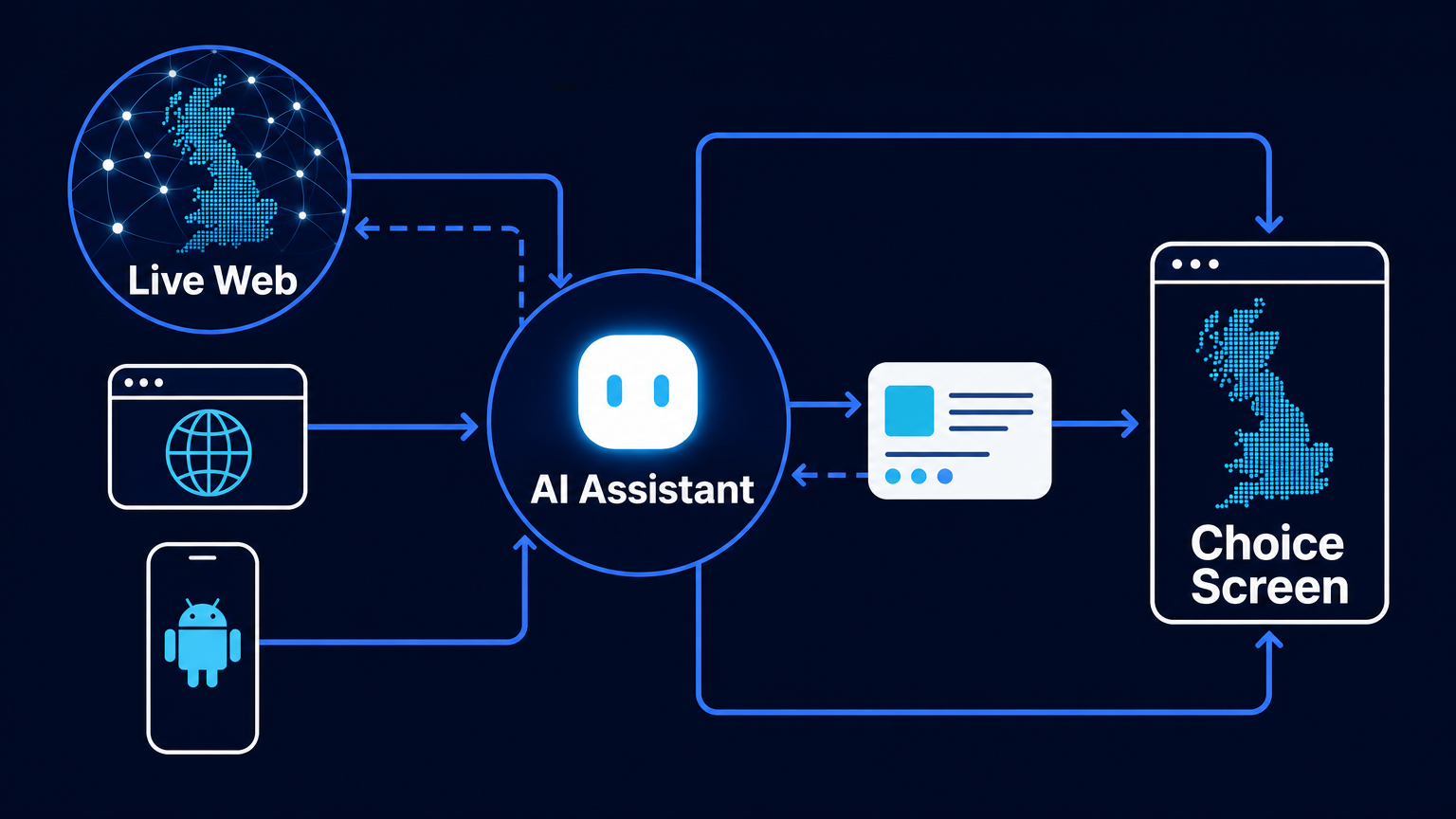
A search assistant may soon have a new route to users in the UK: not an app-store listing, a browser tab or a marketing campaign, but the moment a person chooses their default search service.
On 23 September, the UK Competition and Markets Authority (CMA) published a further consultation on a proposed Google search-choice requirement. Its important move is technology-neutral: an AI assistant could be eligible to appear on choice screens alongside conventional search providers if it meets the eventual criteria. The CMA had already identified AI assistants as an emerging competitive threat to Google’s general-search service.
This is not an order to Google, and it does not put any named assistant on a choice screen. It is a draft proposal under consultation. Responses close at 5 p.m. on 9 October 2026, and the CMA says it will consider them before proceeding; its accompanying announcement says a final decision is expected by the end of 2026. But the proposal is consequential because it recasts part of AI competition as a distribution problem at the browser and operating-system layer.
What the CMA is proposing
The draft would require search-choice screens on relevant Chrome installations and on new Android devices in the UK where Google Search is preinstalled and set as the default. Users would also receive a skippable opportunity each year to revisit their selection. A temporary “test-drive” option would let a user try a provider as the default before deciding whether to keep it.
Google would administer the process, but the proposal requires it to be clear, fair, robust and transparent. Google would have to report its decisions to the CMA and provide detailed reasons when it rejects an applicant.
The document therefore does not propose a generic assistant directory. It proposes a regulated route into a high-value access point: the default-search decision on Google-controlled Chrome and Android surfaces in the UK.
An assistant would have to behave like general search
The proposal does not treat conversational fluency as sufficient. To qualify, a service would need to address the full range of general-search use cases across subjects, including by searching the web. It would need a functioning experience on the relevant Chrome and Android access points. And it would need evidence that a meaningful, non-trivial proportion of UK users regard or use it as a general-search service.
That last condition is especially material. A provider cannot assume that a strong model or a popular chatbot is automatically a search competitor for this purpose. It would have to make a case that people use, or regard, the service as general search. The draft sets a functional and user-behaviour threshold, not a model-quality threshold.
The CMA does not require an eligible provider to own a search index. A service could use syndicated search infrastructure. But it would need to provide current information and search the web. This creates space for new entrants while retaining a basic expectation of live, broad retrieval rather than a closed-answer experience.
Attribution becomes a distribution requirement
For generative-AI summaries, the draft requires clear and accurate attribution of web content and a clear route for users to access that content. It does not prescribe one attribution design, and it does not create a payment, licensing or revenue-sharing obligation. The proposal is about source visibility and user access, not publisher compensation.
Still, the operating consequence is substantial. An assistant seeking this channel would need attribution that works in the actual search experience, not only in a policy document or an occasional citation feature. It would need a dependable path from generated answer to underlying web content, across the query types it presents as search.
For product teams, web retrieval, source presentation and mobile or browser integration stop being adjacent features. Under the proposed eligibility test, they become part of the product definition required to compete for distribution. For publishers, attribution design becomes connected to a regulated route by which an assistant may reach users at the point of default selection.
The default is not a result page
This proposal matters because defaults shape the first action, not merely the next comparison. A user who selects a service as default is not being offered another destination in a list of apps. That service is being placed into a recurring entry point for information seeking.
The CMA’s approach recognizes that AI assistants may compete with general search in some circumstances, while refusing to treat every assistant as a substitute by declaration. The criteria make the distinction operational: can the service cover broad search needs, retrieve current web information, work on the relevant access points, demonstrate meaningful search use and identify its sources clearly?
The competitive question is no longer only which system gives the best answer. It is which systems can satisfy the conditions to be present when the question is first asked.
What has not changed
No assistant is guaranteed inclusion. Providers would have to apply and meet the final criteria. UK users cannot currently choose an AI assistant through the proposed screens. The consultation applies to relevant Chrome installations and Android devices in the UK under the CMA’s digital-markets regime; it is not a global rule. Nor should the proposal be conflated with the separate publisher, fair-ranking and data-portability requirements that the CMA imposed on Google in June 2026.
The proposal also gives no basis for predicting adoption, market-share gains or losses. A choice screen changes a route to distribution; it does not determine what users will choose, whether they will remain with it, or how providers will meet the eligibility requirements.
A practical design test for AI search products
Teams that want to be credible candidates should read the consultation as an architectural checklist rather than as an invitation to add a search toggle. Can the service search the live web and handle broad general-search demand? Can it run cleanly through Chrome and Android access points? Is there evidence of meaningful UK search use? Can every generated web summary provide clear, accurate attribution and a usable route to its sources?
Those questions join product integration, retrieval infrastructure, measurement and source presentation into one distribution capability. Model quality remains important, but the draft makes plain that quality alone may not be enough to compete at the default layer.
The CMA has not yet made this route available. It has, however, described the doorway. For AI-search providers, the work is no longer just to answer a query well. It is to build a service that can credibly function as general search where the user’s search habit begins.

