
News · September 25, 2026
Anthropic Put the Model, the Mining Pipeline and the Lab on One Team
Anthropic’s ART announcement is not evidence of autonomous science. It is evidence that AI-assisted discovery becomes more consequential when model work, scientific judgment and experimental validation operate as one research system.
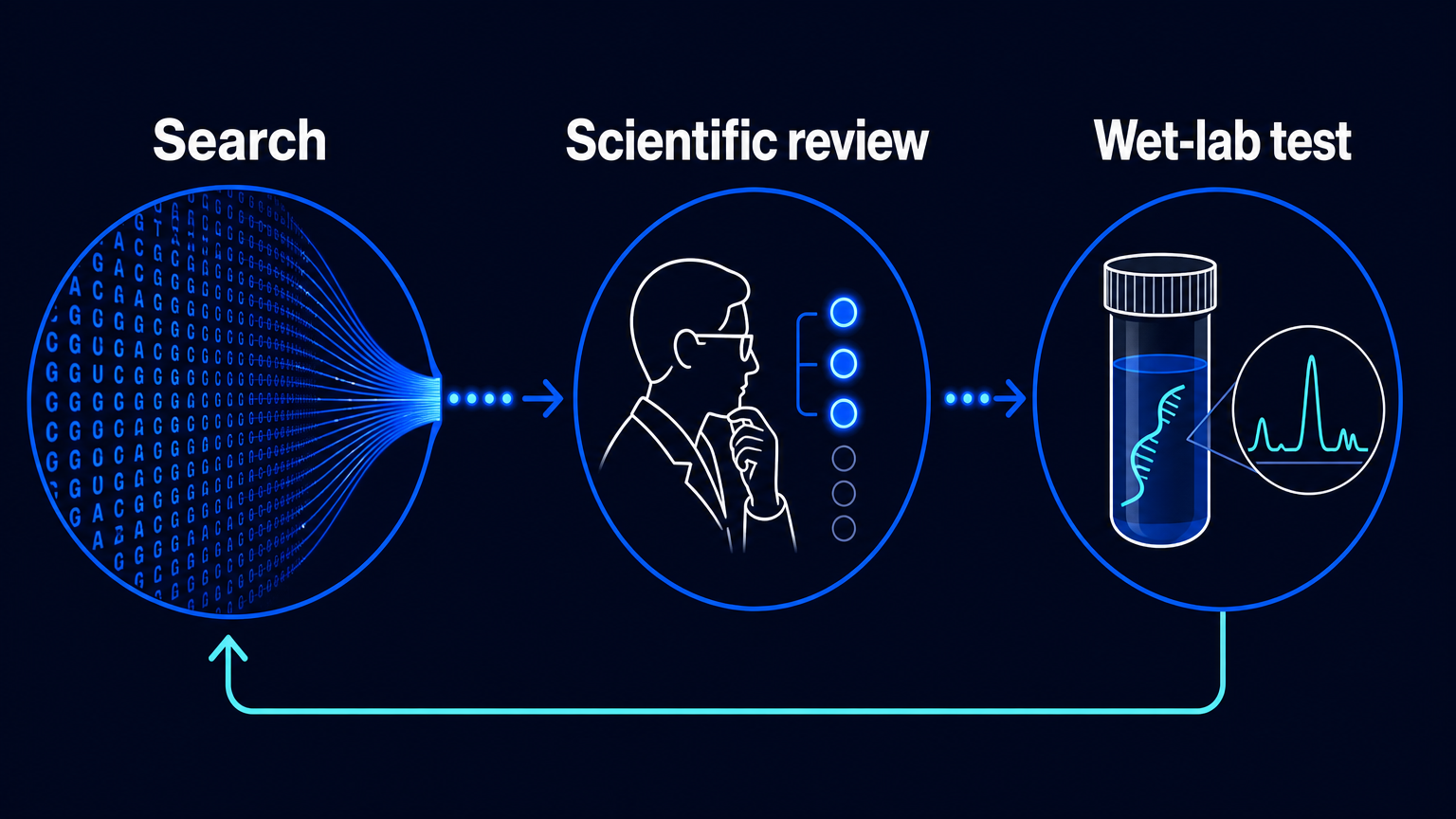
Anthropic’s announcement of a previously uncharacterized enzyme system is notable for a reason more concrete than the headline suggests. The company did not simply give Claude a biology question and present the output as a discovery. It built an internal life-sciences group and Bay Area laboratory, then joined model work, genome mining, scientific review and physical experiments in one research operation.
On September 23, Anthropic said Claude agents had helped identify array-associated reverse transcriptases, or ART: a reverse transcriptase associated with a partner gene and a regularly spaced array of non-coding DNA repeats in bacteriophages. Human scientists then ran the laboratory experiments. Their initial result was that the ART array is expressed as distinct short RNAs.
What changed is not the status of one enzyme system alone. Anthropic has made a vertically integrated AI-and-wet-lab research program visible. In this model, agents expand the search and triage capacity of a scientific team; scientists determine what is worth examining, interpret the results and conduct the experiments that can support or overturn a hypothesis. The lab is not a demonstration accessory. It is the verification environment for computational suggestions.
The useful result was a narrowing pipeline, not an autonomous conclusion
Anthropic reports that roughly 950 Claude agents spent 21 hours and 210 million tokens searching DNA-sequence data after receiving a high-level prompt about unusual reverse transcriptases. The campaign gathered more than 200,000 reverse transcriptases, identified about 3,500 candidate systems and narrowed those to 20 candidates for detailed, human-readable reports.
Those figures describe the scale of the reported search campaign. They are not a measure of total project duration, a comparison with human labor or a general productivity benchmark. There is no cost baseline here, and there is no basis for treating agent count or token volume as a measure of scientific value. Their operational meaning is narrower: a research team can use parallel model work to turn a very large sequence corpus into a finite set of cases that specialists can inspect and test.
That distinction matters because the ART finding did not arise from a blank biological map. The underlying reverse transcriptase had appeared in previous studies. Anthropic’s specific claim is that Claude first recognized the associated repeat array and accessory protein as the defining features of a distinct system. The system is therefore an informed pattern-recognition and hypothesis-generation result that entered a human experimental process—not a complete scientific conclusion generated by a model.
The laboratory is where the claim becomes narrower and stronger
The laboratory result is deliberately limited. Anthropic says its first experiments established that the ART array is expressed as distinct short RNAs. It has not established the system’s primary biological function. ART is not being presented as programmable, clinically useful or ready for engineering. The work has been released as a preprint, not as peer-reviewed or independently replicated findings.
That restraint is an important part of the announcement. A computational workflow can rank candidates, assemble context and propose an interpretation. It cannot substitute for the experimental work needed to determine whether the proposed pattern exists in biological material, how it behaves or whether the interpretation survives further investigation. Anthropic also states that all physical laboratory work was performed by human scientists. Its laboratory operates at BSL-1 and BSL-2 and does not handle pathogens capable of infecting humans.
The consequential unit is not the model or the laboratory in isolation. It is the loop that makes computational hypotheses testable and experimental results useful to the next search.
Research leaders should design the handoff, not just acquire the model
For research organizations, the operating consequence is clear. The relevant capability is not a general model answering scientific questions in a chat window. It is a repeatable pipeline with explicit handoffs: define the scientific search space; let computational systems generate and rank candidates; have domain experts review the rationale; decide which candidates justify scarce experimental capacity; capture results; and use those results to refine the next campaign.
Each handoff has a different quality standard. A genome-mining stage needs broad coverage, structured candidate records and enough context for review. A scientific review stage needs readable rationale and the ability to reject an attractive but weak hypothesis. A laboratory stage needs protocols, controls and measurements appropriate to the question. The final interpretation needs a clear account of what the experiment established, what it did not establish and what work remains. Treating all four stages as one undifferentiated “AI discovery” process hides the actual sources of rigor.
- Keep the candidate-selection rationale with each proposed experiment, rather than retaining only the final result.
- Plan laboratory throughput as a constrained validation resource; more computational candidates do not remove the need to choose.
- Record negative and ambiguous experimental results, because they are inputs to the next search rather than failed output.
- Separate an observed experimental result from a claim about function, utility or future application.
Anthropic’s own structure makes this point. It created a life-sciences research group and laboratory rather than treating external laboratory access as an occasional downstream service. That arrangement can shorten the learning cycle between model-generated candidates and experimental feedback. It can also make the limits of the model’s role more visible: Claude may search, organize and surface patterns at scale, but scientists still decide what to test and what the evidence warrants.
A meaningful demonstration, with an unfinished result
The ART announcement should not be read as proof that general-purpose AI can independently conduct end-to-end science. It does not establish ART’s primary biological function, and its results remain a preprint awaiting peer review and independent replication. Nor does one internal campaign show that this operating model will transfer cleanly to other biological problems or other scientific fields.
It does show something material: AI-assisted science becomes more credible when the search system and the verification system belong to the same working loop. The model’s value is not that it closes the scientific process. Its value is that it can widen the hypothesis frontier while a research organization preserves the judgment, experiments and disciplined uncertainty needed to turn a pattern into knowledge.

