
News · 1 October 2026
AMD Is Buying a Window Into the Workloads Its Next Chips Must Run
AMD’s proposed $8.2 billion all-stock acquisition of World Labs is a move to place frontier model research inside infrastructure design. The deal has not closed, and it does not yet change any AMD product.
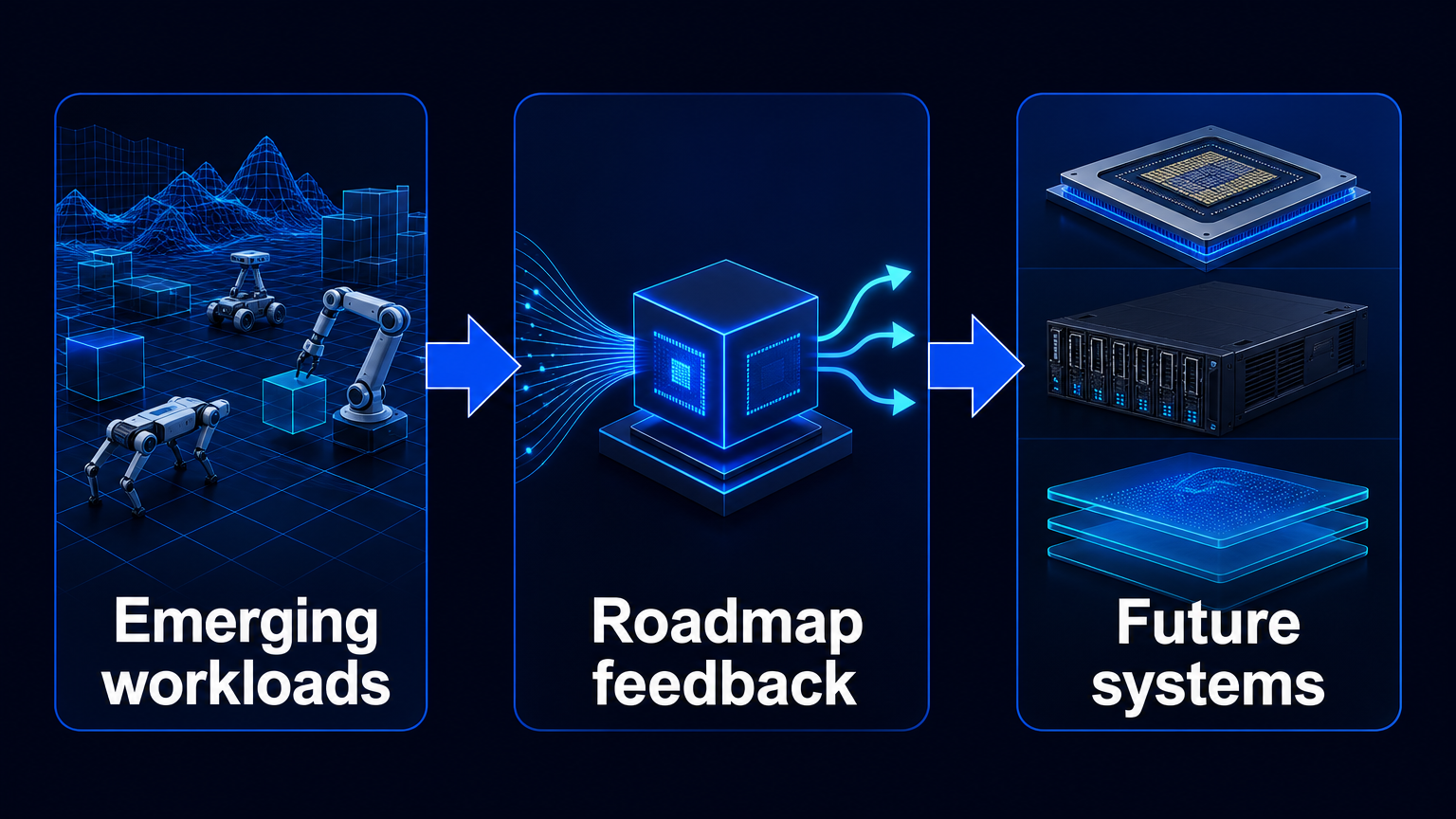
AMD’s proposed acquisition of World Labs is not principally a bet on one spatial-AI product. It is a bid to bring a frontier model-research organization closer to the people deciding what future AI hardware, software and systems should be built to do.
On September 28, AMD announced a definitive agreement to acquire World Labs in an all-stock transaction valued at approximately $8.2 billion, subject to customary adjustments. AMD’s SEC filing says the merger agreement was signed on September 26. The companies expect to close by the end of 2026, subject to regulatory approvals and customary closing conditions.
That distinction matters. AMD has announced an agreement; it has not completed an acquisition. No new accelerator, system, software release, deployed compute capacity or customer entitlement follows from the announcement. The practical change today is an organizational commitment: if the transaction closes, a model lab will sit inside a major semiconductor company’s technology-roadmap process.
A model lab becomes an infrastructure input
World Labs develops spatial-intelligence models that generate, reconstruct and simulate interactive 3D environments from text, images and video. Its work also covers technology for robotic learning and simulation. These are workloads with different pressures from familiar language-model serving: they may involve visual and spatial representations, simulation, rendering-like operations, interactive environments and training or inference patterns that are still evolving.
AMD is unusually direct about the purpose of the transaction. It says World Labs’ model expertise is intended to provide deeper insight into evolving workloads and help shape future hardware, software and systems roadmaps. World Labs says the companies began a technical partnership in 2025, including model training and inference optimization on AMD GPUs. AMD Ventures then disclosed an investment in World Labs in March 2026.
The sequence suggests that the acquisition is not an attempt to discover the workload after signing a deal. The companies already have a working technical relationship. The proposed combination would turn that relationship from external collaboration into a shared organizational setting for research and infrastructure design.
This is the important strategic signal. Infrastructure suppliers traditionally learn demand through customers: procurement plans, benchmark requests, support cases, design wins and deployment telemetry. Those channels remain valuable, but they arrive after a workload has acquired a recognizable commercial shape. A research organization working at the model frontier can expose emerging requirements earlier—before they become a standard request for a GPU cluster or server configuration.
The acquisition does not prove that AMD has found the winning architecture for spatial AI. It shows that AMD considers direct exposure to emerging model workloads worth $8.2 billion in stock.
Competition is moving upstream
For enterprise infrastructure teams, the useful inference is not that every chip supplier now needs to buy a model lab. Different suppliers can learn from customers, software partners, internal research, developer ecosystems and deployed systems. Nor does ownership guarantee better hardware. The companies have not identified a chip feature, software capability or systems design that World Labs has already changed.
The more grounded conclusion is that infrastructure competition is moving upstream into workload discovery. As models expand beyond text generation into spatial reasoning, world generation, simulation and robotics-related learning, the relevant computing patterns may not be fully represented by today’s standard purchasing categories. Suppliers that understand those patterns early have more opportunity to align hardware, compilers, libraries, runtime software and system architecture before demand hardens.
That is an operating consequence, not a branding point. A roadmap designed around a stale picture of workloads can force enterprises into compensating architecture: extra conversion layers, inefficient pipelines, fragile integration or a premature dependence on a single vendor’s assumptions. Conversely, early alignment is only useful if it becomes reliable products, compatible software and deployable systems. The announcement offers none of that proof yet.
What customers should and should not infer
Customers should not read this as an immediate change to AMD’s product portfolio or a reason to assume that World Labs’ research will be available in a particular form. There is no announced production offering, service-level commitment, deployment metric or integration timetable. There is also no evidence in the announcement that the acquisition increases AMD’s accelerator market share, revenue, installed base or available compute capacity.
They should also avoid treating World Labs as a proven enterprise operating system for robotics or simulation. Its stated capabilities are material to the direction of research, but the acquisition announcements do not establish production adoption or business outcomes for those uses.
There is, however, a concrete point to track after closing. Fei-Fei Li, World Labs’ co-founder and CEO, is expected to become AMD executive vice president and chief scientist, reporting to CEO Lisa Su. World Labs is expected to continue its model-research work. That proposed reporting line places research leadership close to the company’s top operating decisions, rather than treating the lab solely as a product feature team.
World Labs also says the combined organization intends to build an open AI ecosystem spanning hardware, software, platforms and accessible open models. This is an intention, not a delivered commitment. Enterprises should evaluate future releases by their actual licensing, portability, support terms, performance characteristics and compatibility—not by the aspiration alone.
The procurement question changes slightly
The immediate purchasing question is not whether this agreement makes AMD a safer or stronger choice for a current deployment. It does not answer that question. Current decisions should still turn on available hardware, software maturity, workload performance, supply, cost, support and the architecture an organization can operate.
But technology leaders planning multi-year AI estates should add a roadmap question: how does an infrastructure provider learn about workloads before they reach conventional enterprise procurement? The answer may come from research partnerships, open software communities, customer co-design, internal labs or acquisitions. What matters is whether that learning creates a credible feedback loop from emerging model behavior to product engineering.
AMD’s proposed World Labs acquisition is a costly and visible version of that loop. It brings researchers working on spatial intelligence, interactive 3D environments, robotic learning and simulation closer to a company building AI infrastructure. The transaction remains unfinished, and its product consequences remain unproven. Yet its logic is clear: the next contest in AI infrastructure will not be decided only by who supplies compute for known workloads. It will also be shaped by who sees unfamiliar workloads early enough to build for them.

