
Independent analysis
The Work You Remove May Be How Your Next Experts Are Made
AI can remove specialist handoffs and accelerate delivery. It can also remove the situated work through which a company produces its next reviewers, troubleshooters and decision-makers.
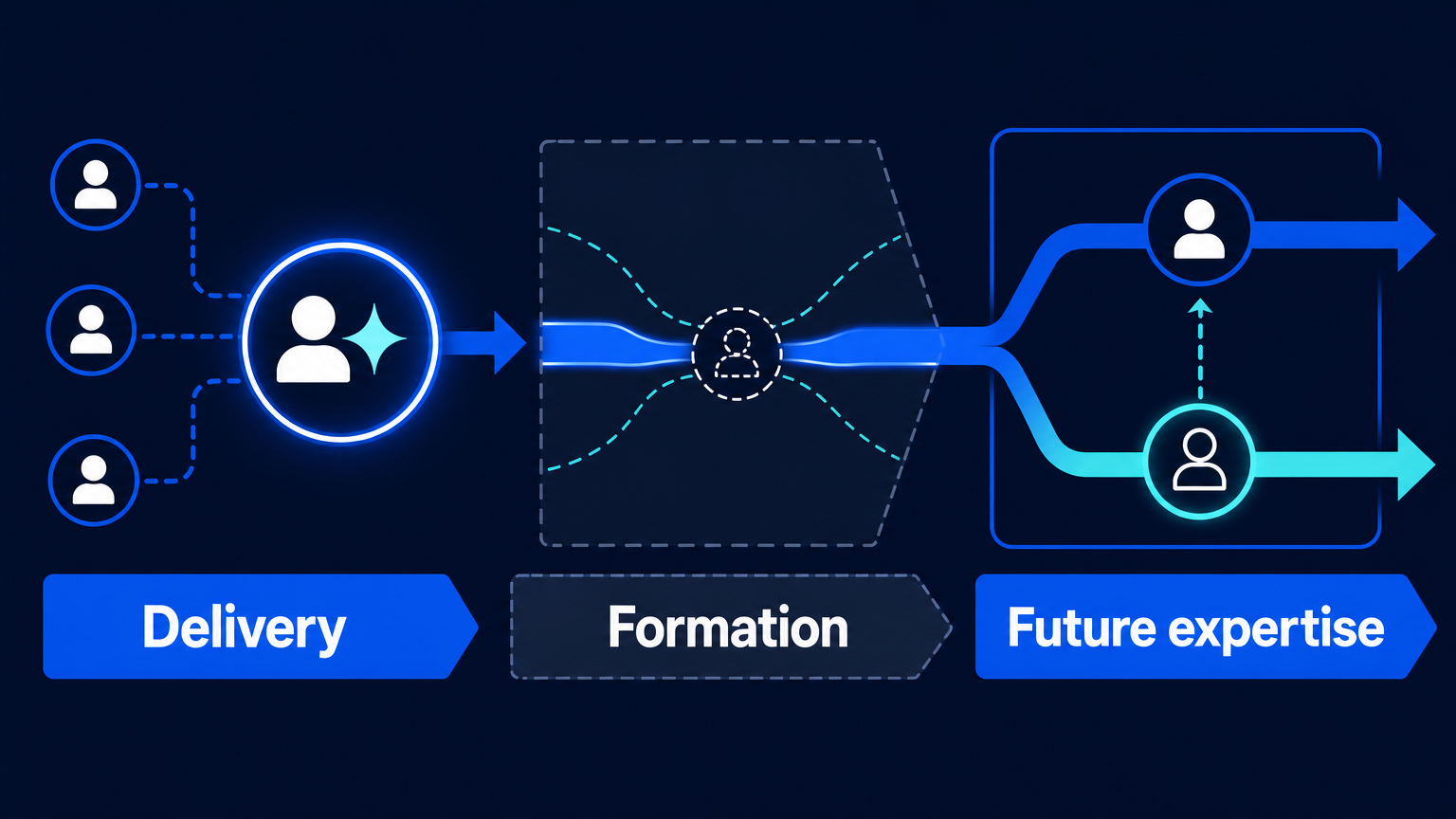
A company can automate the work that teaches people how to run it. That is the overlooked risk in many AI redesigns.
The usual business case is straightforward: remove handoffs, shorten cycles, and let a smaller number of experienced people deliver more with AI. Much of that case is real. OpenAI’s July 2026 research, based on more than 800,000 work-related messages from U.S. ChatGPT users, found that 16.8% of work-related messages concerned tasks historically associated with another occupation. Among occupation-specific messages, the figure was 43.5%. Workers are already crossing task boundaries that once required a specialist handoff.
But a workflow does not produce only today’s business result. It also produces, or fails to produce, tomorrow’s supply of expert judgment. When AI absorbs analysis, drafting, debugging and coordination into a senior-plus-AI workflow, it can make delivery faster while removing the repeated, situated encounters through which less experienced staff learn how the work actually fails.
That is not an argument for preserving inefficient work. It is an argument for recognizing that some apparently removable work is part of the company’s expertise-production system.
Task crossover changes the route into expertise
OpenAI describes task crossover as evidence of a changing division of work, not evidence that occupations are disappearing. That distinction matters. Being able to attempt a task historically performed by another profession is not the same as acquiring the competence, authority or accountability to perform consequential work in that profession.
Yet the operating effect can still be substantial. A senior analyst with AI can draft material that once gave a junior analyst practice in structuring an argument. An experienced engineer with AI can diagnose and patch issues that once exposed a newer engineer to unfamiliar systems, weak signals and production constraints. A manager can consolidate coordination work that once taught someone how dependencies, commitments and exceptions move through the organization.
In each case, the work may have had two values. Its immediate business value may have been modest. Its learning value may have been high because it placed a developing practitioner close to real context, real consequences and senior judgment. Remove it without replacement, and the company does not merely save time. It narrows the route by which people become capable of carrying responsibility later.
This risk may arrive unevenly. OpenAI found more task crossover among typical-volume users in smaller workspaces: 18.9% in workspaces with two to five seats, compared with 16.3% in workspaces with 101 or more seats. The study does not equate workspace seats with company size. Still, the pattern is a useful warning for smaller teams, where there are fewer parallel pathways through which junior staff can observe, attempt and recover from real work.
Assisted output is not independent capability
The concern is not that AI assistance always damages learning. The evidence is more specific—and more operationally useful—than that.
Anthropic ran a randomized controlled trial with 52 mostly junior software engineers learning an unfamiliar Python library. Participants using AI scored 17% lower on a later mastery quiz. The study found no statistically significant overall improvement in task speed. This is a small study in one technical setting, not a universal deskilling rate for knowledge work. But it establishes an important possibility: better or completed work during assistance can coexist with weaker unaided mastery afterward.
The interaction pattern mattered. Participants who asked AI for explanations, conceptual help and support for their own comprehension could retain stronger learning outcomes. That finding rules out the lazy response of banning AI from development work. The question is not whether a person used AI. The question is whether the workflow required the person to form and test a mental model, or allowed the system to supply a result before one was needed.
A controlled logic-puzzle study released in August 2026 points in the same direction, within a narrower domain. Cheaper access increased requests for assistance. People who requested help performed worse after it was removed, and their earlier assisted performance overstated their later independent ability. Short-term puzzle learning is not workplace performance. Still, it is a caution against treating AI-assisted throughput as a measure of human capacity.
Microsoft’s survey of 319 knowledge workers adds a related signal. Greater confidence in generative AI was associated with less self-reported critical-thinking effort, while task-specific self-confidence was associated with more. The survey also reported a shift from direct execution toward verification, integration and task stewardship. These are self-reported associations, not longitudinal proof of skill loss. They do, however, make the staffing implication clear: a company shifting work toward review needs people who can independently recognize when a plausible output is wrong.
The scarce asset is not the completed draft or patch. It is the organizational mechanism that creates the next person able to challenge one.
Build two paths into critical workflows
The practical response is a dual architecture for critical workflows. One path is the production path: it should be designed for reliable delivery, with AI used wherever it improves the result or reduces unnecessary effort. The other is a formation path: it should be designed to create future operators through selected participation in real work.
These paths will overlap, but they should not be confused. A production path may rightly route an urgent, high-consequence incident to the most capable available senior-plus-AI team. A formation path may reserve a lower-consequence live case for a developing operator, with a senior attached to the work. The aim is not a training exercise detached from operations. It is deliberate exposure to the conditions under which judgment is formed: incomplete information, local history, trade-offs, feedback and accountability.
Start by classifying tasks on two axes: business value and learning value. High learning value does not mean every repetitive junior task deserves protection. Some tasks offer little more than mechanical repetition and should disappear. The important category is work that repeatedly exposes people to failure modes, system context, customer reality, diagnosis, trade-offs or the standards used to decide that an output is acceptable.
A formation path has concrete design choices
- Reserve selected live, low-consequence work for developing staff. The work should matter enough to carry context, but be bounded enough that supervision and recovery are practical.
- Require a prediction, diagnosis or problem formulation before AI reveals a generated answer. This preserves the moment when the operator must commit to a model of the situation.
- Use AI first as a coach, simulator or critic when independent reasoning is the objective. Ask it to explain alternatives, challenge assumptions or generate practice cases rather than silently completing the task.
- Expand scope progressively as competence is demonstrated. The route from observation to assisted execution to independent work should be explicit for capabilities the company cannot safely lose.
- Keep senior review attached to real work. A course can teach concepts; it may not reproduce the organizational context in which experts learn what signals matter and what shortcuts fail.
Measure renewal, not just output
For every capability that would be dangerous to lose, define a skill-renewal objective. This is not a generic AI-training target and not another request for more review. It is a design question: which experiences create a competent practitioner here? How many people are currently moving through those experiences? What evidence shows that assisted performance has become independent capability?
The evidence should fit the work. It might include unaided diagnosis of unfamiliar cases, an explanation of why a proposed output is sound, successful handling of a bounded live assignment, or a senior assessment based on observed practice. Completion counts and AI-assisted throughput are insufficient on their own, because they can measure the system’s capability while obscuring the operator’s.
Founders and functional leaders should ask an uncomfortable question whenever an AI initiative removes a layer of work: where will the next generation learn the judgment previously formed there? If the answer is a generic course, an occasional prompt workshop or nothing at all, the redesign has probably treated expertise as a stock rather than a renewable capacity.
A company can choose to consume its accumulated expertise for a period. It cannot assume that expertise will regenerate automatically after the work that formed it has been removed. AI makes that choice easier to miss because the immediate result can look excellent. The architectural task is to keep delivery efficient while preserving a living route from novice participation to independent judgment.

