
External case · Customer development
BioRender Made the Follow-Up Draft Fast. The Representative Still Owns the Promise.
A Zapier-published BioRender case shows a useful boundary for post-call automation: reconstruct the conversation and prepare a role-specific draft, then leave commercial judgment and sending with the representative.
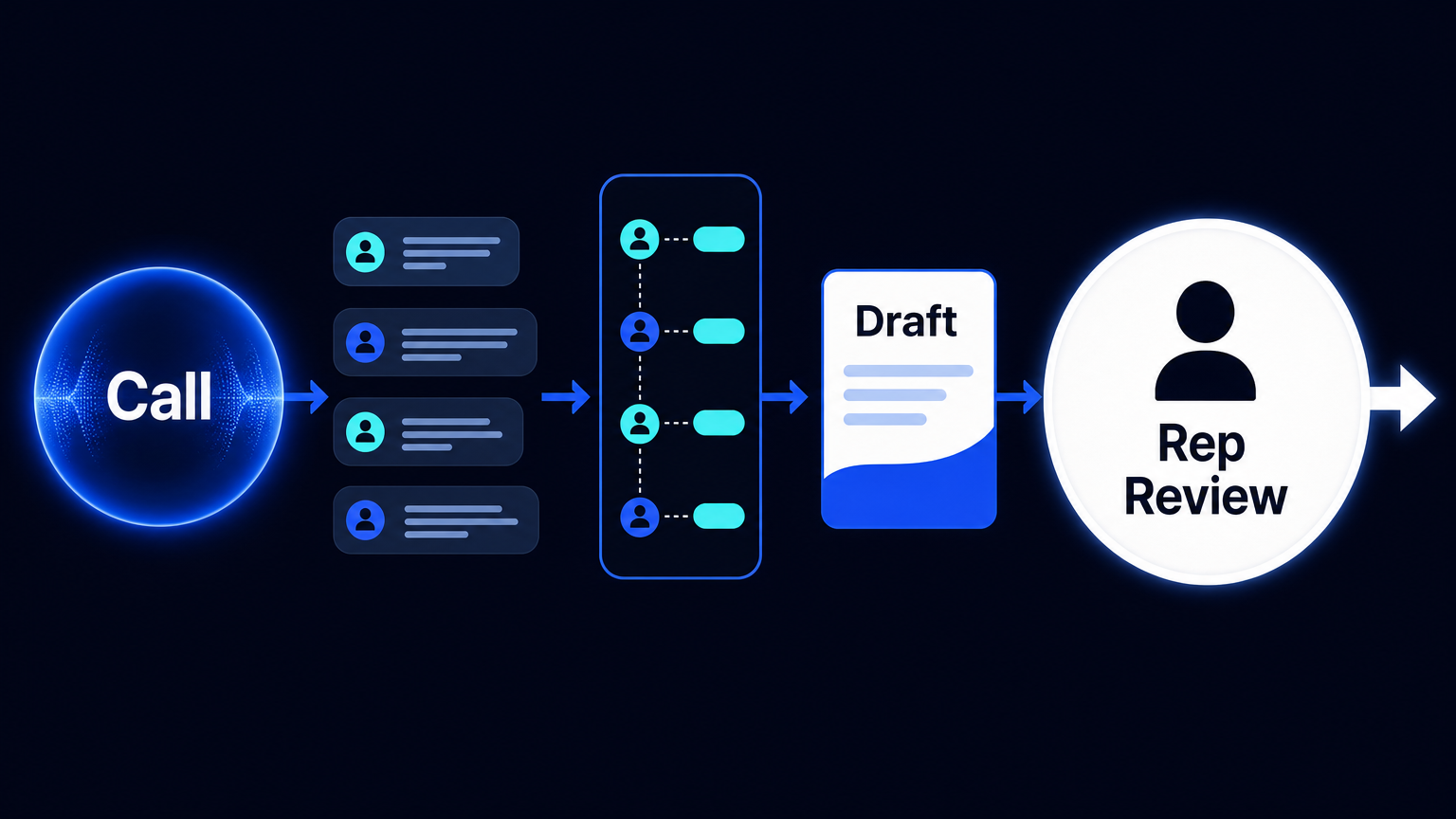
The slow part of a customer call often begins after the call ends. A representative has to reconstruct who attended, what each person cared about, which promise was made, and what should happen next. That work is necessary. Replaying the conversation from notes and a transcript is not always necessary.
BioRender’s revenue-operations team built a workflow around that distinction. In a customer story published by Zapier on September 23, 2026, the company describes a process that turns each logged call into a role- and call-specific follow-up draft. The draft is then put in front of the representative, who opens it in Gmail, checks it, changes it where needed, and decides whether to send it.
That final boundary is the important part. The workflow reduces the reconstruction and drafting work between a conversation and a follow-up. It does not establish that customer communication should become autonomous.
What changed—and what did not
According to Zapier’s account, BioRender launched the workflow in March and later rolled it out in stages across customer success, business development, and account-executive teams. Zapier reports that it generated many thousands of drafts and reduced estimated drafting time from roughly 20 minutes to under three minutes per draft—an estimated reduction of about 85%.
Those figures belong to BioRender’s Zapier-published customer story, not to AES and not to a general market benchmark. The story does not disclose an exact number of drafts, a sampling method, an observation window, an exception rate, or an independent audit. It is useful evidence that the workflow can remove substantial preparation work in one named setting. It is not evidence of improved conversion, faster customer replies, more completed next steps, or realized payroll savings.
Nor did the workflow remove the sales or customer-success role. People still conduct calls, interpret the commercial situation, decide what a commitment means, verify the recipient, adjust the tone, attach the right material, and determine whether the proposed next step should be sent at all. The documented output is a Gmail-ready draft, logged in Google Sheets and delivered through Slack with a button that opens the sender’s Gmail. The source does not describe automatic outbound email.
The process: turn a call into a reviewable working draft
The documented workflow runs after every logged call. Gong provides the call transcript and metadata to Zapier. A JavaScript step structures participant data. AI then extracts the account, recipient, discussion points, promises, and proposed next steps. Routing selects one of six paths based on the recipient’s role and the call type. Code assembles the result into a Gmail-formatted draft.
This is a more disciplined design than asking a general-purpose assistant to “write a follow-up from this transcript.” It gives the drafting step a defined input, an explicit routing decision, and a specific output surface. A business-development follow-up may need a different structure from an account-manager message or a customer-success recap. The role is not decoration; it changes what the recipient should receive and what the sender must verify.
- Capture only the logged call, its transcript, and the metadata needed for the workflow.
- Structure participants and conversation data before asking a model to interpret the content.
- Extract a bounded set of fields: account, recipient, discussion points, promises, and next steps.
- Route the record by call type and recipient role to an appropriate drafting path.
- Create a Gmail-ready draft, log the workflow result, and present it to the responsible representative for review and sending.
For a process owner, the operating consequence is clear: the unit of automation is not “customer communication.” It is the preparation of a reviewable communication artifact. That narrow definition makes it easier to specify what the workflow may infer, what it must preserve from the source call, and where it must stop.
A draft is not a commitment
Post-meeting follow-up carries commitments that may be commercial, contractual, operational, or simply relational. A transcript can misattribute a speaker. A model can turn a tentative idea into a firm-sounding promise. A routing rule can select the wrong recipient pattern. A polished draft can still omit a caveat that the representative understands from the wider account context.
That is why the send gate should be designed as an operating responsibility, not treated as a ceremonial approval click. The representative needs enough source context to check the recipient, the facts, every commitment, the tone, attachments, and the proposed next action. If the workflow cannot identify a recipient or a clear next step with adequate confidence, it should create an exception for human handling rather than manufacture certainty.
A useful implementation measure is therefore not just draft volume or time to draft. Teams should inspect the share of drafts materially edited, discarded, rerouted, or escalated; the reasons for those outcomes; and whether certain meeting types produce recurring ambiguity. These are operational signals for improving templates, routing, and training. They are not proof that sending should be automated.
The data path needs its own design
This workflow moves sensitive conversational material across several systems: Gong, Zapier, Slack, Google Sheets, and Gmail. Gong supports webhook rules for sending selected call data to an external URL, and its API can expose participant and transcript data. Those capabilities make the workflow possible; they do not decide whether every transcript should travel through every system.
Before implementation, establish the recording-consent approach appropriate to the locations and industries involved. Gong notes that consent requirements vary and provides controls for consent notices and prompts. Then define the minimum fields needed for drafting, which teams may access drafts and source content, retention periods, deletion procedures, redaction rules, and the handling of sensitive calls. Zapier’s Data Processing Addendum covers personal information processed within Zapier, while noting that separate agreements govern transfers to third-party services. The full path must be assessed, not only the automation platform.
A practical starting scope is usually narrower than “all calls.” Select one repeatable meeting type, one accountable team, and one draft format. Define the circumstances that bypass automation: sensitive accounts, unclear consent, missing transcript data, unidentified participants, or calls that contain commitments requiring specialist review. Train the people who will review the drafts, then examine the exceptions before extending the workflow.
Automate reconstruction, keep ownership personal
BioRender’s reported workflow is valuable because it places automation in the gap between a completed conversation and a human-owned message. It compresses the effort of finding the relevant facts and arranging them into a usable first draft. It does not pretend that a transcript carries the authority to make or confirm a promise.
For leaders responsible for customer development, the question is not whether AI can write an email after a meeting. It plainly can produce a draft. The harder and more useful question is which meeting types deserve that draft generation, which information may enter the workflow, and exactly where the human send gate belongs. Start there, and the process can become faster without making customer commitments less deliberate.

