
Commercial operations
Instrumental Group Stopped Rebuilding a Quote for Every Small Add-On
A HubSpot customer case shows that the useful automation starts before payment: turn repeatable add-on work into a clearly bounded commercial unit, then simplify its quote path.
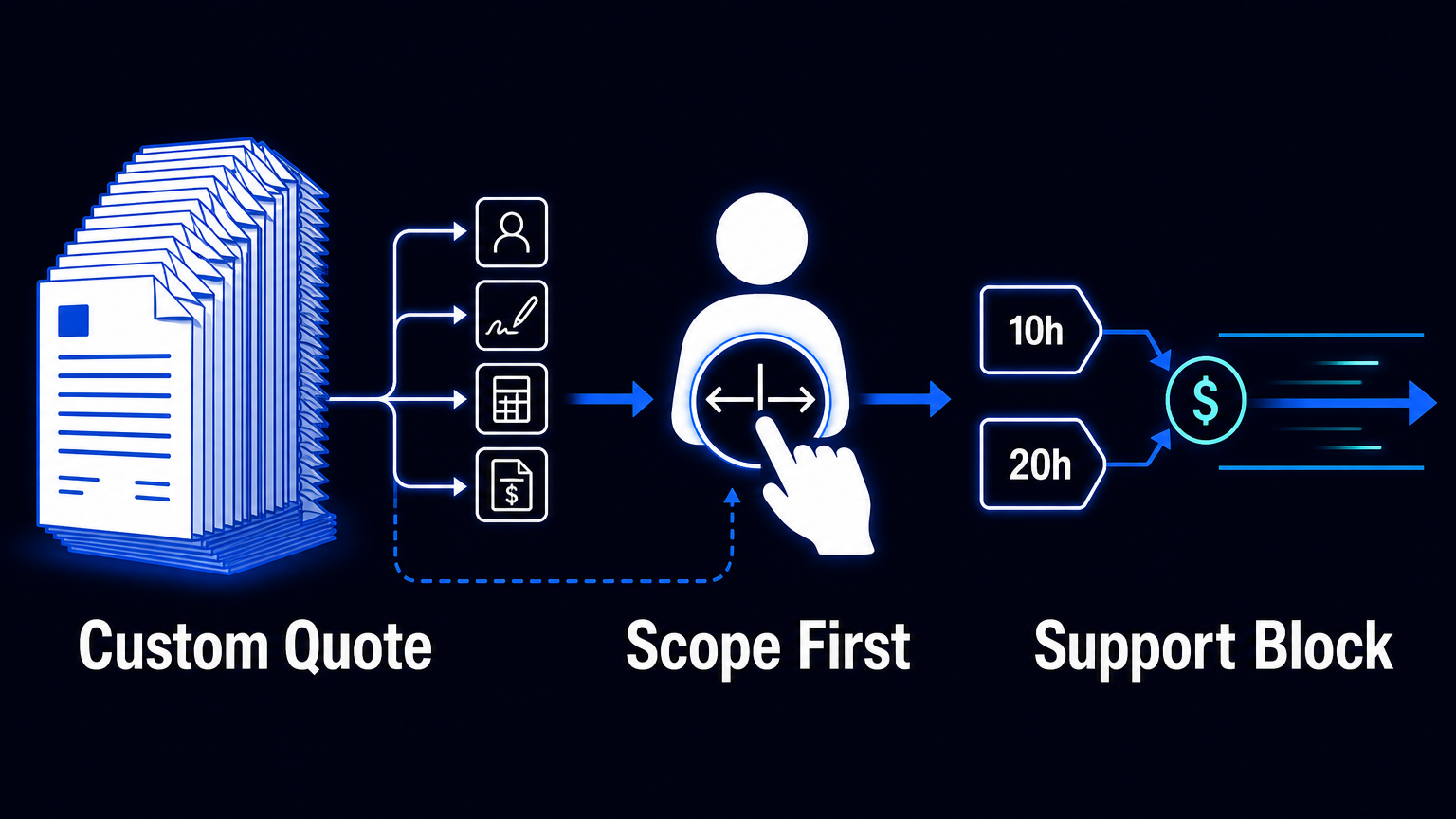
A small client request can create a large internal transaction. An extra piece of support, a modest configuration change, or a limited follow-on engagement may require almost the same chain as a major project: create a deal, prepare a proposal, seek approval, send it, collect a signature, hand the contract to accounting, and issue an invoice.
Instrumental Group, an agency with ad-hoc service work and software subscriptions, found that this was exactly the problem with frequent small additions. Its solution was not to make every sale automatic. It first made a defined category of work purchasable: 10- or 20-hour support blocks. Only then could the company give account managers a shorter, preset quote and payment path.
That sequence matters. A payment link is not a substitute for scope. It is a delivery mechanism for a commercial unit that has already been defined.
The old process treated a small request like a new project
In Instrumental Group’s own account of its earlier repeat-engagement process, a small request passed through seven steps: deal creation, PandaDoc proposal creation, approval, sending, signature, contract handoff to accounting, and invoicing. The sequence supplied controls, but it also imposed a full proposal cycle on work that could be comparatively routine.
The HubSpot customer story describes the resulting constraint as manual quoting for small additions, alongside disconnected administration for subscriptions. These are related commercial operations problems, but they should not be collapsed into one claimed result. The support-block workflow concerns small one-off quotes. Subscription payment links and account activation are a separate workflow.
The intervention was a product decision before it was a workflow decision
Instrumental Group converted more than 200 one-off quotes per year into a preset sales process, according to HubSpot’s vendor-published customer story. The operating design can be read as five linked decisions:
- Identify add-on requests that recur often enough and vary little enough to be sold as a bounded unit.
- Define the unit: Instrumental Group offered support blocks of either 10 or 20 hours.
- Let the account manager select the appropriate block and send a templated HubSpot quote with a preset payment link.
- Associate the commercial event with the customer record, rather than leaving payment outside the operating record.
- Begin the paid work only when the relevant commercial conditions have been met; handle subscriptions through their own recurring-payment and activation path.
The first two decisions do the hard work. They specify what is being bought, how much capacity it represents, and when a request belongs outside the standard path. The quote template and payment link reduce handling only after that definition exists.
What changed — and what did not
What changed was the route for a recognized, limited support request. Instead of rebuilding a bespoke proposal, an account manager could send a templated quote for a preset block with payment enabled. HubSpot’s current documentation confirms that payment links can support one-time or recurring items, create payment records, create subscriptions for recurring items, and feed workflows. Those are current implementation options, not evidence that every option formed part of Instrumental Group’s original workflow.
What did not change was the need for commercial judgment. Account managers still need to decide whether a request fits a block. Commercial owners still need to define inclusions and exclusions. Project managers still need to resolve ambiguity, custom scope, and work that threatens to exceed the purchased block.
This boundary became visible in the case itself. Instrumental Group reported that poorly defined support blocks created expectation-management problems. The company moved toward a more formal addendum process and client sign-off. The lesson is not that a standard block eliminates scope management. It makes scope management more explicit because the exception path has a clear reason to exist.
The reported benefit is time released from quote preparation
Instrumental Group’s CTO estimated that the revised process released 45 minutes per small quote and approximately 155 hours over the preceding 365 days. The arithmetic is consistent with roughly 207 small quotes. This is Instrumental Group’s estimate, reported in a HubSpot customer story; it is not an independent audit, an AES result, payroll savings, or a general market benchmark.
The metric is also narrow in a useful way. It concerns estimated quote-preparation time for the company’s small quotes. It does not establish revenue impact, total onboarding time, subscription performance, or the value of every downstream action. For a process owner, that precision is more useful than a broad automation claim: it identifies one recurring administrative load that can be removed without pretending that the commercial work has disappeared.
Where the pattern fits — and where it should stop
A bounded-purchase path fits frequent, low-variance additions: a standard support allocation, a defined service extension, or another offer whose inclusions and exclusions can be stated plainly. It is a poor default for bespoke work, regulated engagements, credit-dependent transactions, security-sensitive changes, or requests whose risk cannot be assessed from a short intake.
Payment should not automatically authorize every next step either. Contract status, eligibility, failed recurring payments, refunds, disputes, credit checks, and security requirements may require a hold or human review. The operational rule is simple: automate the path for a known commercial event, not the judgment that decides whether that event is appropriate.
Start with one repeated request
The useful question is not “Where can we add a payment link?” Ask instead: which repeated client add-on still causes a full proposal cycle, and can its scope be expressed as a unit a customer can genuinely buy? If the answer is yes, define the unit, its exclusions, its exception route, and its owner before simplifying the transaction around it.
Sources: Instrumental Group, “MultiPay for HubSpot: 3 Use Cases to Inspire You,” updated May 24, 2023: https://www.instrumental.net/blog/multipay-for-hubspot-3-use-cases-to-inspire-you. HubSpot customer story, “Instrumental Group”: https://www.hubspot.com/case-studies/instrumental-group-hubspot-payments. HubSpot knowledge base, “Create and share a products payment link,” updated October 26, 2026: https://knowledge.hubspot.com/payment-links/create-and-share-a-products-payment-link.

