
Market case · HubSpot and Canva
HubSpot Stopped Treating Brand Approval as a Queue
HubSpot’s Canva case shows a practical marketing design: put approved brand components into reusable templates, while keeping new formats and content claims with people.
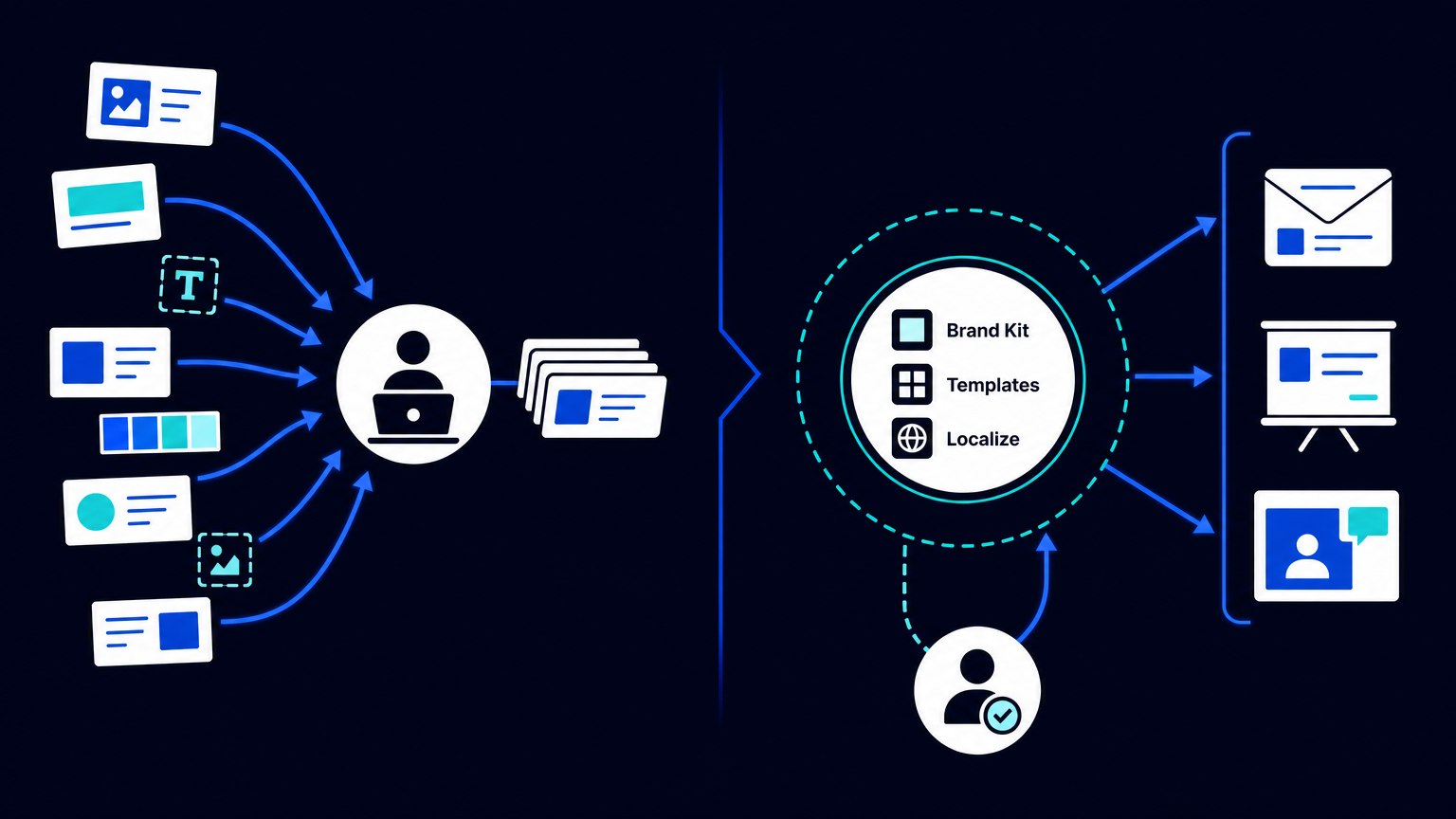
Brand approval is often treated as a service queue: a marketer needs an email, a webinar deck or a regional social post; a designer receives the request, checks the brand, makes the asset and returns it. That arrangement protects quality, but it also makes a small design team the throughput limit for routine marketing work.
HubSpot’s reported work with Canva suggests a more useful division of labour. The company did not attempt to remove design judgment from marketing. It moved already approved design decisions—current brand rules, imagery and reusable elements—into a shared template system. Marketers could then adapt standard materials themselves, while the design team retained responsibility for the system and for requests that did not fit it.
This is an external Canva customer case about HubSpot, not an AES deployment or an independent audit. Its value is not a universal performance benchmark. It is a concrete process design for teams whose campaign work is slowed by repeated requests for materials that differ in copy and locale but not in fundamental format.
The bottleneck was not simply a lack of design tools
Before the change, HubSpot marketers depended on a relatively small design team. According to Canva’s case study, urgent work could lead people to desktop tools, personal Canva accounts or freelancers. Outdated guidelines and old assets then contributed to visual inconsistency. A presentation could also require coordination across several formats before it was ready to use.
Giving every marketer a design application would not, by itself, solve that problem. It can merely distribute the same uncertainty: which logo is current, which image is approved, which layout is appropriate, and when a local adaptation has become a new brand decision. The operating issue is not access to a canvas. It is access to a maintained set of choices that have already been made.
The intervention: make approved design reusable
Canva reports that HubSpot moved 150 Canva Teams users to Canva Enterprise. Working with its Brand Infrastructure function, it built a template library based on current brand guidelines, alongside central folders for photographs, brand assets and Brand Kits. The case says the resulting library contained more than 600 templates. That figure describes the scale of the library; it is not a measure of savings or campaign performance.
The templates covered social posts, email materials, presentations, print, virtual events, webinars and landing pages. Regional teams could localize these materials independently. HubSpot also ran a demonstration and training process so that the library could become part of normal marketing production rather than a repository people had to discover by chance.
The workflow can be understood in five steps:
- The brand and design functions establish the current reusable components, rather than asking each requester to interpret a static guide.
- They place approved imagery, brand assets and layouts in a centralized library.
- They provide templates for recurring marketing formats where the structure is already known.
- Regional marketers adapt copy and local context within those templates.
- A Slack route remains available for a new template set or an unusual request; the design team creates the new pattern and provides brief training.
That final step matters. A template library is not a claim that every request is standard. It is a way to separate repeatable production from the work that genuinely needs design attention.
What changed—and what did not
The material change was the location of routine brand decisions. Instead of being recreated request by request in a designer’s queue, approved elements became shared production infrastructure. Standard campaign materials could begin from a known layout and current assets. Canva says this allowed HubSpot’s design team to spend more attention on larger campaigns instead of repetitive requests.
Several boundaries remained. The design team still owned the system and handled exceptions. Regional teams localized content; they did not replace brand stewardship. Product owners and legal reviewers still need to check claims about features, prices, terms or other factual promises. A visually consistent template cannot establish that an offer is accurate, permitted or appropriate for a specific market.
Nor should this historical case be read as evidence that a complete campaign can be automatically generated and published. The reported mechanism is a managed library, self-service adaptation and a human exception route. Canva’s case does not provide enough measurement detail—such as sample, method or observation period—to treat time reductions or fewer design requests as audited KPIs.
The integration is useful, but it is not the system
Current HubSpot documentation, updated September 14, 2026, confirms that users can create graphics in Canva and use them in HubSpot posts, ads, pages and emails. The marketplace listing also describes moving from HubSpot editors into Canva and returning completed materials to HubSpot’s file manager. This supports a practical handoff between production tools and campaign surfaces.
There is an important technical limitation: HubSpot’s documentation says Canva fonts and Canva Brand Kits cannot be imported directly into HubSpot editors. Teams should therefore avoid designing a process around an assumed one-click transfer of every brand setting. The integration can move a finished design into HubSpot; it does not make the two editors a single brand-management environment.
A useful test for marketing leaders
Start by examining the design queue, not by buying another creative tool. Which requests recur with the same basic format? Which delays arise because the requester cannot find the current asset, does not know the approved layout, or needs a designer to make a small local change? Those requests are candidates for reusable templates.
Then make the human boundary explicit. Someone must own the brand system, decide which templates are safe for self-service, retire obsolete assets and accept or reject requests for new formats. Someone else must review product and legal claims where required. Without those roles, a template library can accelerate the use of outdated or unsuitable material.
HubSpot’s case points to a restrained goal: do not turn every marketer into a designer, and do not make designers reassemble the same approved work. Build a maintained route for common formats, keep an escalation route for exceptions, and reserve expert attention for decisions that are actually new. If your marketing team is repeatedly waiting for the same kind of asset, that process is worth mapping before the next campaign asks the design team to work faster.
Sources: Canva, “HubSpot” customer case study (checked October 13, 2026; publication date not shown), https://www.canva.com/case-studies/hubspot/ . HubSpot Knowledge Base, “Add Canva designs to your HubSpot content” (updated September 14, 2026), https://knowledge.hubspot.com/files/add-canva-designs-to-your-hubspot-content . HubSpot Marketplace, Canva listing, https://ecosystem.hubspot.com/marketplace/listing/canva-205937 .

