
External case · pipeline review
The CRM Says There Is a Next Step. The Calendar Can Test It.
Docebo’s pipeline-review practice pairs a manually entered CRM next step with calendar-derived meeting activity. The point is not to automate selling; it is to make a discrepancy visible before a forecast meeting becomes anecdotal.
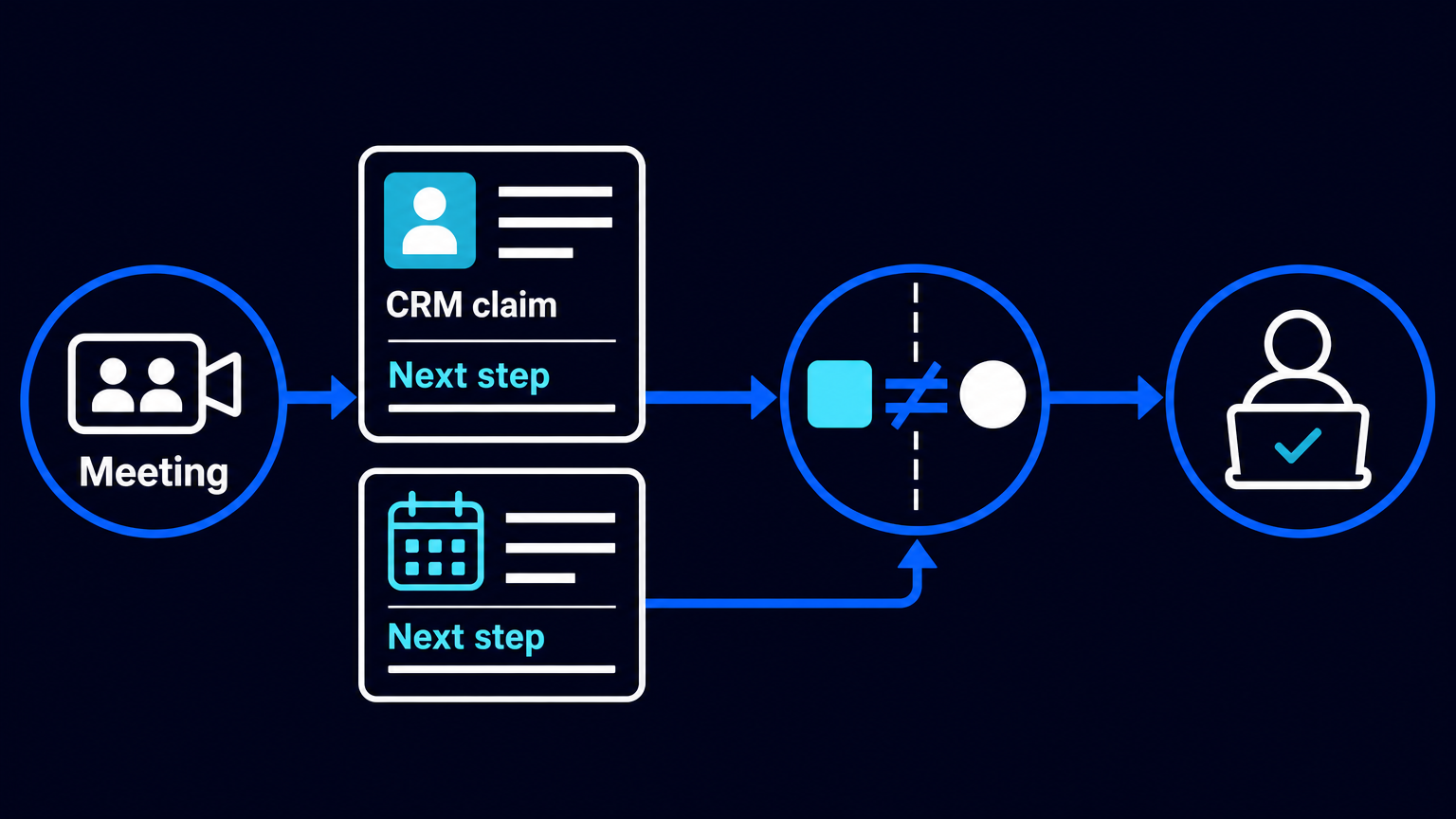
A CRM field can make a pipeline look orderly long after the customer has stopped moving. “Send proposal,” “schedule technical review,” or “follow up next week” may be a useful account of intent. It is not, by itself, evidence that a meeting is scheduled, an action has an owner, or the customer has agreed to anything.
That distinction is the useful part of a pipeline-review practice described in Gong’s customer story about Docebo. Docebo placed the representative’s manually maintained CRM next-step field beside Gong information indicating, from calendar activity, what the next meeting or step was. The purpose was to compare the representative’s stated assumption with observable activity and give managers and representatives a more productive basis for discussion.
This is a market case, not an AES deployment or an AES result. Gong’s case study is undated and was accessed on October 10, 2026. It reports a qualitative benefit: less anecdotal pipeline discussion and better manager–representative conversations. It does not publish conversion, follow-up speed, overdue-action, revenue, or next-step-completion results. That limitation matters. The mechanism is still worth examining because it addresses a common process failure without pretending that a scheduled calendar event closes a deal.
The problem is not an empty CRM field
Before the pipeline-review change, Docebo’s managers had to navigate separate CRM account, opportunity, contact, and report views to review a deal. That layout creates two costs. First, the manager spends review time assembling the operational picture. Second, a stated next step can survive as a plausible sentence even when the surrounding activity does not support it.
An empty next-step field is easy to challenge. A completed field is more dangerous because it can create false comfort. A seller may have written the intended action immediately after a demonstration; the buyer may later have deferred, declined, or simply not scheduled the proposed conversation. The CRM entry can remain unchanged while the opportunity loses momentum.
Calendar activity is not proof of customer commitment. A calendar event can be cancelled, irrelevant to the opportunity, or poorly associated with it. It does, however, answer a narrower operational question: is there observable scheduled activity consistent with the declared next step? That is enough to make a pipeline review more specific.
A five-part comparison loop
- Capture an authorized customer meeting. Recording, where used, must be configured with the organization’s appropriate notices, consent approach, and access rules; it is not a silent technical default.
- Associate the conversation and relevant calendar activity with the correct CRM opportunity. Gong documents CRM integrations that can import CRM entities and export captured activities, but a team should not assume every documented product option was used in the Docebo case.
- Keep the CRM next step as a representative-owned statement: an action, an owner, and preferably a date. Do not replace it with an inferred claim about what the buyer agreed to.
- Compare that statement with scheduled activity. A declared “technical review next Tuesday” with no corresponding planned meeting is a discrepancy to inspect, not an automatic finding that the seller is wrong.
- Surface missing, stale, or inconsistent actions in pipeline review. The representative confirms the commitment and writes or approves the customer-facing follow-up; the manager decides whether coaching, intervention, or no action is appropriate.
The important design choice is to preserve both records. The CRM field represents the seller’s account of the next move. The calendar-derived signal represents an observable operational trace. Collapsing one into the other loses information. Keeping them side by side exposes the difference that a person needs to interpret.
What changed at Docebo—and what did not
The reported change was the review surface: managers could see a manually entered next step alongside calendar-derived information about the next meeting or activity, rather than reconstructing the situation by moving across multiple CRM views. Gong says Docebo used this comparison to reduce anecdotal discussion and support a more productive conversation between manager and representative.
Several things did not change. The case does not establish that follow-up emails were generated or sent automatically. It does not show that calendar evidence proves buyer agreement. It does not replace the seller’s demonstration, negotiation, or relationship ownership. And it does not make the manager’s judgment automatic. A discrepancy may reflect a rescheduled meeting, a customer’s procurement process, a wrongly associated event, or a genuinely stalled deal. Those are different cases requiring different human responses.
This boundary is commercially important. Teams often try to turn a pipeline-review weakness into an automated outreach problem. That can produce a polished message to a customer precisely when a seller should first understand why the next meeting disappeared. Start by making the state legible. Automate a customer-facing action only after the team has defined valid triggers, exclusions, approval rules, and ownership.
Build the test around a narrow operating question
For a customer-development team, the practical question is not “does every opportunity have a next step?” It is: “after a completed demonstration, can we identify the owner, the dated intended action, and the observable activity that supports it?” The answer can be reviewed weekly without asking a manager to read every call or inspect every record manually.
- Share of completed demonstrations with an owner and dated next step.
- Elapsed time from meeting end to approved follow-up.
- Number of overdue actions.
- Discrepancy rate between the CRM next-step field and scheduled activity.
These are recommended prospective process measures, not results reported by Docebo. Before reporting them, define the denominator, the review period, what counts as a completed demonstration, what counts as scheduled activity, and how cancelled or rescheduled meetings are treated. A discrepancy rate without those rules can reward poor data entry rather than better sales execution.
Data handling is part of the workflow
Meeting capture introduces information that is more sensitive than a CRM status field. Gong documents administrator-configured pre-call notices, consent pages, and audio prompts. The appropriate method depends on organizational policy and applicable law. The same applies to access: not every participant in a pipeline review needs access to every recording or transcript.
Retention also needs a deliberate decision. Gong documents a standard retention period of the shorter of three years or the customer’s contract period, with separate attention required for calls in its company library because they are not automatically deleted under that standard rule unless the relevant setting is enabled. That is product behavior, not a universal retention policy. A team should select retention, deletion, and access rules for its business purpose and applicable requirements before scaling capture.
Treat the discrepancy as work to resolve
The strongest lesson from the Docebo example is modest: a next step should be treated as a claim that can be checked against operational traces. The calendar does not tell a manager whether the deal is healthy. It makes one important absence or mismatch visible early enough to discuss.
For owners of customer-development processes, that is a better starting point than demanding more CRM hygiene or deploying automatic follow-ups everywhere. Map the path from demonstration to scheduled next interaction, place the declared action beside the observable signal, and assign a person to resolve exceptions. If your team is redesigning that process, AES can help define the workflow, measurement rules, and human review boundary before automation reaches the customer.
Sources
Gong, “How Gong helped Docebo become an efficient revenue team” (undated vendor customer story; accessed October 10, 2026): https://www.gong.io/customers/case-studies/how-gong-helped-docebo-become-an-efficient-revenue-team Gong Help Center, “CRM integrations”: https://help.gong.io/docs/crm-integrations Gong Help Center, “Call recording and consent settings”: https://help.gong.io/docs/en/call-recording-and-consent-settings Gong Help Center, “Data retention policy”: https://help.gong.io/docs/data-retention-policy

