
Model strategy
Microsoft Is Willing to Leave Capability on the Table
Microsoft AI’s draft code says future MAI models may give up generality, autonomy or capability to preserve human control. For enterprise buyers, the practical change is a new procurement question: which limits are built into the model, and do they apply to the model being bought?
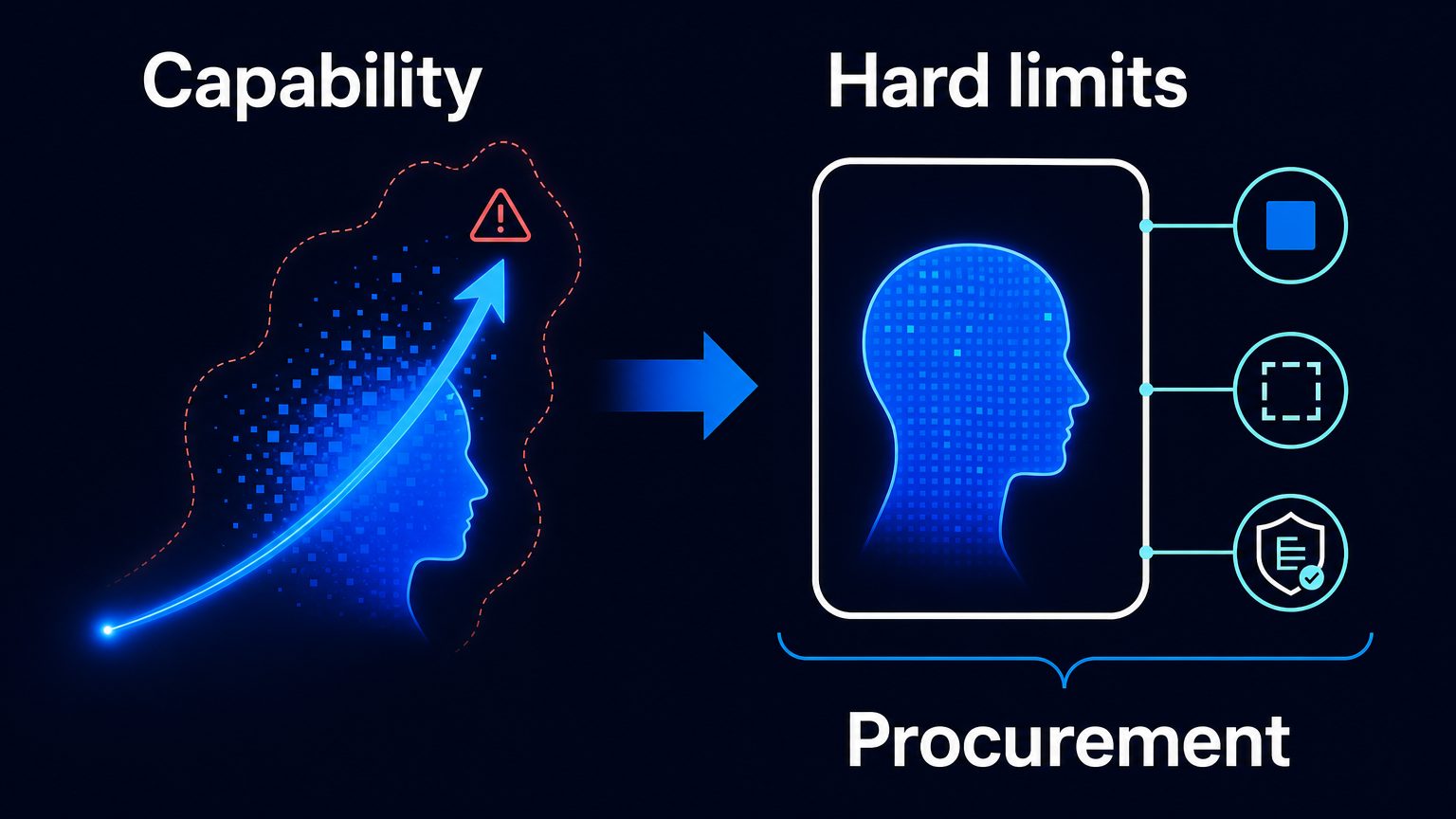
Microsoft AI has published the first draft of its Humanist AI Code of Conduct. Its most consequential statement is not a new feature or a benchmark claim. It is a product trade-off: Microsoft AI says it is willing to compromise on generality, autonomy or capability rather than build an all-purpose superintelligence that could evade meaningful human safeguards.
That is a notable shift in how a major model developer describes its roadmap. The usual public framing of frontier models is additive: more capability, more tasks, more independence. Microsoft AI’s draft introduces a different proposition. Some capabilities may be intentionally excluded if retaining them would weaken human control.
For enterprise operators, this does not yet describe a property of a deployed model. It describes a stated direction for future MAI development. But it makes the boundaries of a model family a procurement and architecture concern, rather than an abstract safety position.
What changed: capability is now an explicit trade-off
Published on September 14, the draft code is accompanied by a six-week public consultation. Microsoft describes it as a training manual for how it intends to develop and deploy models produced by Microsoft AI. The document rejects an all-purpose superintelligence that could evade safeguards and explicitly says that Microsoft AI will accept compromises in generality, autonomy or capability to preserve safety and human control.
The draft also proposes requirements that would not be overridable. A model should not resist authorized interruption, correction or shutdown. It should not create independent goals, expand beyond its authorized scope, or tamper with safeguards, monitoring or records. Enterprise operators could configure MAI models within defined limits, but neither operator configuration nor user instructions could override these absolute constraints and human-control requirements.
This is more specific than a general commitment to responsible development. It distinguishes between adjustable product behavior and constraints that the provider proposes to keep outside the customer’s configuration surface. In principle, a customer may choose how to use a model within its available operating range, but not request that the model disregard its interruption, scope or safeguard requirements.
What did not change: this is not a present-day technical guarantee
The code is a draft, not an applied training rule. Microsoft says it is not using the document to train Microsoft AI models today. It plans to revise the code later in 2026 and use the revised version to guide model development from 2027 onward. The consultation is an opportunity for public input, not a binding process or a commitment to incorporate every submission.
Nor has Microsoft announced a pause in development, a cap on training compute, or a measurable limit on the speed of its model work. The draft sets out intended behavioral and strategic boundaries. It does not quantify a slowdown, and it does not establish independently tested guarantees that current or future systems will always behave as proposed.
Scope matters just as much. The code applies to the MAI model family developed by Microsoft AI. It does not automatically cover OpenAI models, every model in an Azure AI catalog, every Copilot product, or all AI services sold under the Microsoft name. The document sits alongside Microsoft’s existing legal, policy and responsible-AI frameworks; it does not replace them with one universal model rulebook.
The announcement is a declared product direction: future MAI models may be designed to do less in order to remain interruptible, bounded and subject to human control.
The enterprise consequence: compare boundaries, not only scores
Model selection has often been treated as a comparison of capability, cost, latency, context length and availability. Those measures still matter. This draft adds another category: the provider’s chosen capability boundary. A buyer should ask not only what a model can do, but what it has been designed not to do—and whether that design is enforceable in the particular model family and service being procured.
This is especially relevant when a model is expected to use tools, pursue work across multiple steps, or operate near consequential business systems. A provider’s promise that certain behaviors are non-configurable can simplify some risk decisions. It can also constrain legitimate operating designs. Either way, the limitation is material: it belongs in architecture reviews, supplier assessments and product requirements, not only in a policy appendix.
Three questions for buyers
- Which exact model family and version does the provider’s stated code or safety commitment cover? Do not infer coverage from a shared brand, cloud marketplace or application suite.
- Which requirements are technically non-configurable, and which are ordinary service settings that an administrator can change? The difference determines whether a boundary is a product property or an operational preference.
- What evidence will the provider supply as the revised code begins guiding development in 2027? A declared direction should be separated from tested behavior, contractual commitments and service-specific documentation.
These questions should not be read as a reason to outsource enterprise responsibility to the model vendor. A non-overridable model constraint cannot define an organization’s permissions, data handling rules, approvals or accountability for external effects. Those remain properties of the enterprise system around the model. But the model’s own declared limits can affect which system designs are viable and where the remaining safeguards must sit.
A roadmap is becoming part of the product
Microsoft AI’s draft makes a useful distinction visible: maximum capability is not the only possible product objective. A developer can choose to retain human control by declining some forms of generality or autonomy. Whether Microsoft’s revised code ultimately produces model behavior that matches this direction remains to be seen. The company has not yet put the draft into training, and buyers should not treat it as proof about today’s models.
Still, the declaration changes the conversation. Enterprise buyers now have a reason to examine provider roadmaps for deliberate limits alongside their capability plans. The important question is not whether a vendor uses reassuring language about safety. It is whether it can state, model by model, which behaviors are out of bounds, who can alter those bounds, and what will demonstrate that the boundary applies in the service an enterprise actually runs.

