
External case • Platform support
Mercari Classified the Ticket Before Letting AI Draft the Reply
Mercari’s reported support workflow shows a more useful pattern than a general-purpose chatbot: classify the ticket, retrieve a narrow policy context, automate only defined cases, and send uncertainty back to people.
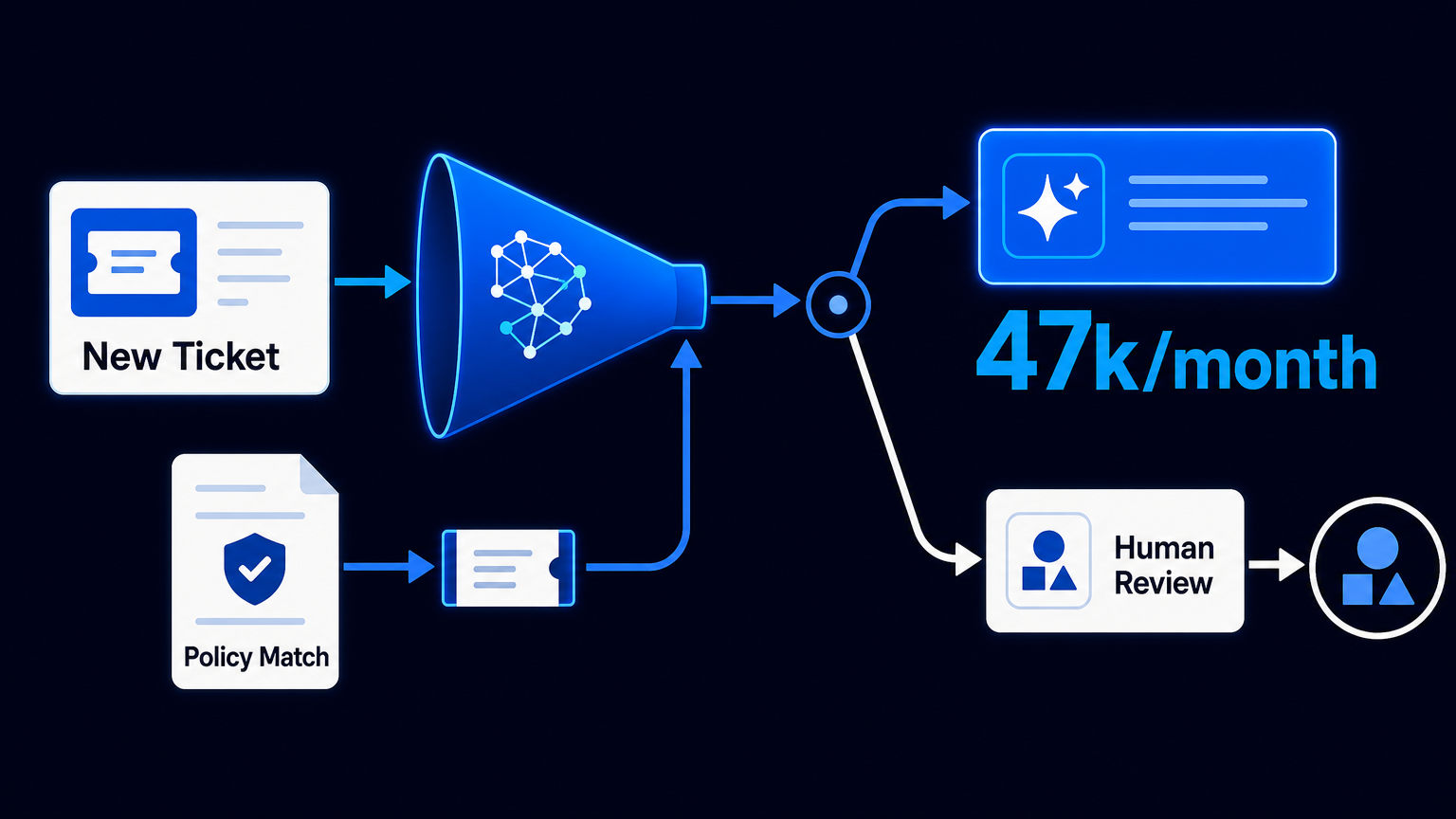
This is an external case, not an AES implementation and not a current product announcement. Zapier described Mercari US’s support workflow on July 14, 2026 and reconfirmed the case on September 23 when it named Mercari’s Eric McNulty a Customer Support AI Builder of the Year. The reported results and operating design belong to Mercari and are presented through Zapier’s customer-story reporting, not an independent audit.
The useful lesson is not that a support team should install one AI assistant and let it search everything. Mercari’s reported design puts a narrower decision first: what kind of ticket is this? Only after that classification does the workflow retrieve the policy logic, prompt and help-centre material relevant to that category. AI writes within a selected lane; people own the lanes, the exceptions and the decision to intervene.
The support problem was too varied for one generic answer path
Zapier reports that Mercari US handles roughly 120,000 support tickets each month. The population includes returns, disputes, account-access issues, payments and customer funds. These are not interchangeable questions. A generic help-centre bot can often answer a simple FAQ, but a response about a dispute or funds needs the applicable policy, the right escalation condition and a clear limit on what may be promised.
The precondition for automation was therefore not simply a good model prompt. It was an operating structure that could distinguish categories and subcategories, associate them with maintained material, and refuse to proceed when the match was uncertain. Without that structure, a broad retrieval layer can turn a policy-specific inquiry into a plausible but inappropriate answer.
The intervention: classify, narrow the context, then choose a response path
Zapier’s account describes a production pattern built around Dixa tickets, Google Sheets, AI by Zapier and category-specific sub-workflows. The public Zapier template documents a reproducible version of that pattern, but Zapier explicitly says it is not Mercari’s exact production workflow and excludes sensitive production sub-workflows. That distinction matters: a template can show system shape without disclosing all rules, data handling or exceptions used in a live operation.
- A new ticket enters from Dixa. Before the workflow supplies the customer message to AI, the reported pattern scrubs selected personally identifiable information. The public template masks common email-address and telephone-number patterns, while explicitly requiring teams to extend the approach for other sensitive fields.
- The workflow classifies the ticket into a category and subcategory. Its category definitions, policy logic, prompts and response material are maintained in Google Sheets rather than left as an implicit instruction for a general assistant.
- The workflow retrieves a narrow packet of relevant help-centre and policy content, then sends the ticket to a specialised path. Zapier describes separate sub-workflows for FAQ responses, routing, response generation and analysis.
- If the classification and applicable conditions support automation, the selected response flow can resolve the defined ticket type. The classification and outcome are written back to the ticket, creating inputs for reporting and later review.
- If confidence is low or a workflow fails, the ticket returns to Mercari’s standard human-support process. A failed run is not treated as an instruction to improvise an answer.
This sequence changes the role of retrieval. The system is not asked to infer the whole support policy from an undifferentiated knowledge base for every message. Classification limits what it can see and which response process it can enter. That is a practical design choice for any team whose policies differ materially by ticket type.
The human boundary is part of the throughput design
Mercari’s CX team retains ownership of policies, edge cases and the conditions under which people must intervene. Human agents handle exceptions, sensitive judgement and tickets that fail or fall below a confidence threshold. This is not merely a safety fallback. It prevents the team from forcing unusual cases through a path designed for repeatable ones, and it gives policy owners a concrete place to improve definitions when recurring tickets are misclassified or escalated.
For support leaders, this also makes the work inspectable. A category can be reviewed against its source material, queue exclusions, confidence threshold, automated outcome and escalation volume. A broad chatbot that answers across every topic may be easier to launch, but it is harder to determine whether its errors cluster around a policy, an ambiguous intake signal or a missing route to a human.
What Mercari reported—and what the figures do not establish
For its roughly 120,000-ticket monthly population, Zapier reports that Mercari fully resolved about 47,000 tickets per month without a human-agent response, sent first replies on roughly 97% of tickets, and released more than 3,000 agent hours per month. Zapier’s July account also reports a one-point increase in CSAT on a five-point scale.
Those are Mercari results as reported by Zapier, not AES results and not a forecast for another support operation. The source does not disclose the observation period, the detailed calculation behind the released-hours figure, the CSAT baseline, category-level error rates or exception volume. In particular, 97% refers to first-response coverage, not to tickets resolved by automation. Released agent time should not be relabelled as payroll savings or eliminated roles.
Still, the results make the operating logic worth studying. The reported automated-resolution volume is attached to a defined subset of tickets, while the rest of the process retains a human queue. That is a more credible starting point than a promise to automate support as a whole.
What to build before selecting an AI support tool
- A maintained taxonomy of ticket categories and subcategories, including categories that must never enter an automated response path.
- Approved policy and help-centre content mapped to each eligible category, with a named owner for changes.
- Ticket-system fields that record category, selected path, confidence state, outcome and reason for escalation.
- A privacy review of every field sent to an AI service. Masking common email and telephone patterns is not a complete treatment of sensitive information.
- Confidence thresholds, explicit queue exclusions and a normal human route for low-confidence, failed and sensitive cases.
- A recurring review of classifications, response quality, escalations and policy changes—not just a count of responses sent.
The aim is not to make every incoming message machine-resolvable. It is to identify the support categories with stable rules, approved source material and a clear human escape route. Those categories can be automated as bounded response processes; everything else remains visible in the queue where judgement belongs.
The practical conclusion
Mercari’s reported workflow makes a plain architectural argument: ticket classification should come before generative response. A model is more useful when it receives the policy context for a known case type than when it is asked to search an entire support estate and decide its own scope. The workflow does not remove human support. It makes the boundary between repeatable service and human judgement explicit.
If your support operation is considering AI assistance, start by examining which categories have stable rules, usable source content and an unambiguous route back to a person. That inventory is more valuable than a generic chatbot demonstration—and it is the right basis for a discussion about an implementable support workflow.
Sources
Zapier, “How Mercari automated customer support with AI”: https://zapier.com/customer-stories/mercari Zapier, “Resolve support tickets with guarded AI orchestration” template: https://zapier.com/templates/details/resolve-support-tickets-guarded-ai-orchestration Zapier, Zappy Award monthly winners, June 2026: https://zapier.com/blog/zappy-award-monthly-winners-june-2026/ Zapier, Zappy Awards winners 2026: https://zapier.com/blog/zappy-awards-winners-2026/

