
External case · CEO Coaching International and HatchWorks AI
The Coaching Session Can Improve the Coach, Not Just Document the Client
CEO Coaching International’s production AI assistant shows a different use for session capture: creating a repeatable feedback loop for the human expert who delivers the service.
Most automation around professional services stops at the client record. A meeting is transcribed, a summary is sent, tasks are drafted, and the next appointment is scheduled. That can remove administrative work, but it leaves a more consequential question untouched: how does the person delivering the service learn systematically from the sessions they conduct?
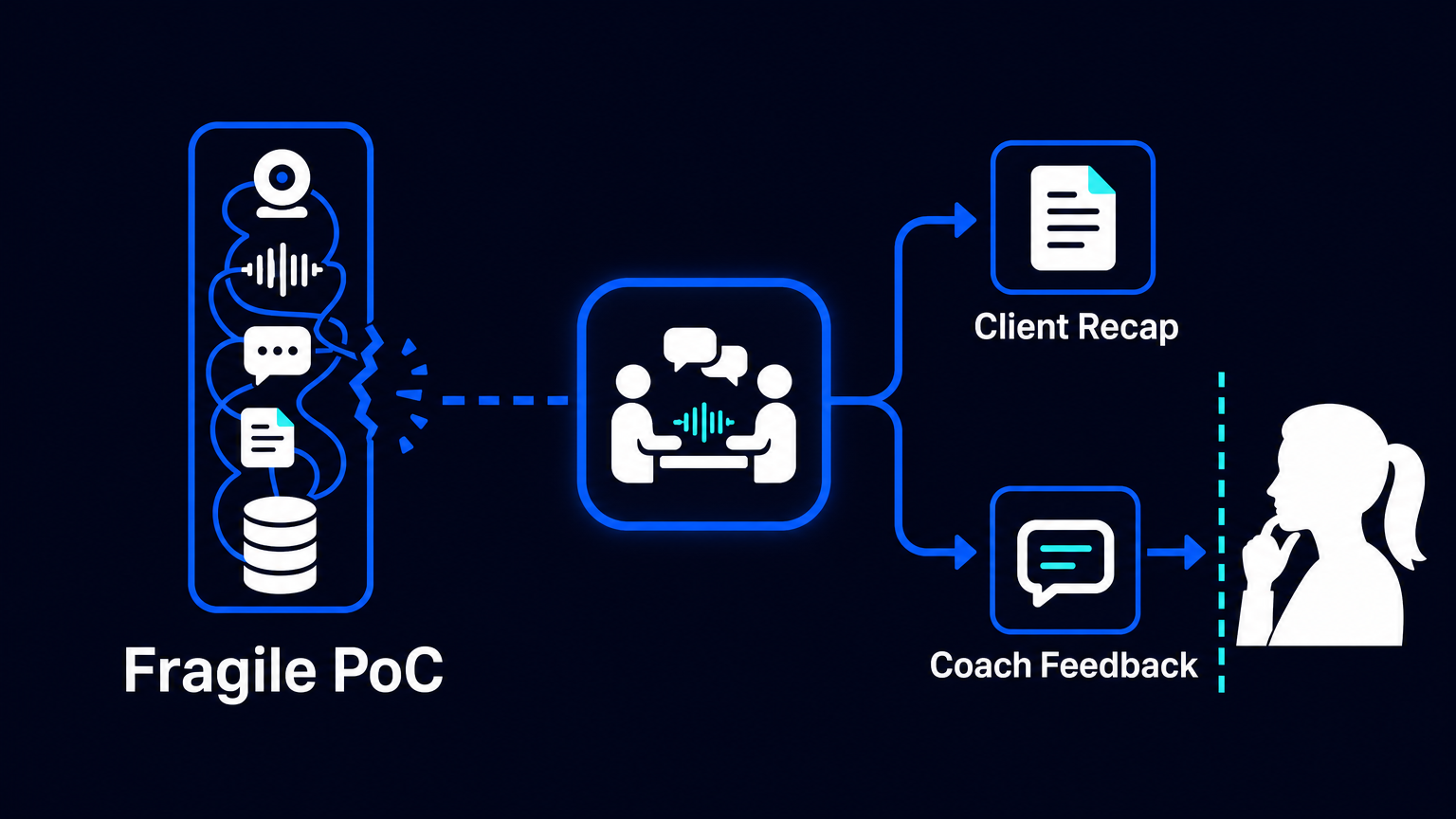
A published case from HatchWorks AI describes a different application in executive coaching. Its client, CEO Coaching International, moved Eve—an AI coaching assistant—from a working proof of concept to a production-grade system. The system joins participating coaching calls, captures specified data points and discussion trends, produces a concise post-session report, and returns feedback to the human coach.
The notable change is not that a call can produce notes. It is that session evidence is also used to give the practitioner a repeatable input for reflection on the service they delivered. HatchWorks says Eve is live in production and supports hundreds of executive-coaching sessions each month. That is evidence of operating volume and repeatable delivery, not evidence that the feedback improves coaching quality, executive decisions, or business performance.
From a fragile prototype to a repeatable service step
Before the upgrade, Eve was already a functioning proof of concept. The constraint was operational rather than conceptual: according to HatchWorks, the prototype was not sufficiently robust or scalable for CEO Coaching International’s weekly volume of coaching sessions, and it lacked an enterprise-scale secure backend.
That distinction matters to any consulting or mentoring firm. A useful demonstration can show that a model can summarize a conversation. A service process needs more: a dependable point of entry, a defined output, predictable delivery, and a way to handle sensitive material without turning every practitioner into an ad hoc systems operator.
HatchWorks describes the production workflow in three observable stages:
- Eve automatically joins a participating coaching call.
- It captures critical data points and identifies trends in the discussion.
- It produces a concise post-session report and feedback for the coach.
The system changed the infrastructure and repeatability of this step. It did not change who conducts the coaching. CEO Coaching International describes its service as individualized coaching delivered by experienced former operators. In that model, the executive remains responsible for business decisions; the coach contributes experience, guides reflection, and challenges the client’s thinking.
The useful output is feedback to the expert
This is the important process design choice. A client summary is an artifact of the conversation. Feedback for the coach is an input into the next delivery of the service. The two outputs may originate in the same session, but they serve different operating purposes.
For a practice leader, that opens a more concrete use case than generic meeting capture. Where several coaches deliver a similar service, session capture can create a consistent moment for professional reflection after each participating engagement. It can surface patterns for the coach to interpret: topics that recurred, points that may need follow-up, or elements of the conversation worth reviewing. The value is not in treating generated feedback as a verdict. The value is in making reflection available at the pace of the work rather than only in occasional supervision or retrospective review.
This boundary should remain explicit. The case does not show Eve making recommendations for the CEO, approving actions, assessing coach competence against a validated standard, or replacing the relationship between coach and client. Nor does it document completed client commitments after a report is delivered. The assistant captures and organizes material; the coach interprets the conversation and provides guidance; the executive decides what to do next.
What the case proves—and what it does not
CEO Coaching International and HatchWorks provide a named, production example at material volume. HatchWorks reports automated delivery of session summaries and coach-feedback reports across hundreds of sessions per month. For a firm considering this pattern, that is useful evidence that the workflow can be operated beyond a one-off demonstration.
The published case does not provide an exact session count, an observation period, a baseline for administrative effort, a measure of report accuracy, or a comparison of coaching outcomes before and after deployment. It therefore cannot support claims about time saved, return on investment, recommendation completion, leadership effectiveness, or revenue. Those results belong neither to this case nor to AES.
It also does not document technical controls in enough detail to infer encryption methods, data residency, retention periods, access roles, or regulatory compliance. HatchWorks describes a secure production system; prospective adopters still need to establish their own requirements and verify how they are met.
Confidentiality is part of the workflow, not a legal footnote
In coaching, the recording and analysis step cannot be separated from the relationship agreement. The current International Coaching Federation Code of Ethics, effective April 1, 2025, calls for clear agreements on roles and confidentiality, secure handling and disposal of records, and ethical and legal obligations when technology systems—including AI—are used. The ICF’s AI Coaching Framework similarly identifies ethics, relationship agreements, communication, assurance, privacy, and accessibility as implementation domains.
In practical terms, a firm should decide before deployment which sessions may include the assistant, how participants are informed, what data is captured, who can access reports, where records are stored, how long they are retained, and how they are disposed of. It should also define what happens when a participant declines AI participation or when the system cannot produce a reliable output. These are operating decisions, not configuration details to settle after the workflow is live.
A design question for consulting and mentoring firms
The relevant question is not whether every session needs an AI observer. It is whether a recurring, consented session type produces enough structured evidence to support a useful feedback loop for the professional delivering the work. If the answer is yes, build the loop around a narrow service purpose: capture the agreed material, produce a bounded report, send feedback to the practitioner, and retain human interpretation at the point where professional judgment matters.
CEO Coaching International’s case offers a disciplined example of that split. Automation makes post-session capture and delivery repeatable at production volume. It does not turn the assistant into a coach, and it does not transfer the client’s decision to software. For service leaders, that is the more useful ambition: improve the conditions for expert work without pretending that the expertise itself has been automated.
Sources: HatchWorks AI case study: https://hatchworks.com/case-studies/scaling-ai-coaching-assistant-for-top-ceos/ · CEO Coaching International, Executive Coaching: https://ceocoachinginternational.com/executive-coaching/ · ICF Code of Ethics: https://coachingfederation.org/credentialing/coaching-ethics/icf-code-of-ethics/ · ICF AI Coaching Framework and Standards: https://coachingfederation.org/resource/icf-artificial-intelligence-ai-coaching-framework-and-standards/

