
External case · customer acquisition
Cyber Advisors Stopped Making One Rep Research, Email, and Call Every Inbound Lead
A HubSpot customer story shows a practical post-intake redesign: automated, recorded email outreach alongside human calling—not a replacement for sales judgment.
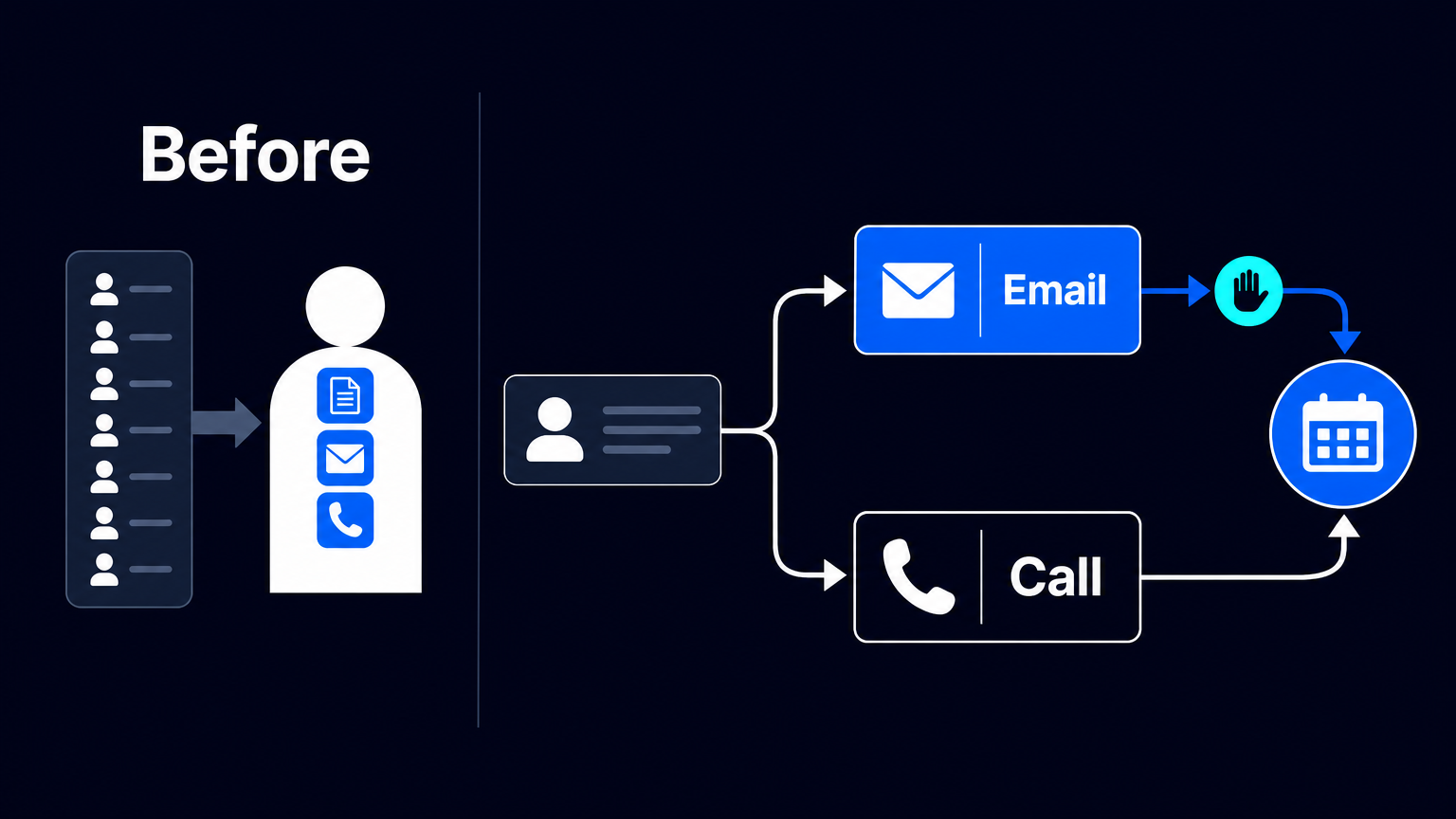
An inbound lead is already an expensive event. Someone has found the company, considered the offer, and submitted a form. Yet many sales teams turn that moment into a private to-do list for one representative: research the account, write the first email, decide when to follow up, make the call, and remember what happened. The CRM may contain the lead, but management cannot reliably see whether contact occurred, whether it was relevant, or whether the sequence simply stopped.
Cyber Advisors, a managed IT and cybersecurity provider, faced this problem as inbound demand outgrew its follow-up process. A HubSpot customer story describes a different division of labour after the lead had already entered the system. Software handled research-supported email outreach and recorded each touchpoint; the business development representative concentrated on telephone calls. The useful lesson is not that an AI system can write an email. It is that research, email administration, and calling need not remain an inseparable job bundle.
What changed: follow-up became a visible two-lane process
Before the redesign, Cyber Advisors assigned leads to sales representatives. Leadership, according to HubSpot’s account, could not reliably tell whether a lead had been contacted or how persistently a representative had followed up. This is a process problem rather than merely an activity problem. A lead can be assigned, a rep can be busy, and the organisation can still lack a dependable first-contact system.
The documented workflow starts after a prospect submits a form. It enriches the lead with ZoomInfo data, researches the company, generates contextual outreach, and logs the resulting touchpoints. Cyber Advisors assigned prospecting email outreach to HubSpot’s Prospecting Agent while focusing its BDR role on calls.
- A prospect submits a form and becomes a record for follow-up.
- The record is enriched with available company data and used to research the account.
- The system prepares and sends, or prepares for review, contextual email outreach; each touchpoint is recorded.
- The BDR works the call lane rather than having to perform every research and email-administration step first.
- The sequence stops when the contact replies or books a meeting, avoiding continued prospecting messages after a clear response.
The final stop condition is an available product control in HubSpot’s current documentation. Prospecting Agent can be configured for review before sending or for automatic sending. Administrators can set sender identity, send windows, frequency, and a maximum number of emails; enrollment ends when a contact replies or books a meeting. Those capabilities should not be read as proof that Cyber Advisors used every setting. They do show that the design can be bounded rather than left as an open-ended mailing loop.
What did not change: a person still owns the sale
This was not a claim that software should qualify every buyer or conduct a cybersecurity conversation. The reported role split retained the BDR for calls. In a sensible implementation, people also own the selling profile, enrollment rules, message constraints, and the decision on whether an email requires review before it is sent.
Live discovery, urgent requests, technical diagnosis, qualification, proposals, pricing, and contractual commitments remain human work. These steps need situational judgment and can create commercial or operational obligations. An automated first-contact sequence can make their handoff more orderly; it cannot establish that a prospect is a fit, that a technical statement is appropriate, or that a commercial promise may be made.
The operational change is not “automate sales.” It is “do not make one person the untracked bottleneck between an inbound form and a useful conversation.”
The benefit is traceability before it is conversion
HubSpot reports that some Cyber Advisors prospects booked meetings before a salesperson called. It also reports that leadership gained a visible record of completed and incomplete outreach. These are vendor-published customer claims, accessed on October 27, 2026, not independently audited results and not AES results. The customer-story page did not provide a reliable publication date, so this is a process case rather than a recent product announcement.
The more durable benefit is the record of the process itself. A manager can distinguish an uncontacted lead from a lead in sequence, a lead that replied, a lead that booked, and a lead that needs human intervention. That distinction changes the management conversation. Instead of asking a representative to reconstruct their activity from memory, the team can inspect defined states and decide where calling capacity, message review, or exceptions are needed.
Do not turn this into a generic conversion claim. The available case does not establish improved conversion, revenue, close rate, or lead quality. It does establish a narrower and useful pattern: consistent, traceable initial outreach can coexist with a salesperson’s direct work, when the organisation deliberately separates the two.
How to apply the pattern without creating an email machine
Start after intake. This design is not about rescuing a missed call or creating a CRM record; the lead already exists. Define which submitted forms qualify for the sequence, what data may be used for enrichment, and which account attributes require exclusion or manual handling. A security incident, an existing customer escalation, a partner inquiry, or a high-value strategic account may need a different route from the first minute.
- Set a small, explicit enrollment rule. Do not enroll every contact merely because an email address exists.
- Define the message boundary: approved claims, prohibited promises, required disclosures, sender identity, and the cases that require review before send.
- Make stop conditions operational. A reply or booked meeting should halt the prospecting sequence; uncertain cases should become visible work for a person.
- Keep email and calling as related lanes around one record. The caller needs to see what was sent and when; the sequence needs to stop when the human conversation changes the situation.
- Review exceptions, incomplete outreach, and message samples regularly. A recorded touchpoint proves that something was sent, not that it was appropriate or useful.
For a sales leader, the design question is concrete: which parts of first contact consume disciplined effort but do not require a live sales conversation? Separate those from the moments that do. Cyber Advisors’ reported workflow suggests that a BDR can spend more of the day calling when research-supported email outreach is treated as a managed process with records and stopping rules—not as invisible preparation attached to every lead.
Source: HubSpot customer story, “How Cyber Advisors made sure no business in crisis got ignored with HubSpot’s Prospecting Agent,” accessed October 27, 2026: https://www.hubspot.com/case-studies/how-cyber-advisors-made-sure-no-business-in-crisis-got-ignored-with-hubspots-prospecting-agent. Product-control details: HubSpot Knowledge Base, “Use the Prospecting Agent”: https://knowledge.hubspot.com/prospecting/use-the-prospecting-agent. If your inbound leads already reach a CRM but first contact remains uneven, map the email and call lanes separately before adding another tool.

