
Independent analysis
The Product Is Not the Playbook. It Is the Loop That Applies It.
AWS Well-Architected Agent shows when accumulated expertise can become an operating product: only when doctrine meets live context, explicit trade-offs and a path into delivery.
A company’s best-practice library is usually treated as a publishing asset. It lives in documentation, training, certification, consulting decks and periodic reviews. Customers can read it, adopt parts of it, and leave the rest untouched. That model distributes knowledge. It does not make the knowledge operational.
AWS Well-Architected Agent, announced in public preview on October 1, points to a more consequential use of accumulated doctrine. It analyzes deployed AWS environments against Well-Architected practices, using resource configurations, utilization metrics and application topology across more than 65 AWS services. Customers define optimization pillars and business goals; AWS says the service then ranks recommendations by impact and effort relative to those goals.
The significant move is not that AWS has put AI beside a familiar framework. It is that AWS is attempting to productize the distance between a principle and a change in a real environment.
Advice becomes valuable when it can meet a decision in context
A playbook can state that workloads should be resilient, secure, cost-aware or operationally manageable. Useful as that is, the statement leaves a large amount of work with the customer. Someone still has to identify the relevant resources, understand the application around them, decide which trade-off matters now, translate guidance into a proposed change, and bring that change into the team’s delivery process.
That gap is where most best practice loses force. The issue is rarely a shortage of recommendations. It is a shortage of situated interpretation: which recommendation applies to this system, for this customer, under this business objective, at this moment?
AWS’s preview makes that interpretation loop visible. Recommendations can be generated at resource, application and architecture levels. They may include console instructions, CLI commands, SSM runbooks or updated infrastructure-as-code. The service can also conduct pre-deployment reviews of Terraform, CloudFormation and CDK projects, rather than limiting its analysis to deployed resources. Scheduled recommendations refresh weekly, and a profile can cover up to 100 AWS accounts across commercial AWS Regions.
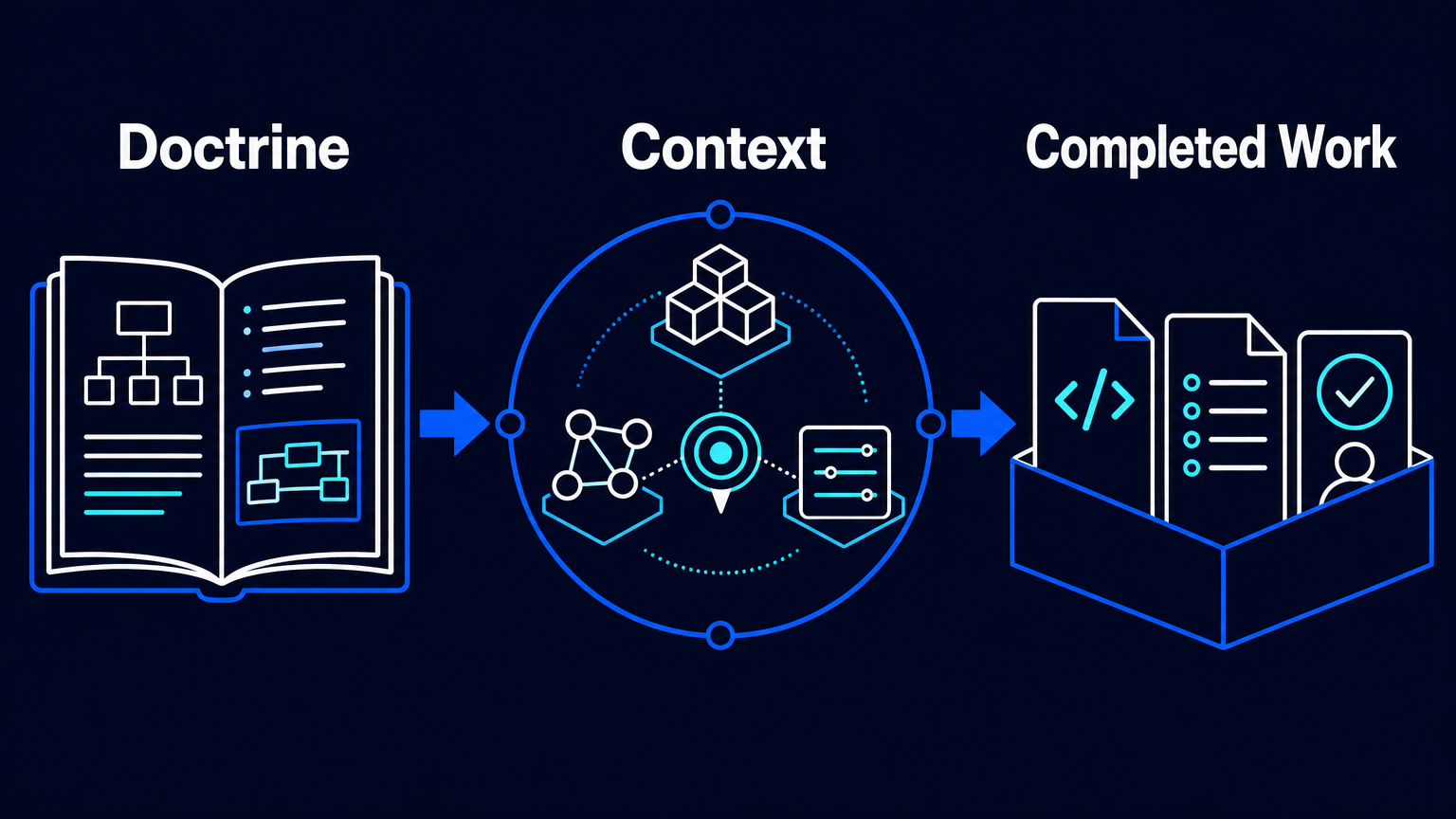
These details matter because they connect four distinct layers that static documentation normally leaves separate: a body of doctrine, access to relevant system state, a way to rank competing improvements against declared goals, and artifacts that can enter existing work. A chat interface over documentation provides none of this by itself.
The defensible asset is not the advice in isolation. It is the recurring loop that interprets advice against customer reality and carries the result toward completed work.
Do not productize doctrine before the inputs exist
This is a useful strategic test for product companies with years of specialist knowledge. The question is not whether their documentation could be made conversational. Nearly any documentation can be placed behind a prompt. The question is whether the company can assemble a reliable diagnostic and implementation loop around that knowledge.
There are four minimum conditions.
- First, the doctrine must be explicit enough to inspect. A product cannot consistently apply expertise that exists only as intuition in a small group of practitioners. The principles, constraints and exceptions need a form that can be reviewed, maintained and challenged.
- Second, the product needs trustworthy access to the state that makes the doctrine relevant. In AWS’s case, that includes configurations, utilization metrics and topology. In another domain, it may mean transaction history, manufacturing telemetry, code dependencies or workflow records. If the system cannot see the condition it is assessing, it can only repeat generic advice.
- Third, it needs a way to rank trade-offs against a customer’s stated goals. A list of findings is not prioritization. The same configuration issue may be urgent for a service pursuing reliability, secondary for a team focused on a near-term migration, or deliberately accepted because another constraint dominates.
- Fourth, it needs implementation artifacts that fit the work already underway. Instructions, code changes, runbooks or structured tasks are more useful than a diagnosis that ends in another dashboard. The endpoint is not a recommendation count. It is a reviewed and completed change.
The order is important. Companies often begin with an assistant because it is the fastest visible feature. But language is only the presentation layer. Without state, prioritization and workflow-compatible outputs, the assistant makes a doctrine easier to ask about, not easier to apply.
A finding is not an outcome
Turning guidance into a product also creates a measurement discipline. A team should not judge the product by the volume of risks found, answers generated or recommendations opened. Those may indicate activity, but they do not establish operating value.
The stronger measures sit downstream: how many recommendations were reviewed; how many became accepted changes; how long they took to move from identification to completion; what proportion were rejected and for what reasons; and whether the resulting changes improved the business or technical objective they were meant to serve. These measures expose whether the product is helping work move, or simply manufacturing a more sophisticated queue.
They also improve the doctrine itself. Repeated rejection of a recommendation may reveal incomplete context, an invalid assumption, a missing exception or an implementation path that does not match how customers work. A productized doctrine should be revised through this feedback, not treated as a fixed body of wisdom with a new interface.
Keep the boundary between recommendation and proof
The preview is equally clear about its limit. AWS warns that AI-generated recommendations may be erroneous or incomplete and should be reviewed before action. Application-level recommendations are currently beta. AWS has not replaced the Well-Architected Framework or manual review: its existing tools and customer-defined lenses remain available. Nor is this autonomous remediation. The documented workflow has customers evaluate recommendations and deploy proposed changes.
That boundary is not an inconvenience to hide in fine print. It is the correct design boundary for a system whose recommendations may change production infrastructure. Generated implementation artifacts shorten the translation from diagnosis to action; they do not prove that the proposed action is safe, suitable or complete for a particular environment.
For founders and product leaders, this suggests a more disciplined ambition. Do not add a chat layer to your accumulated expertise and call it an operating product. Start where you can connect inspectable doctrine to live customer state, explicit priorities and artifacts that a delivery workflow can absorb. Make both the reasoning and the proposed change reviewable. Then measure completed work, not the number of observations produced.
That is when a company’s best practices stop being material that customers are expected to interpret periodically. They become a product that helps interpret reality repeatedly—while leaving the consequential judgment, and the final deployment, where it belongs.

