
External case · Team processes
A Meeting Is Not Finished Until Its Decisions Have Owners
Xero’s reported Asana workflow offers a practical rule for distributed teams: make the agenda, decision, assigned task and status update one continuous operational record.
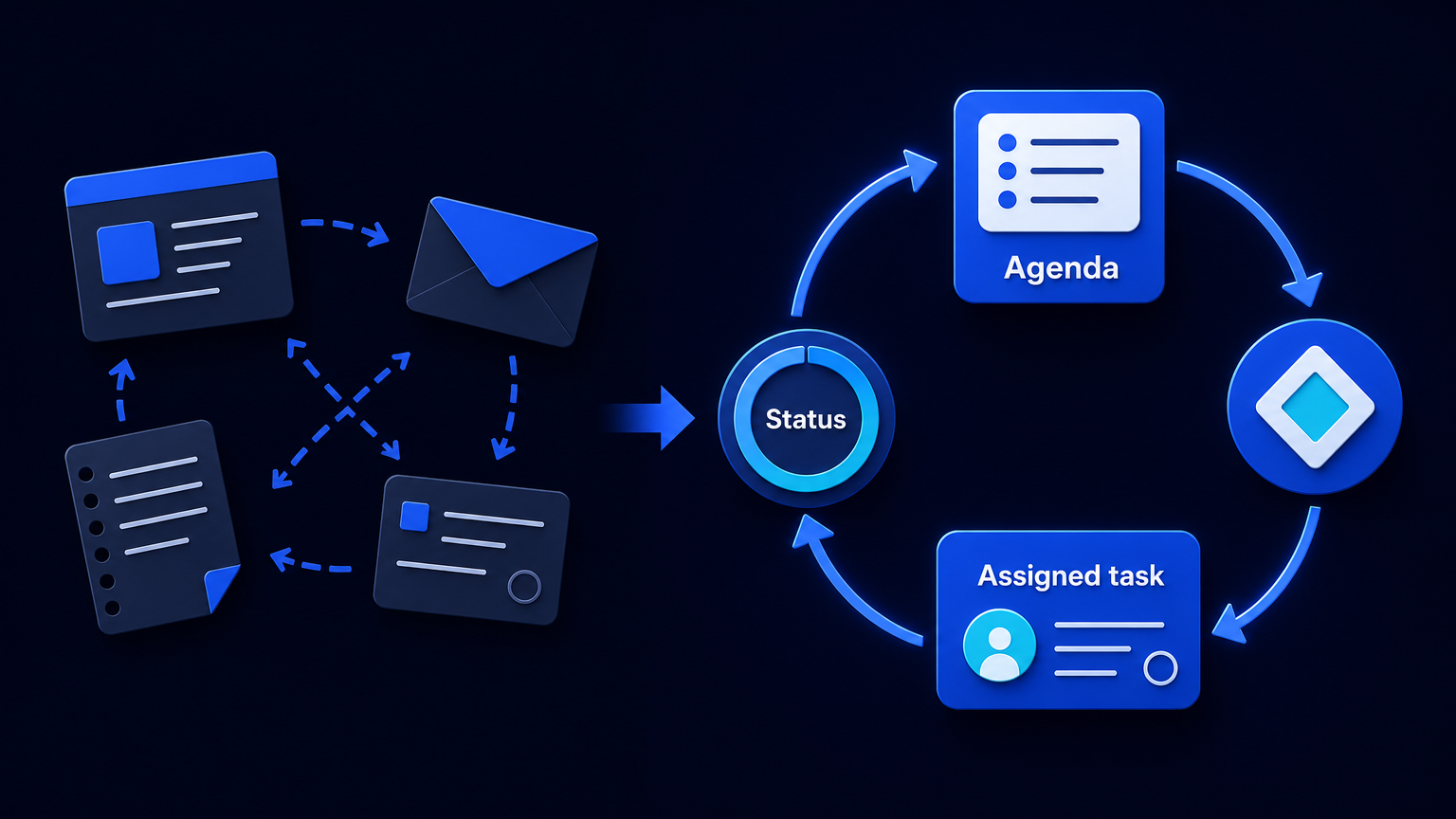
A recurring meeting often creates two jobs. First, people decide what to do. Then someone turns those decisions into minutes, emails, follow-up messages and eventually tasks. Between the call and that second job, the decision becomes ambiguous: the owner is assumed, the deadline is missing, and the context is scattered across a slide deck, a chat thread and a private note.
The useful standard is simpler: a decision that requires work should become an assigned task before the meeting ends. The meeting record should not be a document written after work has already been agreed. It should be the place where the next unit of work is created, owned and connected to the discussion that produced it.
Xero’s reported use of Asana illustrates this operating design. This is not an AES implementation, and the outcome is reported by Asana in its Xero customer story rather than by an independent audit. Still, the case is specific enough to show how a distributed organization can stop treating status meetings and task management as separate systems.
The problem was not only remote work
According to Asana’s account, Xero’s teams operated across time zones. Company goals lived in static spreadsheets, departments worked from different information held in multiple tools, and employees spent substantial time in status meetings. In that environment, a meeting can easily become a reconstruction exercise: What changed? Which version is current? Who is waiting for whom? What did the last meeting actually decide?
The familiar response is to improve the meeting deck or write more detailed minutes. Both may make the reconstruction clearer, but neither removes it. A deck summarizes work elsewhere. Minutes describe work that must still be created elsewhere. The organization remains dependent on a person accurately translating conversation into operational records after participants have left the room.
That translation step is where commitments are routinely lost. It also obscures accountability. A sentence such as “the team will follow up” sounds acceptable in a summary, but it is not executable work. It has no accountable person, no due date, no location for questions and no observable state.
Xero joined the meeting record to the work record
Asana’s customer story describes a more direct sequence at Xero. Teams built meeting agendas in Asana, reviewed the work in the same environment, and assigned action items as tasks during the meeting itself. The meeting did not produce a separate administrative artifact that later had to be interpreted. It changed the live work record.
The reported operating pattern had five connected parts:
- Prepare the agenda in the work-management system, where relevant projects and existing tasks are already visible.
- Review live project status instead of assembling a separate status presentation from several sources.
- When participants agree a next step, create or update the task during the meeting and assign an owner.
- Keep subsequent project questions in the relevant task so that the discussion, records, workflow and artifacts do not split across email, slides and other locations.
- Update projects weekly; use portfolio views in leadership meetings to identify work at risk or off track, with deeper portfolio reviews every two weeks.
The sequence matters more than the particular product. An agenda alone is not a workflow. A task board alone is not a decision process. The value comes from joining the two: the item being discussed is the item whose status, owner and next action are changed in real time.
Software can preserve the decision. People still have to make it.
This design should not be confused with automatic task extraction. A transcript tool may suggest a possible action, but it cannot safely convert a remark into a commitment on its own. Participants must decide what was agreed, whether it is actually a task, who owns it, when it is due, and whether completing it requires a priority or resource change.
That human boundary is especially important in management meetings. “Explore options” may be an appropriate task. “Commit the budget” is a different kind of decision, with different authority and review requirements. The work system can preserve the chosen outcome, route questions and surface risk. It should not infer agreement or allocate organizational responsibility from conversational language.
The same boundary applies to access. Not every discussion belongs in a shared project. Personnel matters, legal issues, sensitive commercial negotiations and other confidential topics need explicit decisions about participants, retention and where any follow-up work is recorded. One continuous record does not mean one universally visible record.
What changes in the meeting room
When this pattern is working, the facilitator no longer ends with “I will send notes.” The closing questions become operational: Which decisions changed work? Does every action have one owner? Is the deadline usable? Where will the next question be asked? Which item needs escalation because capacity, priority or authority has changed?
This changes the purpose of status meetings. Asana characterizes Xero’s qualitative outcome as a shift from status meetings toward action-oriented decision sessions. The source does not provide an isolated quantitative measure of time saved by this workflow, so it would be wrong to assign a percentage reduction in meeting time or missed follow-ups. The practical benefit is structural: less time should be spent reconstructing status when the status record is already maintained with the work, while responsibility has a durable location.
For a process owner, the test is visible without a survey. Open a task created from the last recurring meeting. Can a colleague see the decision context, the accountable owner, the due date, the current status and the unresolved question without searching email or asking the minute-taker? If not, the organization still has a gap between discussion and execution.
Adoption depends on a few rules, not a better template
This approach fails if tasks are written as vague reminders, if owners are assigned after the meeting, or if project status is updated only before executive review. It also fails when people continue to conduct the real discussion in private messages while leaving the shared task as a thin administrative shell.
Start with one recurring meeting where missed handoffs are expensive: a delivery review, client onboarding meeting, product planning session or cross-functional operating review. Agree a small task-writing standard: a task states the intended outcome, has one accountable owner, carries a due date when one is known, and retains material questions in the relevant record. Decide in advance which matters must stay outside the shared workspace. Then require a project-status update before the meeting, not after it.
The aim is not to capture every spoken word. It is to ensure that each decision requiring execution has one durable path into work. If a recurring AES client meeting still loses decisions between the call and the task system, that handoff is a concrete process worth mapping before adding another meeting-note tool.
Source and attribution
Market case: Asana, “Xero” customer story, https://asana.com/case-study/xero. The page showed no clear publication date and was verified for this article on October 30, 2026. Statements about Xero’s workflow and qualitative outcome are attributed to Asana’s account; they are not AES results or independently audited measurements.

