
External case · team processes
One Meeting Should Produce Two Records, Not Two Rounds of Typing
Sprout Social’s reported Loom, Confluence and Jira workflow shows how one meeting artifact can create linked context and draft work—without asking a coordinator to reconstruct the discussion twice.
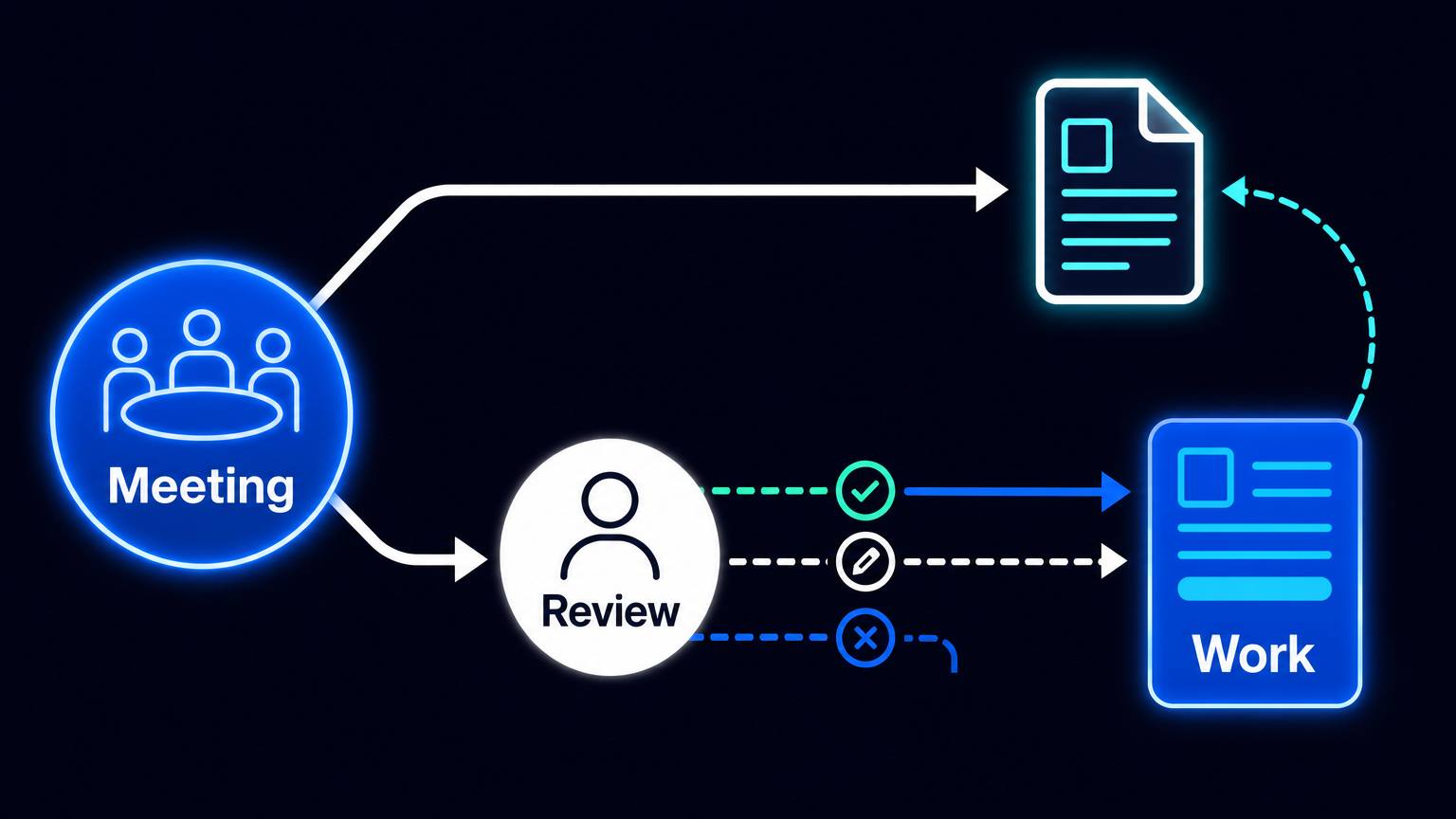
Most meeting automation is judged by the quality of its summary. That is too small a test. The expensive part of meeting follow-up is often not writing the notes; it is rewriting the same discussion into two different systems after the call has ended.
One record must preserve context: what was discussed, what constraints were named, and why a decision was made. Another must organize execution: a bounded action, one owner, a due date and a place in the work queue. These records should be connected, but they should not be collapsed into one document—and they should not require a coordinator to recreate the discussion twice.
A 2026 Atlassian customer story describes this pattern at Sprout Social. Atlassian says teams use Loom’s AI notetaker to capture meeting notes, publish them to the appropriate Confluence pages, and create Jira tickets for action items. Mason Proud, Sprout Social’s Director of IT, reports that his own weekly routine of adding notes to Confluence and creating Jira tickets fell from about two hours to about five minutes of minor edits.
That is a useful result, with a narrow meaning. It is a self-reported measure for one named employee’s weekly administrative workflow in an Atlassian vendor case. The implied difference is about 115 minutes released per week. It is not an independently audited company-wide result, payroll savings, proof of better task completion, or evidence of revenue impact. It is nevertheless a clear process observation: duplicate transcription can be removed.
The coordinator was doing integration work by hand
The before-state is familiar. A meeting produces a recording, personal notes, chat fragments and vague recollections. Someone then writes a durable account of the discussion in a knowledge space. The same person—or another—extracts actions, rephrases them as tickets, assigns people, and tries to preserve enough background for the work to make sense later.
This is not merely clerical overhead. It creates two avoidable failure modes. Context can disappear when a ticket contains only a terse instruction. Or the task can disappear when a decision remains buried in notes. Each manual rewrite also creates an opportunity for the Confluence account and the Jira task to diverge.
The architectural mistake is treating notes and tickets as competing destinations for the same text. They are purpose-specific records derived from the same source artifact. Confluence should retain the durable account of the meeting. Jira should hold executable work. The relationship between them is the important part: a task should point back to the discussion that explains it.
Capture once, then branch by purpose
The Sprout Social case establishes automatic note publication and ticket creation followed by small edits. A stronger operating design can preserve that speed while making the boundary explicit. This is a recommended process design, not a claim about Sprout Social’s internal approval rules.
- Capture the meeting as the source artifact. Keep the recording and generated notes available at the appropriate access level; neither a transcript nor an AI summary is the authoritative action list.
- Extract decisions and candidate actions into a structured draft. The system can identify stated actions, dependencies, deadlines and references, but it should retain a link to the relevant meeting source.
- Publish the contextual record to the appropriate Confluence location. This record explains the decision, alternatives, constraints and discussion that a later reader may need.
- Create linked Jira task drafts for candidate actions. A ticket should carry the source link rather than attempt to contain the whole meeting.
- Ask a responsible person to confirm, edit or reject each ambiguous task before it is treated as executable work. Confirm the action, one owner, scope, intended outcome, deadline and source.
This sequence lets automation transport and structure the output of a meeting. It does not give automation the authority to decide that every detected statement is an approved commitment. “We should look at this” may be useful context; it is not necessarily work. “Can someone check by Friday?” may need an owner and a clearer scope before it becomes a task.
The review point protects the work record, not the notes
A useful task is more demanding than a plausible sentence extracted from speech. Atlassian’s action-item guidance names practical fields: one owner, a clear action, context, intended outcome, deadline and source. They make a compact review checklist for a meeting-generated ticket.
The reviewer does not need to rewrite the meeting. Their job is to resolve meaning where it matters operationally. Is the owner a person or a team? Does “prepare a proposal” mean a one-page outline or a priced commercial document? Is Friday a delivery deadline, a review date, or a prompt to schedule another conversation? Does the ticket point to the material that explains the request?
If those questions cannot be answered quickly, the item should remain a draft, be returned for clarification, or stay in the contextual record without becoming a task. That is not a failure of automation. It is an accurate representation of an unresolved decision.
Measure the removed rewrite, then inspect the exceptions
For a team considering this design, the first measure should be simple: coordinator time spent turning meetings into published notes and assigned work, before and after the workflow. Separate that from review time. A five-minute edit is valuable only if it does not hide substantial correction, follow-up or exception handling elsewhere.
The next operational measures are quality checks, not promotional KPIs: the share of generated task drafts that need material rewriting; tasks rejected because they were observations rather than actions; tasks lacking an owner or deadline; and broken or missing source links. These measures show whether the workflow is reducing transcription or merely moving ambiguity into Jira.
Do not attach Sprout Social’s broader reported $180,000 annual figure to this workflow. Atlassian attributes that figure to contract and tool consolidation, not to meeting-note follow-up. The relevant reported benefit here is the narrowly defined time change in Proud’s own weekly administration.
Build the branch, not another summary bot
The practical decision is not whether to automate meeting notes. It is whether the meeting has one inspectable source and two connected destinations: context for people who need to understand the decision, and reviewable work for people who need to execute it.
Start with one recurring meeting where notes and task creation are currently rewritten by hand. Map where its durable context belongs, what makes an action executable, who can confirm it, and how the task links back to its source. Then measure the administration removed and the exceptions introduced. A good workflow makes the second transcription disappear without making uncertain work look certain.
Sources: [Atlassian customer story: Sprout Social](https://www.atlassian.com/customers/sprout) (2026); [Atlassian guidance on action items](https://www.atlassian.com/work-management/project-collaboration/team-meetings/action-items).

