
Market case
MGA Didn’t Automate Creative Judgment. It Unbundled the Brief First.
MGA Entertainment’s documented workflow turns a bundled creative request into tagged tasks and candidate assets before a project manager plans the work. The useful lesson is not autonomous marketing: it is removing interpretation and search from the first production cycle.
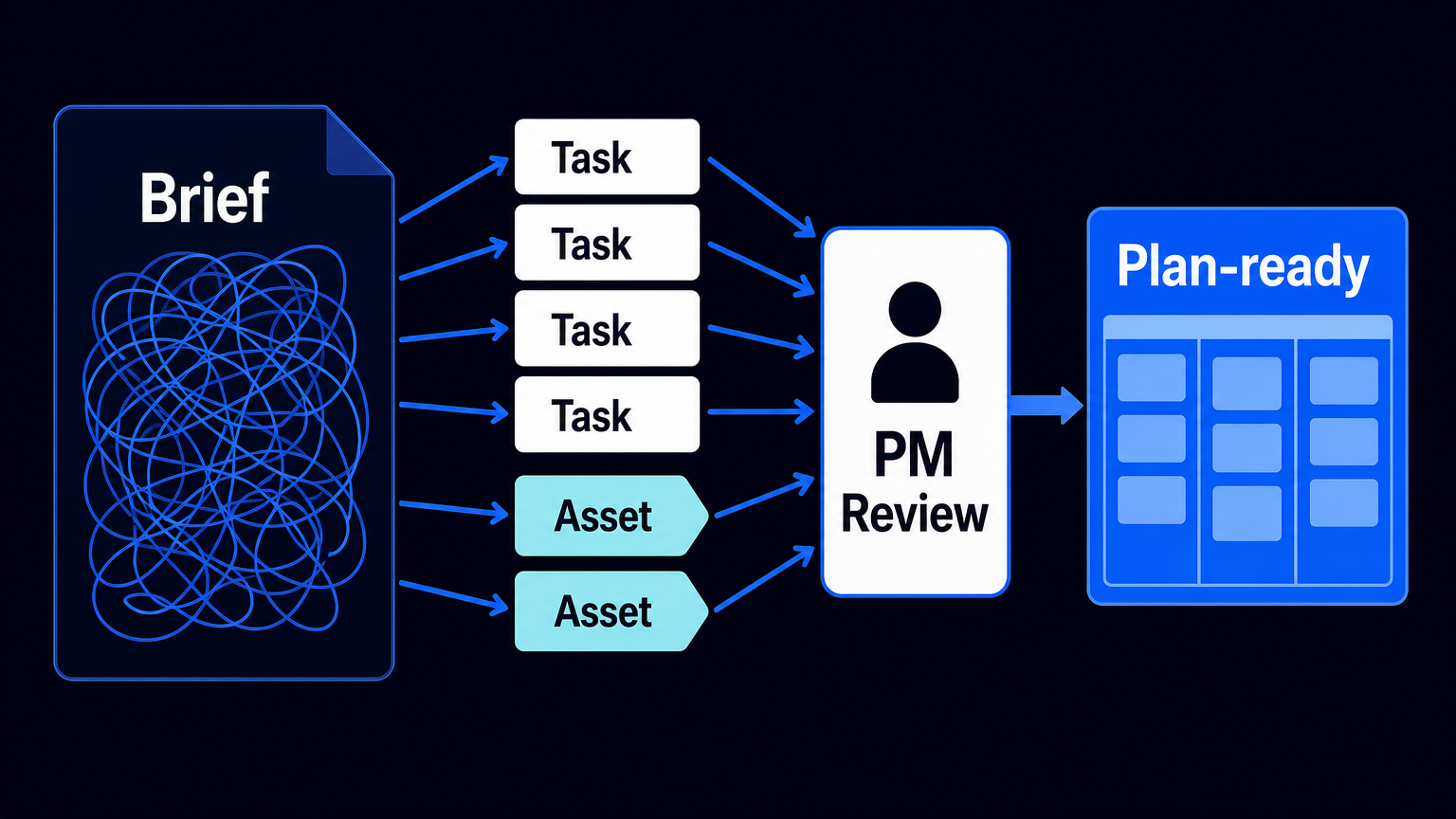
A creative brief is often treated as a single work item because it arrives as a single message. That is a category error. One request may contain product references, channel requirements, copy needs, asset searches, approvals, deadlines and several separate deliverables. When all of that enters production as one opaque block, the project manager becomes the first parser, researcher and translator in the chain.
MGA Entertainment’s documented workflow offers a narrower answer than “automate creative work.” According to Airtable’s customer story, requests reached the team through different communication channels and could contain the equivalent of seven or eight briefs’ worth of tasks. Planning and scheduling became difficult because project managers first had to separate the work and locate relevant inputs.
The change was to decompose and enrich the incoming request before human planning began. It did not transfer creative judgment, campaign priority or final approval to an automated system.
The bottleneck was not the brief itself
A bundled brief creates the same avoidable work several times. A project manager reads it to identify deliverables. A designer or producer may read it again to understand the product. Someone then searches a repository for images, packaging, product references or existing creative. If a detail is absent or unclear, the request returns to its sender. Only after this interpretation loop can owners and dates be discussed.
This is not merely an intake inconvenience. It makes planning unreliable. A task cannot be scheduled well when its scope is still concealed inside prose. Nor can a team responsibly assume that the first asset returned by a repository search is current, licensed, approved for the channel or suitable for the audience.
The important operating distinction is between a request and plan-ready work. A request expresses intent, often incompletely. Plan-ready work names the constituent tasks, carries usable context and presents unresolved questions to the person who can decide them.
What MGA changed
Airtable describes MGA using Airtable Omni to process an unstructured creative brief into tagged tasks. The workflow scans the brief for SKU numbers and retrieves relevant assets from MGA’s Box repository. If no SKU is present, it searches for related products. The structured output is then available to help project managers plan the work.
That sequence matters more than the specific product names. The operating pattern is straightforward: centralize intake, split a bundled request into distinct work items, use product clues to retrieve candidate context, and put the result in front of a responsible planner.
- Capture the request in one intake path rather than leaving the work distributed across messages and channels.
- Extract identifiable elements: deliverables, product references, channels, deadlines and missing information.
- Create tagged task candidates instead of preserving one undifferentiated brief as the unit of work.
- Retrieve candidate assets from approved repositories or product records, using SKU matches where available and related-product search where they are not.
- Send the structured result to a project manager for scope, priority, owner, schedule and asset review.
Airtable reports that the workflow reduced creative-brief processing time by about 60% and made asset searches faster. That figure belongs to Airtable’s customer story about MGA, not to AES. The published account does not provide the measured population, observation period, calculation method or a precise definition of the start and end of processing. It is therefore useful as a directional vendor-reported outcome, but not a sufficiently specified performance claim for this analysis.
The human gate is where the process remains accountable
The workflow documented by Airtable helps project managers plan. It does not establish that an automated system decides whether a campaign matters more than another, whether a deadline is feasible, who should own the work, whether a brand interpretation is correct, or which asset may finally be used.
That boundary is practical, not ceremonial. A SKU can retrieve an asset without proving that it is the latest approved version. A related-product search can be helpful without proving that the product match is correct. A generated task list can expose likely deliverables while still missing an exception embedded in the brief. The project manager’s review is where those uncertainties become decisions rather than silent assumptions.
Automation should make the first planning conversation more specific. It should not quietly replace the people responsible for scope, brand and delivery.
What must be true before copying the pattern
This design depends on more than an AI feature or an intake form. Product identifiers must be usable often enough to support retrieval. Asset repositories need metadata, stable permissions and a clear record of where approved materials reside. Task tags need a maintained vocabulary; otherwise the system merely produces a new form of ambiguity. And the team needs an exception route for vague briefs, absent product references, conflicting requirements and outdated assets.
It also needs a disciplined intake boundary. If requests continue to arrive in uncontrolled channels but only some are captured, the planning board will look orderly while the actual workload remains fragmented. Centralization is not a dashboard exercise; it is an agreement about where work enters and how incomplete work is returned for clarification.
Decompose before production, not after it stalls
For marketing and creative operations leaders, the useful question is not which tool can write a better brief. It is which incoming request currently forces every downstream specialist to interpret the same unstructured text independently.
Start with one recurring request type: a product launch, campaign adaptation, retail asset update or content package. Map the components hidden inside it. Define the fields that can be extracted, the records that can supply context, and the decisions that remain with a project manager or creative lead. Then build an explicit exception path before measuring speed.
MGA’s case suggests a sober objective: begin production with work that can be planned, rather than spend the first production cycle discovering what work exists. If one of your incoming request types repeatedly arrives as a bundle, it may be the right process to convert into plan-ready tasks.
Source: Airtable, “MGA Entertainment” customer story: https://www.airtable.com/customer-stories/mga-entertainment

