
External case · customer acquisition
Autotorino Turned Unanswered Calls Into Salesforce Leads. The Sale Stayed Human.
Autotorino’s reported intake workflow shows a narrower, more useful role for automation: preserve an inbound request as structured CRM work before it disappears.
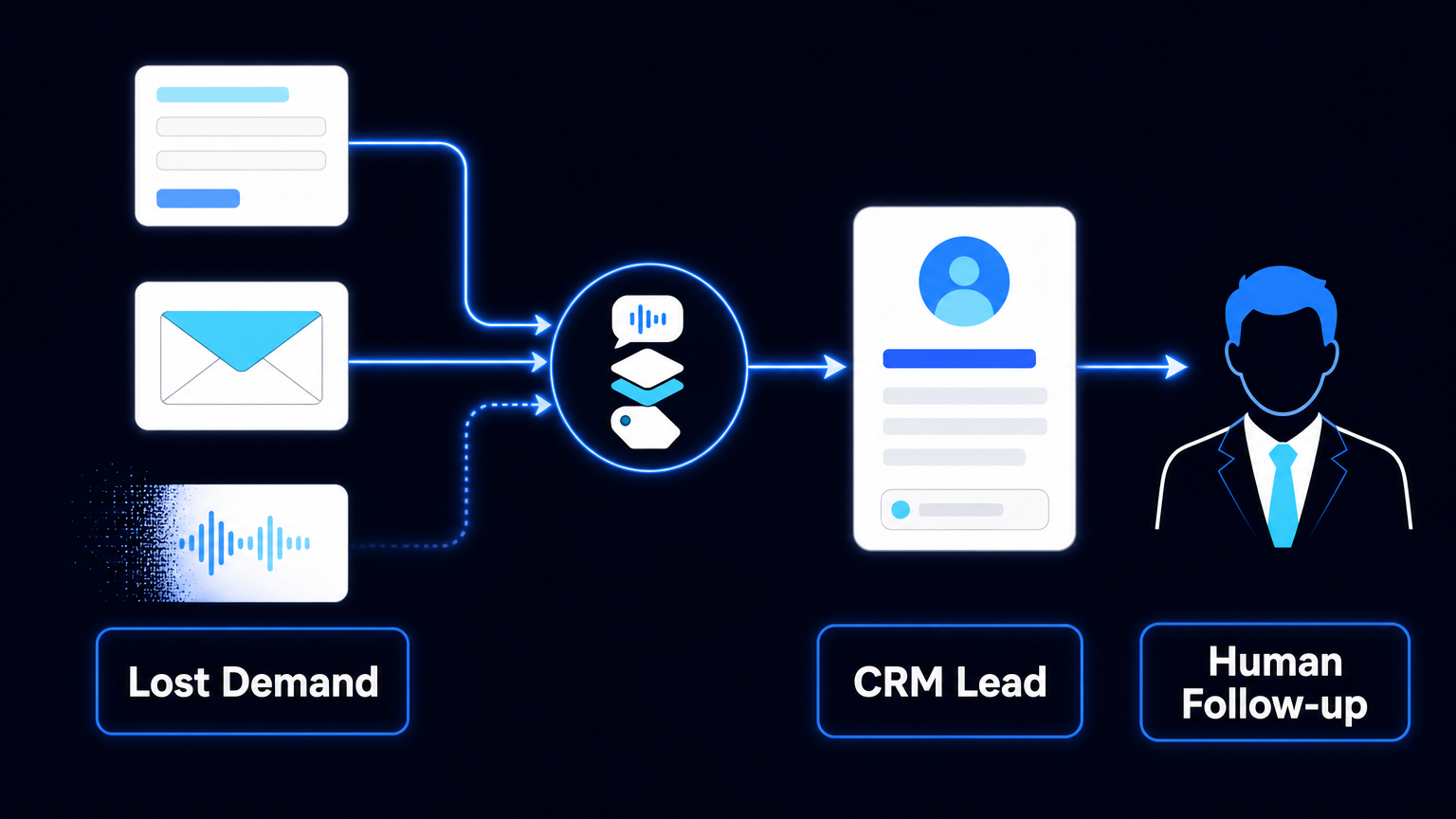
A customer can be interested before the sales team ever sees a lead. They may complete a form, respond to an ad, send an email—or call when no one is available. If that request remains in an inbox, a voicemail system or a spreadsheet waiting for re-entry, it is not part of the commercial process. It is disappearing demand.
Autotorino, an Italian automotive group operating sales and after-sales service across 74 locations and 23 brands, built its intake process around this problem. Its reported workflow did not automate the sale. It made more inbound demand visible in Salesforce, in a form that a salesperson could work with.
This is a market case published by Zapier on 8 August 2026, with named Autotorino employees. It is a supplier-published customer story, not an independent audit, and the results below belong to Autotorino—not AES.
The operational loss came before qualification
Autotorino received enquiries through landing pages, forms, lead ads, email and telephone. Before automation, an employee manually transferred each digital request into Salesforce and matched it to the appropriate process. That work is easy to underestimate. It is not merely typing: someone must find the request, identify its source, interpret the available details, select the route and create a usable record before a sales team can act.
Telephone created a different failure mode. Autotorino reported roughly 100,000 incoming calls per month. A missed call is not necessarily a lost sale, but a recorded customer message that never becomes a work item cannot be followed up through the normal sales process. The relevant problem was therefore not how to make an AI sell a vehicle. It was how to turn a previously unworkable voice message into a visible, structured request.
The intervention: separate intake from the commercial decision
Autotorino created separate production workflows for different sources rather than forcing every enquiry through one generic path. Zapier’s case reports 109 Zap scenarios writing data into Salesforce. On more complex digital routes, the company enriched or classified data before creating the CRM record. The stated purpose was to keep the system of record clean—not to make an automatic commercial decision.
One described voice workflow connected AssemblyAI, OpenAI, Zapier and Salesforce. Recorded audio was transcribed, the request was classified using Autotorino’s internal system, and a structured result was written to the CRM. The team reported that, when accuracy was problematic, it separated AI stages and adjusted prompts. That is a practical implementation detail: a single opaque step is harder to improve than a chain with distinguishable transcription and classification stages.
- Capture the request from its actual source: digital form, lead ad, email or recorded phone message.
- Normalize the information into fields that can support routing and follow-up; enrich or classify only where the route requires it.
- Create a structured Salesforce lead and place it in front of the appropriate sales team.
- Let a salesperson conduct the conversation, apply judgment and advance—or decline—the commercial opportunity.
What changed—and what did not
According to Autotorino’s calculation, its digital workflows returned 2,394 hours to the CRM team in 2025. The published case identifies the period and team, but does not disclose the calculation method, the number of leads, time per record or a verification procedure. The figure is useful as the company’s reported measure of time released from manual work; it is not evidence of payroll savings, and it should not be converted into a universal productivity benchmark.
The earlier voice pilot reportedly captures about 1,500 customer requests per month that previously went unanswered by turning recorded messages into Salesforce leads. The source does not disclose how many dealerships participated or the exact measurement window. It also does not show that these requests became sales, nor that the workflow covered all of Autotorino’s calls. Still, the operating change is material: a request that had no place in the sales system now has an owner-facing record and can enter a follow-up queue.
What did not change is as important. The source documents automation of capture, transcription, classification and record creation. It does not document autonomous buyer qualification, price setting, offer approval, terms negotiation or deal closure. Autotorino’s employees still handle customer conversations and work requiring judgment.
The useful boundary is simple: automation preserves and prepares the request; people decide what it means commercially.
A CRM record is the handoff, not the outcome
For sales leaders, the lesson is not to begin with an AI voice agent. Begin with the point at which demand falls outside the operating system. A lead may be lost because nobody answered a call, but also because a submitted form needs manual re-entry, an email has no owner, or a source-specific field is discarded before it reaches the CRM.
The right design question is: what is the minimum structured record needed for a person to make a timely next move? Usually that means preserving the source, contact details, request context, timestamp and route. It does not require the system to decide whether the buyer is serious or what commercial terms they should receive.
This distinction also makes measurement more honest. Track records created from each source, time from receipt to assignment, follow-up completion and the volume of records requiring correction. Keep a separate view of commercial outcomes. A captured voicemail, a qualified opportunity and a closed sale are different states. Combining them makes the process look more intelligent than it is—and makes its failures harder to find.
Where this pattern fits—and where it needs care
The pattern suits organizations with several inbound channels, a CRM that is expected to be the working system of record, and a real cost to delayed follow-up. It is especially relevant where a request arrives outside business hours or where source-specific data must be preserved for the receiving team.
It needs careful design when voice recordings or inbound messages contain personal or sensitive information, when records can be duplicated across channels, or when an inaccurate transcript may route the request incorrectly. The published Autotorino case does not provide detail on consent handling, low-confidence review or exception procedures. Those controls should be designed explicitly rather than assumed from the presence of transcription and classification tools.
The practical starting point is modest: map one source whose requests currently vanish or require retyping; define the fields a salesperson needs; create the CRM record; and measure whether it is assigned and followed up. Once that handoff is dependable, teams can decide whether another source deserves the same treatment.
Autotorino’s reported result is not an argument for removing salespeople from the process. It is an argument for ensuring that a customer’s first signal reaches one.
Source: Zapier, “How Autotorino automates lead intake and inbound calls,” published 8 August 2026: https://zapier.com/blog/autotorino-lead-intake-inbound-call-automation/

