
External case · customer operations
A Paid Course Should Open Before Someone Sends the Contract
Apps Without Code’s HubSpot case shows a useful split in customer operations: grant standard course access after a confirmed payment, while leaving contracts and exceptions with people.
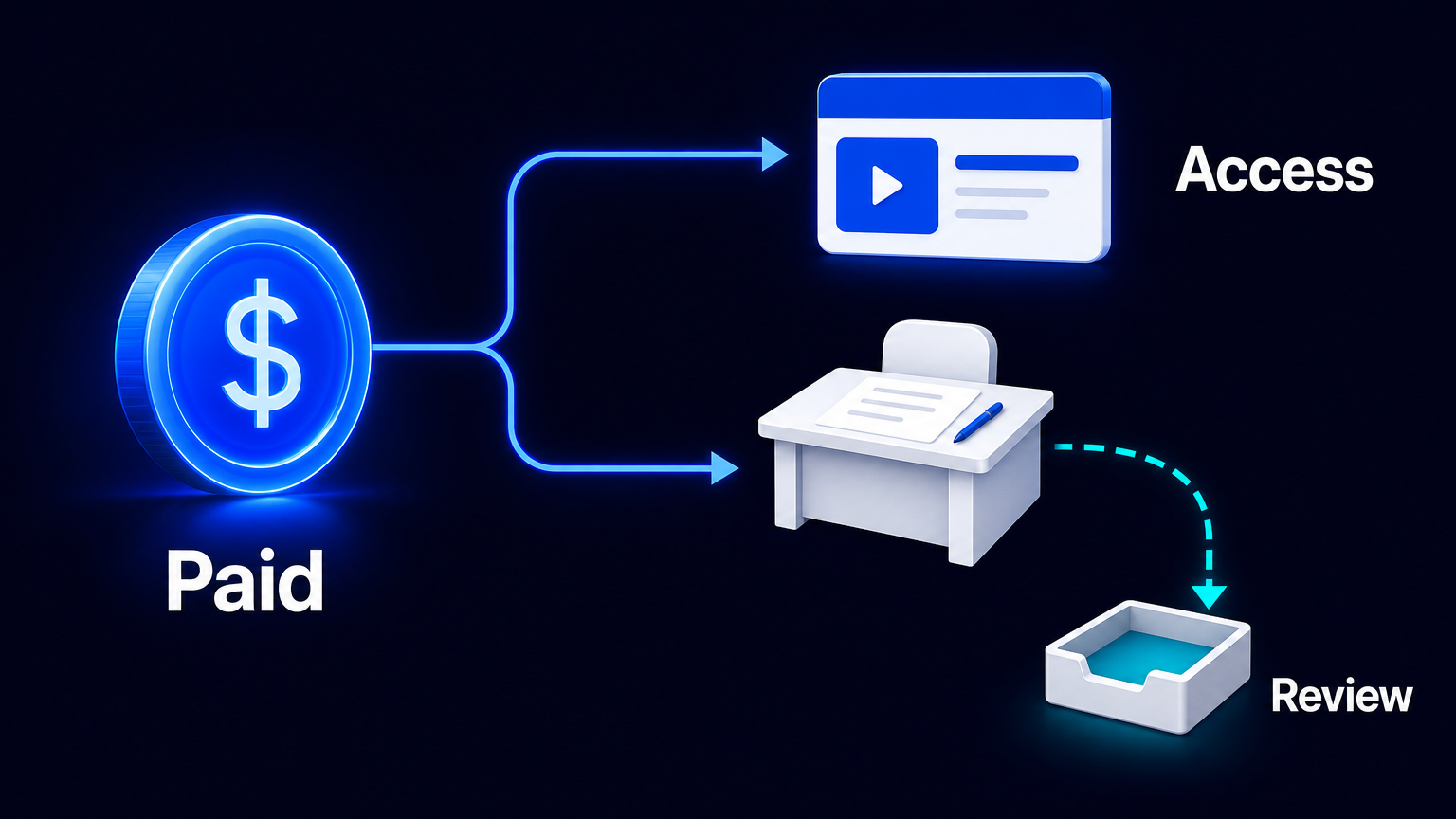
A customer who has paid for a standard course should not wait for an employee to copy payment information from one system to another. But a successful payment should not quietly turn into approval of bespoke commercial terms. Those are two different outcomes, and treating them as one queue creates delay where speed is safe and automation where judgment is still required.
An external HubSpot customer story about Apps Without Code offers a concrete version of this split. A completed purchase triggered access to the company’s course-content application, while notifying the agency team that it needed to send a contract. The published case is not an AES implementation, and it does not say that contracts were generated, reviewed, signed or approved automatically. Its value is more precise: it separates a routine fulfilment action from a commercial task that remains human.
That distinction remains technically relevant. HubSpot’s payment documentation, updated on September 3, 2026, distinguishes processing, succeeded, failed, refunded and disputed payment states. It also documents payment-based workflows for successful-payment communication and task creation after failed payments. The available workflow surface has not made every payment a reason to grant access. It makes payment state a usable input for designing different routes.
The old process was a chain of repair work
Before the change described in HubSpot’s case, Apps Without Code used Stripe, PayPal and Kajabi for payments; ClickFunnels and Kajabi for order forms; and hundreds of Zapier automations to move information into HubSpot. The issue was not merely the number of tools. When information failed to arrive or arrived in the wrong place, diagnosis could take hours or days, and critical repair knowledge sat with one person.
This is a familiar failure mode in course sales, membership programmes and service onboarding. The customer asks a simple question: “I paid. Where is my access?” Internally, the answer may depend on whether a payment was confirmed, whether the buyer can be matched to an existing record, which product was purchased, whether a seat or course is standard, and whether a contract must still be sent. When those questions are resolved informally in a shared inbox, customer service becomes the integration layer.
The cost is not only slower access. Staff spend time checking statuses, customers receive inconsistent answers, and a specialist becomes the fallback for a process that should be understandable by the whole operating team. Replacing tools alone does not solve that problem. The workflow has to distinguish the ordinary paid path from the work that deserves review.
What changed: access and contract work took separate paths
HubSpot describes an eight-stage full-service customer journey, from initial payment through orientation and product delivery, managed in the CRM. Within that journey, the relevant design decision is small but consequential: a completed purchase can release course access while creating visibility for a person to send the contract.
For a comparable process, the operational sequence should be explicit:
- Start from an appropriate confirmed-payment state, not checkout initiation and not a payment still marked processing.
- Match the payment to the buyer, the purchased product and the required access. A confident match is a condition for the standard route, not an assumption.
- Grant the defined standard access to the course or programme and record that action against the customer.
- Create a contract task for the responsible team, carrying the customer, product and payment context needed to send the right document.
- Route failed, disputed, unmatched and non-standard records to a person rather than attempting to force them through the same path.
The order matters. Access is an operational fulfilment decision for a known standard product after a suitable payment confirmation. A contract can involve pricing, scope, legal wording, customer-specific conditions or an incomplete commercial record. It should remain a visible human task unless the organisation has separately designed and approved a narrower standard-contract process. The Apps Without Code case supports the first arrangement; it does not prove the second.
Payment is not one state
The most important implementation mistake is to treat any payment-related event as proof that fulfilment can proceed. HubSpot’s current documentation lists processing, succeeded, failed, refunded and disputed states. These names are not interchangeable operational signals.
A processing payment does not support a claim that the money has been received. A failed payment may need recovery work; HubSpot documents manual recovery for some failed payments. A disputed payment requires action. A refund may change what access the business should provide, but the public documentation does not prescribe a universal access-removal rule. That rule depends on the product, refund policy and customer commitments.
The practical consequence is straightforward: define the payment state that opens the standard route, then define the states that stop it. Do not hide the second list inside automation settings. Make it part of the process description used by customer operations, finance and the team responsible for delivery.
The human boundary is a feature, not unfinished automation
In this pattern, people retain work that benefits from commercial context or intervention: reviewing and sending contracts, handling custom conditions, recovering failed payments, responding to disputes, and resolving records that cannot be matched with confidence. That is not evidence of a failed workflow. It is what prevents a standard fulfilment rule from becoming a blanket approval mechanism.
The boundary also creates better customer communication. The standard customer receives access without waiting for routine internal handoffs. The exception customer receives a case that is owned by a team member, rather than a generic message that says a system is processing their request. The organisation can then measure two different things: how reliably the standard path releases access, and how quickly people resolve exceptions. One number cannot describe both.
What the case does—and does not—establish
The Apps Without Code story attributes public business benefits to its HubSpot implementation. Those figures are not used here because the public materials do not disclose the measured population, baseline definition, observation period or calculation method required to interpret them responsibly. The evidence supports a qualitative conclusion: consolidating the customer record and separating access fulfilment from contract follow-up can reduce status checking and dependence on fragile handoffs.
It does not establish that every business should grant access immediately after every payment, or that a contract can be automated safely. It also does not show that removing tools alone caused the outcome. The documented change combined a payment trigger, CRM-based customer journey and downstream workflow design.
Map the wait after payment
For owners of customer operations, the useful starting question is not “Which automation platform should we buy?” It is: where does a confirmed payment still wait for a person to activate a standard entitlement? Map that interval from payment state to access. Then put the contract, custom terms, disputes and uncertain matches on their own visible route.
The aim is not a touchless customer journey. It is a journey in which routine fulfilment is fast, exceptions are deliberate, and nobody mistakes a paid course for a signed commercial agreement.
Sources: HubSpot customer story, Apps Without Code: https://www.hubspot.com/case-studies/apps-without-code-hubspot-payments | HubSpot, “Manage payments,” updated September 3, 2026: https://knowledge.hubspot.com/payments/manage-payments | HubSpot Analyst Day 2022 materials, showing the case was public by September 7, 2022: https://www.hubspot.com/hubfs/HubSpot%20Analyst%20Day%202022%20FINAL.pdf

