
External market case
ABAC Stopped Sending Buyers Into a Receipt-and-PDF Maze
An Academy of Mine customer story shows a practical fulfillment redesign for continuing education: treat a completed purchase as the start of a recorded entitlement, not as a prompt to email instructions.
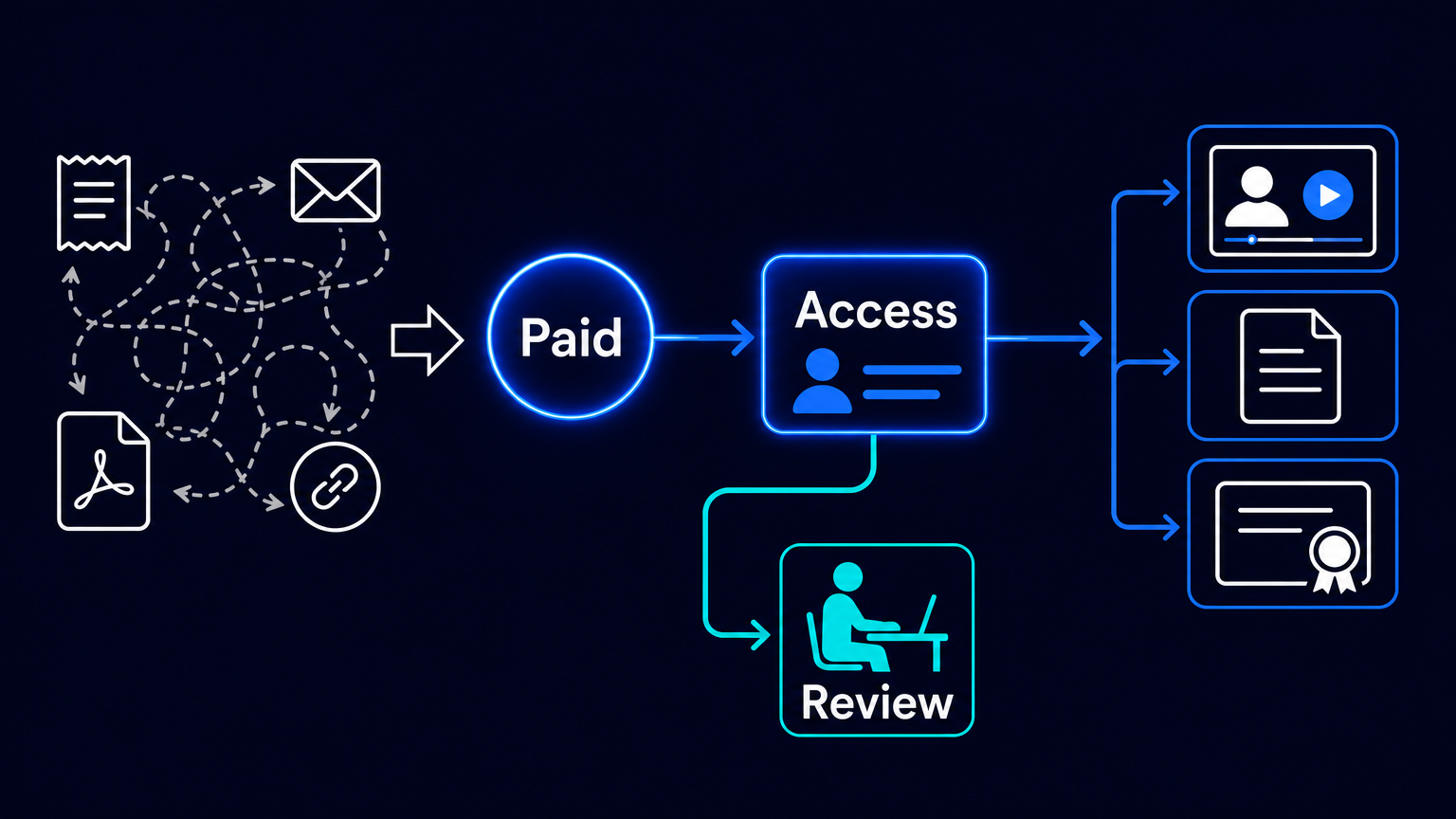
A buyer has paid for a webinar. The service is not delivered when the receipt arrives; it is delivered when that buyer can enter the webinar, find the materials and later retrieve the record that proves completion. If those steps live in separate emails, PDFs and external links, the customer has bought a task rather than received a service.
That was the operational problem described in a customer story about ABAC, The Applied Behavior Analysis Center, LLC, a continuing-education webinar provider. Academy of Mine published the story in December 2025 about a customization project initiated in 2019. This is not an AES deployment or an independently audited result. It is a vendor-published account of a specific fulfillment redesign, and its useful lesson is narrower than the platform: a completed purchase should create a usable, traceable access entitlement.
Before: payment ended in instructions, not access
Before the redesign, buying a webinar did not automatically grant a learner access. According to Academy of Mine’s account, the learner had to find an emailed receipt, open a PDF attachment, read the instructions and use a separate webinar-platform link. The learner also had to retain that link for later use.
Each component may appear minor. Together, they turn a commercial event into a recovery exercise. A customer has to establish that they paid, locate the right message, interpret an attachment and preserve an external credential. Staff then inherit predictable questions: Where is my link? Which session did I buy? How do I find the recording? Where is my certificate?
The issue is not that email is always bad or that every learning service needs a custom platform. The issue is that a receipt is evidence of a transaction, while access is a state of service delivery. When the two are not connected in a system of record, each support interaction reconstructs the connection by hand.
What changed: one site connected purchase and learning access
The documented requirements were automatic course access after a completed purchase, integrated webinar delivery, a learner dashboard, purchase history, course materials and support for further integrations. Academy of Mine reports that, after implementation, learners could pay for and access webinars through one integrated website. Their dashboard exposed prior webinars, grades, certificates and order history.
The case also included profession-to-template mapping for automatic certificate generation. That detail matters because it shows that fulfillment did not end at admission to a session. The system connected a qualifying learning record to the appropriate certificate template. At the same time, ABAC’s live instruction remained central. The redesign automated fulfillment and administration; it did not automate teaching judgment.
Academy of Mine additionally reports that webinar recordings, which had previously taken 48 hours or more and sometimes longer when corrections were needed, became available within a handful of hours. The source does not provide a sample, measurement period or calculation method. It is therefore useful as a narrowly attributed indication of a changed workflow, not as a benchmark or headline promise.
The operating pattern is four states, not one trigger
For an owner of customer operations, the important design is not “send access after a form.” It is a small fulfillment chain with distinct states and evidence at each handoff.
- Accept a completed-payment state. Access should begin from the payment state your business recognizes as complete, not merely from an order-form submission. The case documents access after a completed purchase; it does not establish how payment capture, fraud review or refunds were automated.
- Match buyer, product and entitlement. The workflow needs to identify who bought which offering and what that purchase grants: a specific webinar, a course, materials, a time window or a certificate path. This is where duplicate accounts, wrong email addresses and special commercial terms become visible.
- Provision access and record its status. Create or update the learner record, assign the entitlement and make the resulting status observable to the learner and support team. A dashboard, history and certificate record reduce the need to reconstruct delivery from inboxes.
- Route uncertainty to a person. Failed or unconfirmed payments, identity mismatches, refunds, eligibility questions, nonstandard terms and integrations without a dependable API should enter a review queue. They should not silently produce access, nor disappear as a denial.
The first three stages reflect the mechanism described in the ABAC case. The fourth is an implementation recommendation for an analogous process, not a claimed feature of ABAC’s workflow. It is the boundary that keeps a useful automation from confusing an incomplete commercial fact with permission to deliver.
What did not change: people still decide the exceptions
A payment-to-access flow is not a reason to remove people from decisions that remain ambiguous or consequential. Someone must resolve a payment that has not been confirmed, an account that cannot be matched safely, a refund request, an eligibility exception or a buyer whose contract changes the standard entitlement. Someone also owns the content, the live session and the conditions under which a certificate is valid.
This distinction protects both the customer and the operations team. A workflow can reliably carry a confirmed standard case across systems. It should not invent a match, infer an exception or grant access because an upstream integration failed to provide enough information.
The business benefit is less reconstruction
The most concrete benefit in this case is qualitative: customers can reach the service they purchased without decoding separate instructions, and staff no longer need to treat ordinary access and certificate delivery as individual email tasks. That is not a claim of payroll savings, headcount reduction, revenue growth or ROI. It is a change in where operational effort goes—from repeatedly reconstructing ordinary fulfillment to handling the cases that genuinely need judgment.
For a program owner, that also produces a cleaner operating record. Instead of asking whether a receipt was sent, the team can ask whether an entitlement exists, whether access was provisioned, and whether an exception is waiting for a decision. Those are service-delivery questions, not inbox-search questions.
Start with the fulfillment event you trust
Do not begin this work by connecting every tool in the commercial stack. First map one paid offering from the event you accept as completed fulfillment through to usable access. List the buyer identifier, product identifier, entitlement rule, destination system, visible status and exception owner. Then test the cases that break the happy path: payment pending, duplicate email, refund, wrong product, missing API and manually agreed terms.
ABAC’s reported redesign is a useful reminder that an integrated learner experience begins before the first lesson. It begins when a confirmed purchase becomes an explicit entitlement—and when uncertainty has somewhere accountable to go. If your customers still hunt through receipts and attachments to use what they bought, map that payment-to-access process with us before adding another reminder email.
Source and scope
Source: Academy of Mine, “Case Study: CE Provider Moves From Fragmented Network of Software Applications to Fully Integrated AOM eLearning Platform,” published December 9, 2025: https://www.academyofmine.com/customer-stories/case-study-ce-provider-moves-from-fragmented-network-of-software-applications-to-fully-integrated-aom-elearning-platform-custom-built-to-their-needs/ . ABAC identity: https://abacnj.com/ . The case is a named customer story published by the implementation vendor, not an independent audit; all reported outcomes and workflow details belong to ABAC and Academy of Mine, not AES.

