
Systems Architect · People and organization
LogicMonitor’s Pooled Customer Success Depends on Shared Context
A reported LogicMonitor workflow grounds an organizational design for post-sale coverage: make account context transferable while keeping the next customer intervention personally owned.
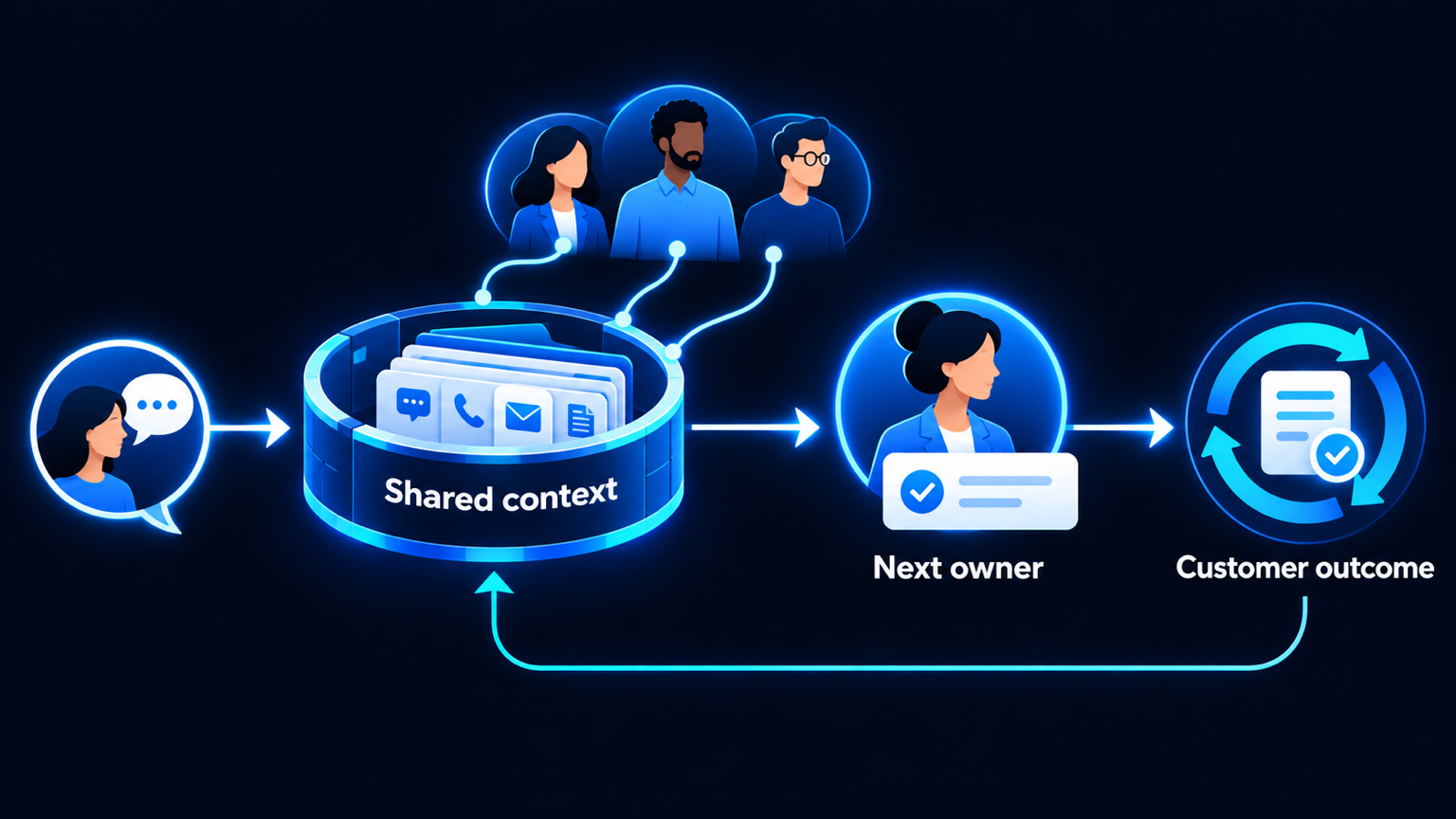
A customer should not have to reconstruct the relationship whenever a different person answers. Yet many service teams keep continuity in the head of an individual customer success manager: why the customer bought, what they are trying to adopt, what stalled, and what was promised last time. An absence or reassignment then becomes a new discovery exercise.
That creates a staffing constraint as well as an information problem. Work cannot move to an available colleague without moving the history first. A shared inbox does not solve this. It distributes messages, but not necessarily the context needed to decide which intervention will help an existing customer.
The useful organizational question is whether customer success can be delivered by a pool of people while the next customer step still has one identifiable owner. Automation can make context transferable. It cannot make responsibility anonymous.
What LogicMonitor’s case actually establishes
Gong reports that LogicMonitor implemented pooled customer success using its Gainsight integration. Calls were logged automatically to Gainsight and could trigger workflows; shared account history included conversations a CSM had not attended. This is a vendor account, not an independent audit or an AES implementation.
The reported operating mechanism matters more here than a productivity headline: relationship context becomes available beyond the person who attended a call. That makes team-based coverage a concrete organizational possibility. It does not establish that every account should lose its dedicated manager or that a recorded conversation proves the customer obtained value.
The before-state: each account carries a private coordination cost
In a common one-person coverage model, the manager remembers the account’s objectives, reconstructs conversations across tools and writes the follow-up. Colleagues ask that person for background before helping. When workload spikes, distributing accounts is difficult because the information needed to serve them is not equally available.
The obvious shortcut is a generic reminder sequence. It can produce more touches without improving adoption. A customer blocked on a technical configuration does not need another invitation to schedule a call. A customer waiting for an agreed change needs an answer about that change. Pooling succeeds only when another qualified person can distinguish those situations without asking the customer to repeat everything.
A design for pooled coverage, not a claim about LogicMonitor’s internal playbook
The following six-step model is a proposed operating design built around the documented integration. Queue rules, assignment decisions and closure criteria below are recommendations, not verified details of LogicMonitor’s implementation.
- Define the service boundary. Choose which existing-customer situations a pool can handle: routine adoption questions, an agreed progress check or a bounded follow-up. Keep complex implementations, sensitive relationships and commercial negotiations on an explicit specialist or dedicated-owner route.
- Capture permitted interaction context against the right account. Check account association, participants, purpose and access. If recording is not permitted, retain an appropriate human-written account note instead; a refusal to record must not make the customer ineligible for service.
- Create a serviceable account history. Separate the customer’s stated objective, what was observed, what remains uncertain and the next agreed intervention. Preserve links to the relevant interaction without requiring everyone to watch the whole conversation.
- Turn a follow-up need into a reviewable work item. State the customer objective, the proposed action and the condition for escalation. A meeting event may start the workflow; it must not by itself prove risk, readiness to expand or successful adoption.
- Assign the next intervention to a named, qualified person. A coordinator or agreed team rule can propose coverage, but the recipient must know who will respond. The human owner validates the context, confirms the next step and involves sales or a specialist when the situation requires it.
- Close against the customer outcome, not the activity log. Record whether the agreed obstacle was removed or the customer confirmed the next milestone. If the matter remains unresolved, preserve the open question and the next responsible person rather than treating another completed call as success.
An activity owner is not automatically the next service owner
Gainsight’s Gong integration FAQ documents automatic Timeline activity logging and states that the Gong owner becomes the Timeline activity owner. That is useful provenance, but it is not a staffing policy. The person who hosted yesterday’s conversation may not be the person best placed to resolve today’s adoption question.
The same FAQ describes conditional merging of an already logged activity with an incoming meeting. Do not assume every duplicate will disappear: account, author and timing conditions matter. Test account matching and duplicate handling with permitted examples before allowing events to create customer-facing work.
Feature availability also depends on the integration path. Gainsight’s current AI Follow-Up guide distinguishes newer capture configurations from classic Gong CS Connectors 2.0, where activities are logged without AI-generated summaries. The design must work with the fields the configured connector actually supplies. A missing summary is not permission to invent the customer’s position.
Shared context does not mean universal access
Pooling expands the set of people who may need context. It should not expand access indiscriminately. Review who can see the Timeline entry, follow a recording link, receive an export or retain a copy. Use the minimum account context needed for the intervention; confidential negotiations and unrelated personal information require a separate route.
Gong documents administrator-controlled capture and consent restrictions, including conditions that prevent recording. It also distinguishes a meeting activity from an actual recording. An activity record must therefore never be treated as evidence that a complete conversation was captured.
Retention needs a cross-system decision. Gong’s published retention policy has library-specific exceptions. A recording, an account note and an exported summary may not share the same deletion behavior. Establish access, retention and removal procedures for each destination; check the applicable contract and organizational policy before connecting real customer data.
Where a pool helps—and where it breaks
A pool is useful when the work is repeatable enough to describe, context is transferable and several people have the competence to act. It can absorb absence and uneven demand without repeatedly re-onboarding the customer. These are expected design benefits to test, not measured savings promised by this article.
It breaks when the team shares history but no one accepts the next step, when every signal becomes an urgent task, or when a relationship requires deep specialist continuity that a queue cannot provide. A dedicated relationship manager and pooled routine coverage can coexist. The important decision is which work may move and which relationship responsibility should remain stable.
Start with one bounded post-sale service motion. Compare context-reconstruction effort, unresolved handoffs, reassignment causes and customer-confirmed progress. Keep activity volume separate from adoption and expansion. More logged conversations are not, by themselves, a better customer relationship.
For a business developing existing customers, the first automation project may be the transfer of usable context—not the next email. AES can help map one recurring customer intervention, its coverage boundary and its closure condition before the team automates the handoff.
Sources and scope
- Gong, LogicMonitor customer story: https://www.gong.io/customers/case-studies/visibility-collaboration-and-predictability-logicmonitor-increases-csm-capacity-by-20
- Gainsight, Gong Integration FAQs: https://support.gainsight.com/gainsight_nxt/Timeline/FAQs/Gong_Integration_FAQs
- Gainsight, AI Follow-Up & Auto Email Capture Admin Guide: https://support.gainsight.com/gainsight_nxt/Timeline/02Admin_Guides/AI_Follow-Up_Admin_Guide
- Gong, How calls are recorded: https://help.gong.io/docs/how-calls-are-recorded
- Gong, Data retention policy: https://help.gong.io/docs/data-retention-policy
- Sources checked on 1 November 2026. The case page has no clear publication date. Company outcomes remain vendor-attributed; the six-step service design is not a claim of a delivered AES deployment.

