
External case · product information workflow
asambeauty Put Product Claims in a Record Before They Reached a Campaign
The asambeauty case shows a practical distinction in marketing operations: templates make materials consistent, but structured, channel-aware product data keeps the underlying claims current before those materials are produced.
A commercial presentation can be perfectly on-brand and still be wrong. The price may have changed, a claim may no longer apply in one market, a product attribute may be incomplete for an online shop, or the sales team may be using last quarter’s file. In that situation, the bottleneck is not design. It is the absence of a maintained product record from which every customer-facing material can safely draw.
This is the useful lesson in asambeauty’s product-information implementation, described in a customer story published by Akeneo. Before the change, the beauty company managed product information in Word documents, Excel spreadsheets, PowerPoint files and email-based workflows. Akeneo describes the resulting version conflicts, duplicated work, distribution of outdated information and coordination that depended on meetings.
The case is a vendor-published customer story, not an independent audit and not an AES implementation. Its reported qualitative benefits should therefore be read as the company’s experience, not as a promised outcome or a market benchmark. But the process design is concrete: product facts were moved out of individual files and into a company-wide product-information source before they were distributed across channels.
Templates solve presentation. Product records solve contradiction.
The distinction matters because the two problems are often merged under “marketing content.” A template system answers: does this deck, landing page or email look like it belongs to us? A product-information workflow answers a different question: are the facts inside it current, complete for this destination and approved for release?
The archive’s recent Canva case concerned reusable brand components and the human review of new formats and claims. asambeauty addresses an earlier operational layer. Before a marketer chooses a slide layout or writes an email sequence, the product facts need a place where they can be structured, checked and maintained once.
This is especially important where one product has several destinations: a local online shop, a sales reference document, a partner catalogue and a campaign for a particular audience. The same product may require different languages, attributes or channel-specific fields. Copying its description into separate documents creates multiple places where a change can be missed.
What changed at asambeauty
According to Akeneo, asambeauty established Akeneo PIM and Shared Catalogs as a company-wide source of product information, connected to its relaunched online shop through seven API integrations. The reported implementation included 111 validation rules, 17 structured workflows and 164 active users. These figures describe the scope of configuration and adoption; they do not establish a financial return, a time saving or a reduction rate.
The reported workflows covered enrichment, approval, lifecycle management and publication. Akeneo reports less manual maintenance, fewer correction cycles after launch and more consistent information across touchpoints. The source does not provide a baseline, a measurement period or a quantified reduction, so those outcomes should remain qualitative.
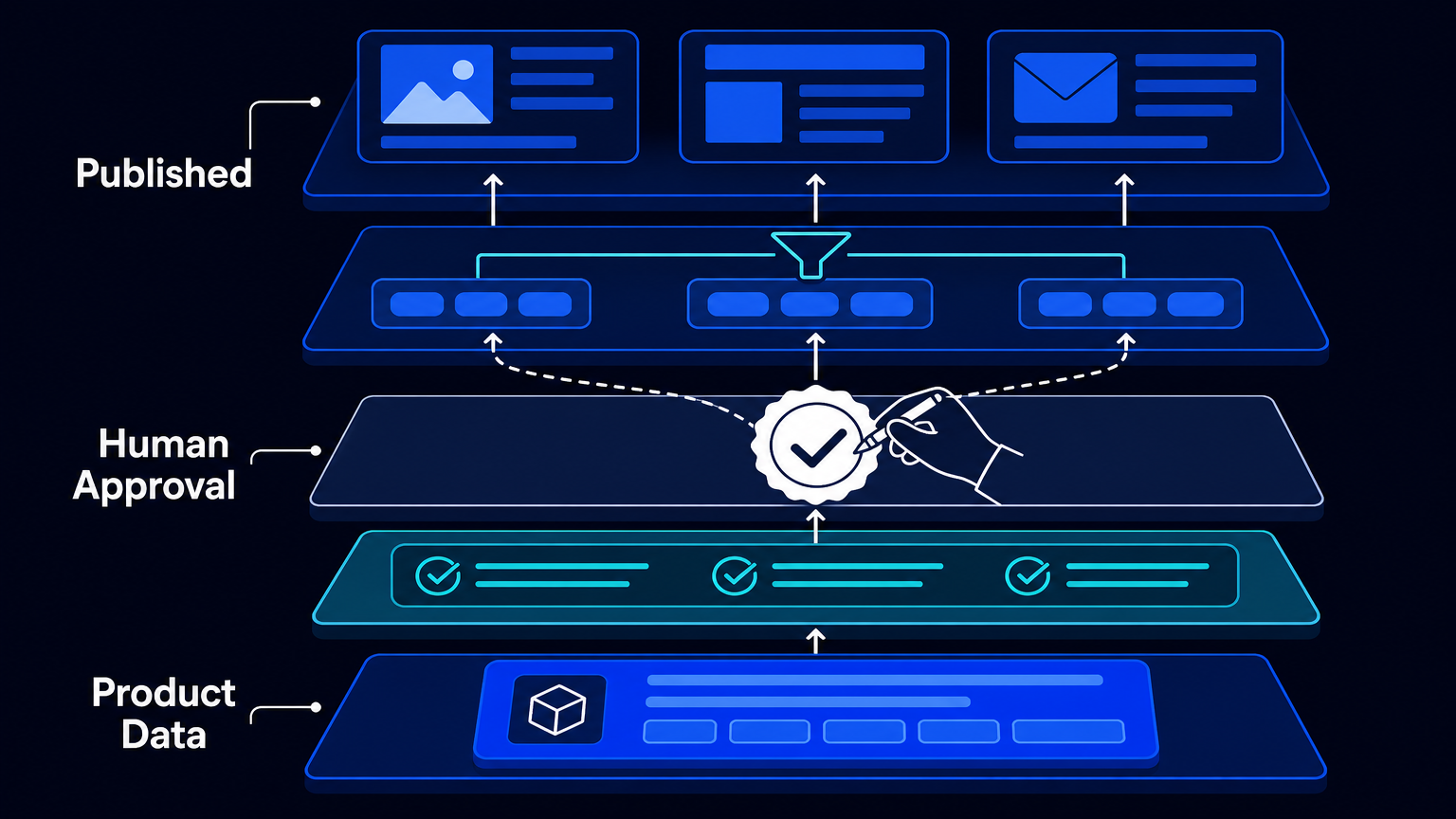
The important architectural decision was not simply to add a new application. It was to establish a sequence: maintain the product record; test whether it contains what a given channel and locale require; obtain the relevant human decision; then expose the approved selection to the people and systems that need it.
A workable flow has five layers
- Product record. Store the fields that form a product claim: name, description, specifications, price-related information where applicable, intended market, language and supporting assets. A field should be updated in the record, not silently rewritten in every presentation.
- Validation. Define which attributes are required for a particular product family, locale and channel. Akeneo documents completeness rules at those levels. Completeness is a release check for required information, not proof that a claim is legally or commercially acceptable.
- Human approval. A responsible product owner decides whether the claim, required fields, audience and publication status are appropriate. Automation can identify a missing field or route a workflow. It must not invent a promise or convert completeness into authorization.
- Shared catalog. Provide a current, controlled selection of approved products and attributes to a defined internal or external audience. Akeneo documents Shared Catalogs as read-only portals with filtered products, attributes, channels and locales, with PDF or XLSX export options.
- Commercial materials. Sales and marketing use the approved selection as a reference for decks, one-pagers, web pages and other materials. Each material still needs the review appropriate to its format, audience and purpose.
What this does not automate
A structured record is not a license to publish. A completeness rule can determine that the fields required for a German e-commerce listing are present. It cannot determine whether the wording is substantiated, whether a claim remains strategically appropriate, whether a segment should receive an email or whether a campaign should go live.
Those decisions belong to accountable people. Product owners define the claim and its status. Marketing owners approve the audience, offer and send action. Legal or regulatory review remains necessary where the product and market require it. The workflow should make those boundaries visible rather than hiding them behind a green “complete” indicator.
The extension to presentations and email is a process design, not the reported deployment
Akeneo’s case establishes the product-data and publication foundation. It does not say that asambeauty automatically generated sales presentations or email sequences. That extension is a practical process-design conclusion: once approved fields are available as structured records, a team can reduce retyping by using them as the controlled input to commercial materials.
For example, a presentation workflow can pull an approved product name, benefit statement, specification and market-specific qualifier into a draft. An email workflow can use approved fields as constrained source material for a draft sequence. In both cases, a responsible person must review the assembled message, approve the audience and authorize publication or sending. The point is not automatic persuasion. It is preventing an unreviewed copy of a product fact from becoming the de facto source of truth.
The operating consequence: start with the claim that must stay true
For a marketing leader, the first useful question is not which content tool to buy. It is which product facts are repeatedly copied into campaigns, decks, partner documents and web pages—and who is responsible when one changes. Start with one product line and one or two destinations. Define the required fields for each destination, the owner of each approval and the point at which information becomes publishable.
Then measure the process honestly: count correction requests, versions in circulation, handoffs needed to answer a product question and the time spent locating the current fact. These are operational measures to establish a baseline, not results that can be assumed from the asambeauty case.
The durable principle is simple. Do not ask every campaign asset to remember the product. Maintain the product once, make its destination-specific requirements explicit, and let people decide when an approved claim may become a promise to the market.
If your team repeatedly reconciles product facts across sales and marketing materials, map one claim from its owner to its published destinations before adding another template or content-generation tool.
Sources
- Akeneo, “asambeauty customer story,” verified for this editorial slot on 16 October 2026: https://www.akeneo.com/customer-story/asambeauty/
- Akeneo Help Center, “Follow your products’ completeness”: https://help.akeneo.com/en_US/serenity-take-the-power-over-your-products/187-serenity-follow-your-products-completeness
- Akeneo Help Center, “Shared Catalogs”: https://help.akeneo.com/en_US/shared-catalogs

