
News · 14 September 2026
OpenAI’s Rust Rewrite Makes Technical Debt a Timing Decision
OpenAI reports that two engineers, assisted by Codex and GPT-5.5, moved most production traffic for Habitat from Python to Rust. The result does not make deferred rewrites universally safe. It shows how stable interfaces, production measurement and a controlled migration can change when a rewrite is worth doing.
Technical debt is often described as a bill that grows until it must be paid. OpenAI’s latest engineering account suggests a more useful framing: some debt is an option whose value depends on timing.
On 11 September, OpenAI published an account of Habitat, its production storage platform. Habitat now handles more than 70 million requests per second, serves more than 500 petabytes of data, operates across almost 40 geographic regions, and supports OpenAI products used by more than 1 billion people each week. The scale is notable. The more consequential detail is how one part of that platform moved from Python to Rust.
OpenAI says that two engineers, assisted by Codex and GPT-5.5, rewrote a Python service in Rust during the second quarter of 2026. At publication, the Rust service was handling 95% of production requests. OpenAI reports 6× greater CPU efficiency, 15× greater memory efficiency, and lower average and tail latency than the Python implementation.
What changed is a large share of a production service has moved to Rust with reported material efficiency improvements. What did not change is equally important: the migration was not yet complete. The former Python service remained in operation for the remaining traffic, and OpenAI said it would be deprecated in the following weeks. Nor does the account establish independently benchmarked results, a financial saving, or an autonomous AI rewrite. OpenAI identifies two engineers and the AI systems that assisted them, but does not quantify the contribution of either.
The Python service was not accidental debt
Habitat began in 2023 as a Python client library connected to one database. As its use expanded, coordinating library changes across dozens of services became slow and operationally brittle. OpenAI separated the functionality into a service, giving product teams a common API rather than requiring synchronized changes across many client deployments.
That service was initially operated in Python. OpenAI characterizes this as a deliberate short-term acceptance of technical debt. Immediate compute efficiency was not the first objective. Platform stability, product development and the establishment of usable APIs came first. The Python implementation ultimately peaked at more than 20 million requests per second.
This sequencing matters. A rewrite is not just a language choice. It is a change to implementation, operating assumptions, deployment paths, observability, failure modes and often team attention. Doing it while interfaces are still moving can force a team to pay twice: once to build the high-performance version and again to adapt it to a product surface that had not yet stabilized.
The relevant question is not whether technical debt exists. It is whether the organization has bought time to learn before it pays for a durable implementation.
OpenAI explicitly says it made a wager: coding models would improve enough to make a later migration easier. Its published outcome is a concrete, but narrow, data point in favor of that wager. Once the platform had matured and its constraints were visible in production, two engineers used Codex and GPT-5.5 to conduct the Rust rewrite.
AI changes the economics of a bounded rewrite
The news is not that an AI system can emit Rust. Code generation alone does not answer whether a migration preserves behavior, meets latency targets, survives partial failure, or can be safely shifted under live traffic. Habitat’s account is more useful because it connects assistance with a bounded production transition and reports operational outcomes.
If AI assistance lowers the engineering effort needed to translate established behavior into a more efficient implementation, it changes the option value of deferral. A team may rationally choose to stabilize an interface, observe real workloads and defer a costly rewrite—if it retains the ability to execute that rewrite later. The qualifier is the entire point. Debt is an option only when it is bounded and exercisable.
For an enterprise team, “exercisable” means the old system has not become unknowable. Its interfaces need to be constrained enough to reproduce. Its production behavior needs measurement rather than folklore. Its service boundaries need to permit a staged cutover. And its migration needs a defined success condition beyond “the new code compiles.” In OpenAI’s case, production traffic allocation and comparisons of CPU, memory and latency made the transition observable.
Three conditions make deferral defensible
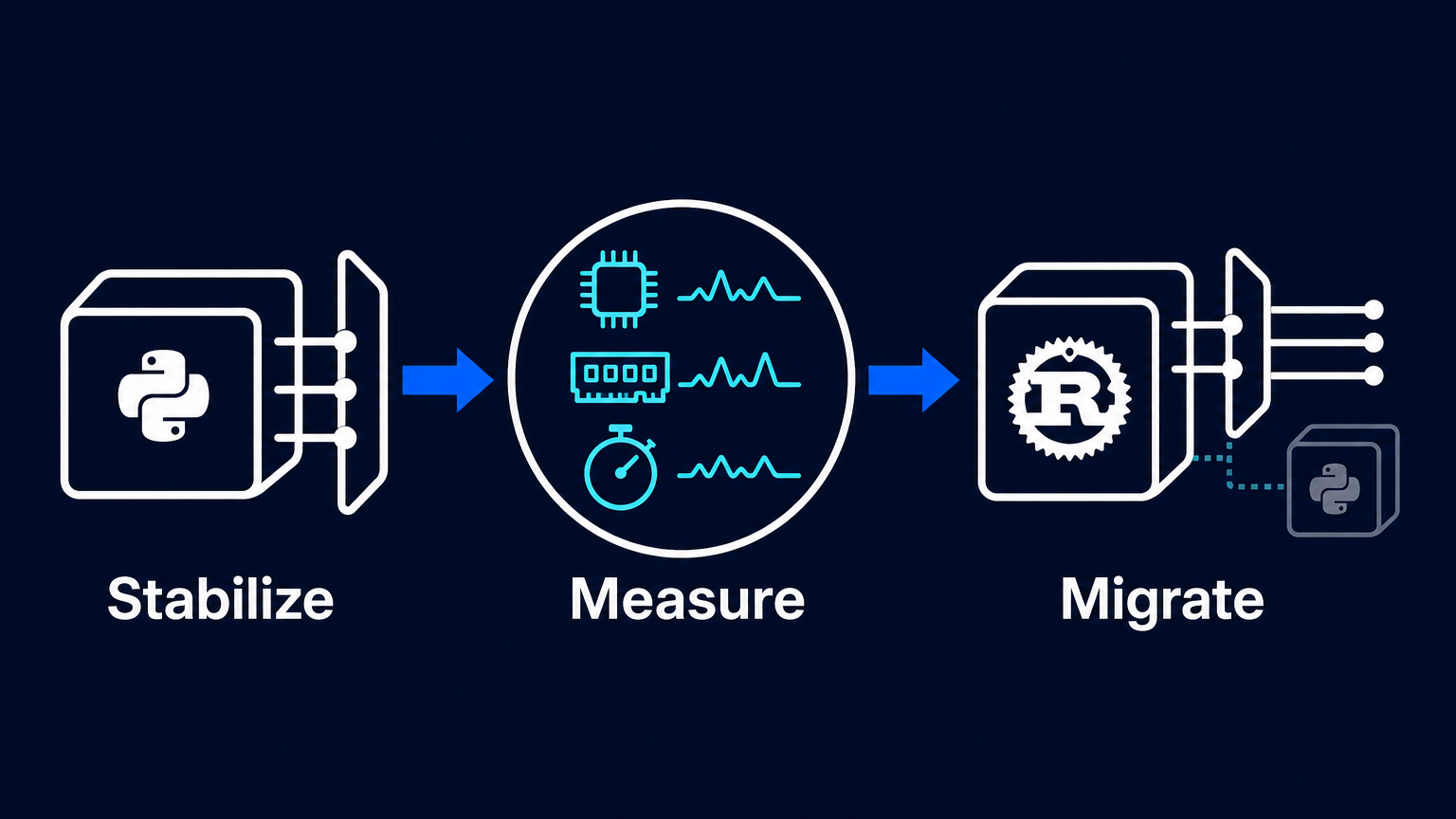
- Stabilize the contract first. A service rewrite becomes more tractable when its API and operational responsibilities are sufficiently settled. Habitat itself was created to avoid brittle coordination of library changes across dozens of services.
- Measure the actual constraint. OpenAI’s published case concerns CPU efficiency, memory efficiency and latency under production traffic. A rewrite should respond to a demonstrated bottleneck, not a language preference presented as strategy.
- Preserve a controlled migration path. The Rust service was carrying 95% of production requests while Python still served the rest. This is a transition architecture, not a one-time replacement event.
Do not turn a case study into a license to wait
The result should not be read as a general recommendation to postpone every hard modernization. OpenAI operated Habitat at exceptional scale, had an already separated service, and reports extensive production measurements. Its APIs and migration path were sufficiently constrained to permit a controlled shift. Those conditions are not automatic in an enterprise estate.
Unbounded debt is not strategic patience. An interface that keeps changing, behavior that is poorly instrumented, or a system with undocumented dependencies does not become easier to replace merely because coding models improve. It can become harder: AI may generate more code quickly, but it cannot supply missing operational knowledge from a system that nobody can characterize or test.
The efficiency figures also need restraint. OpenAI’s 6× CPU and 15× memory figures are first-party production measurements, with no published test methodology in the account. They should not be converted into a savings estimate. Still, they are operationally meaningful: they show that, in OpenAI’s reported environment, an AI-assisted implementation change was associated with substantially better resource efficiency and latency after most traffic had moved.
The practical consequence: manage debt as a dated option
Engineering leaders should not ask teams to defend every non-optimal implementation as if speed and durability had no trade-off. They should ask for an explicit debt position: what is being deferred, why the current implementation is adequate, which production signals would trigger a rewrite, what must remain stable for that rewrite to be feasible, and how traffic could move without a blind cutover.
That approach puts a date and operating conditions around the decision. It also avoids a common misuse of AI coding tools: treating them as an excuse to delay architecture. The stronger use is the opposite. Use the period before a rewrite to narrow interfaces, collect behavior, establish performance baselines and design the migration boundary. Then use AI assistance where it can reduce translation and implementation effort without replacing engineering judgment.
OpenAI’s Habitat account does not prove that AI has made rewrites cheap, routine or safe. It documents something more credible: under measured production constraints, with a stable enough platform and a staged deployment path, AI assistance can alter when a team chooses to pay down technical debt. The strategic asset is not the generated Rust. It is the preserved ability to make the change when the evidence says the time is right.

