
External market case · customer onboarding
The Sale Is Not the Onboarding Brief
Amsive’s client-onboarding workflow shows how a sold scope can move from CRM into reviewed, service-specific delivery work—without asking Operations to reconstruct the client from scattered context.
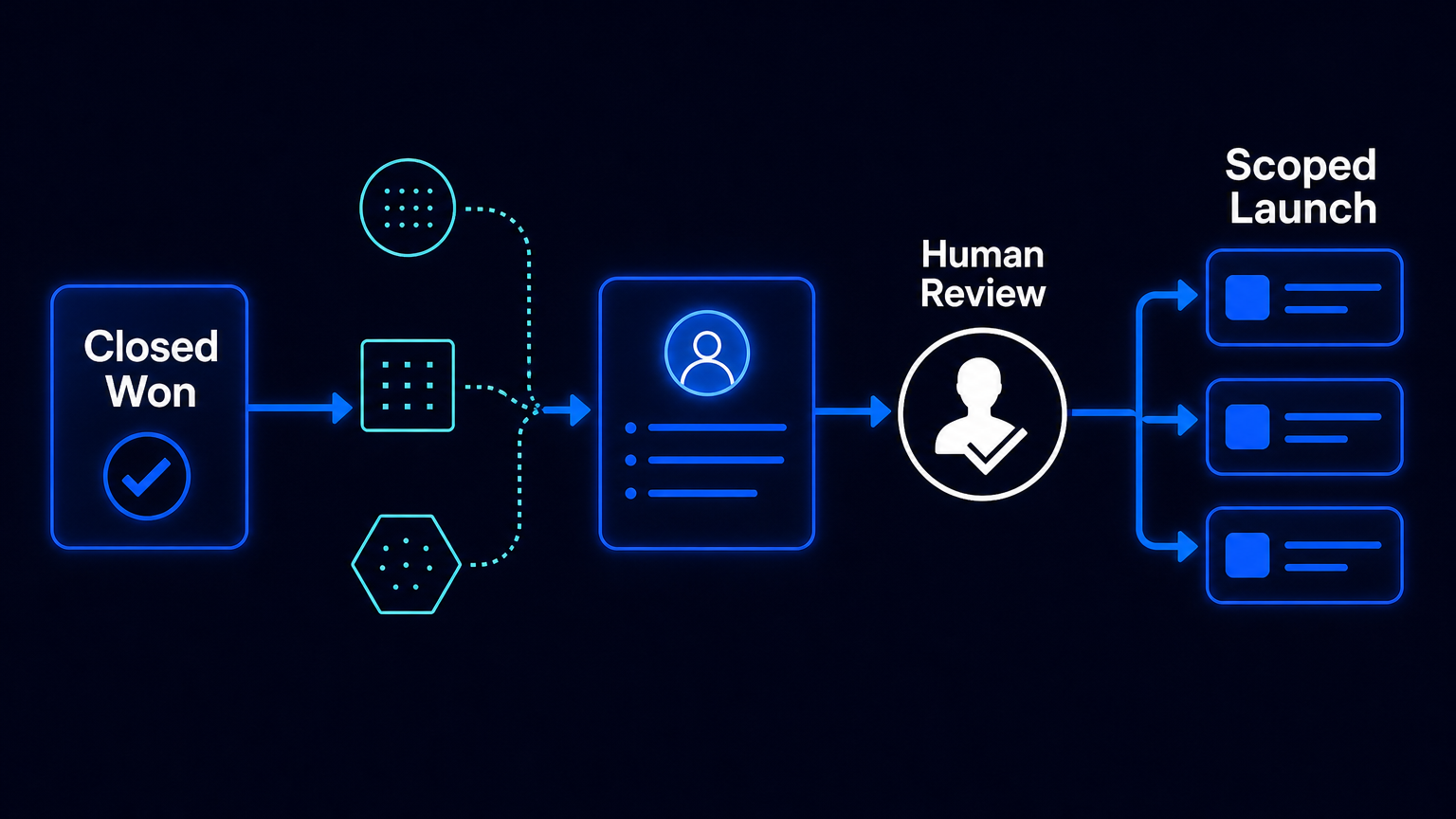
A closed deal is a commercial outcome. It is not yet an onboarding brief.
That distinction is where many client operations teams lose time. Sales has recorded the opportunity, agreed the services and converted the prospect into a customer. Delivery still needs to establish what was sold, when work begins, which context matters, and which teams must act. When those answers sit across a CRM, chat threads, shared folders and individual inboxes, the handoff becomes a second discovery process.
Amsive, a performance-marketing agency, offers a concrete external example of a different design. In a customer story published by Asana on September 17, 2026, Amsive describes a workflow that carries the sold scope into onboarding work. This is a vendor-published customer case, not an independent audit and not an AES implementation. Its value is the process pattern: assemble the available context, put a person at the point of interpretation, then create work that reflects the services actually sold.
The old handoff asked Operations to rediscover the client
Before the change, Amsive recorded a sales result in Salesforce. Other relevant client details remained distributed across Slack, SharePoint and individual inboxes. As information moved between teams, Amsive said, details could become incomplete or inconsistent.
This is a familiar failure mode. The sales record may establish that a deal exists, but it rarely serves as the complete operational picture on its own. The onboarding team then searches for prior discussions, reconstructs the engagement, asks questions that have already been answered and re-enters details into new forms. The work is not merely administrative. It introduces delay and creates a risk that delivery begins from an outdated or partial version of the agreement.
The operational problem is therefore not simply that systems are disconnected. It is that the meaning of the sale does not survive the transition into delivery in a usable form. A handoff note may announce that a client is “won”; it does not reliably tell each delivery team what it should now do.
The trigger is a business state, not a reminder
In the documented Amsive workflow, a Salesforce opportunity is marked Closed Won and converted into a customer. The Salesforce–Asana integration creates a client-card task. That task includes information such as the engagement start date and the services sold.
This is an important starting point. The trigger is not an email telling someone to begin onboarding, nor a manually maintained checklist. It is a change in the commercial record: the opportunity has reached the closed-won state. The resulting client card gives the next process a durable object around which information, review and delivery work can be organized.
But the client card is not treated as a complete brief. That restraint matters. The case explicitly describes further context spread across connected systems. Treating a CRM field set as complete when it is not would only automate a thinner version of the old handoff.
The useful design is assembly, review, then scoped work
Amsive’s documented intervention can be read as six connected steps:
- A Salesforce opportunity reaches Closed Won and is converted into a customer.
- The Salesforce–Asana integration creates a client-card task with core engagement data, including services sold and start date.
- An AI Teammate gathers existing client context from connected systems.
- It constructs a client profile and creates a connected document that records profile updates.
- An Operations Manager receives a review subtask, verifies that the profile has been assembled correctly and converts the client card into an onboarding project.
- After that human review, the system creates onboarding tasks according to the services sold; functional teams carry out their own follow-on work.
The order is the point. Information assembly happens before launch. Human review happens before project conversion. Service-specific task creation happens after review, not before it.
The workflow does not show an AI system approving commercial scope, negotiating terms or deciding how an exception should be handled. It assembles context and coordinates records. Operations checks the assembled profile and initiates the project. Commercial interpretation, exception handling and client decisions remain human responsibilities.
The benefit is continuity, not unattended onboarding
Amsive reports that the new process replaces inconsistent handoffs with a standardized workflow. It says the team can track timelines, identify delays, reduce repeated information gathering and avoid duplicate forms. These are qualitative benefits reported by Amsive through Asana’s customer story. They should not be read as an AES result or as a benchmark for another organization.
The more durable lesson is narrower and more useful: onboarding work should inherit its scope from the sale, but not blindly. A delivery process needs both the commercial facts and the contextual information that makes those facts actionable. It also needs a named point where someone can detect that the assembled picture is wrong, incomplete or no longer current.
That design avoids two opposite mistakes. One is a manual handoff in which Operations starts from scattered messages and institutional memory. The other is a fully automatic launch based on a CRM record that may omit important context or conceal an exception. A reviewable profile creates a practical middle ground: the system does the retrieval and structuring; the accountable person decides whether the case is ready to become delivery work.
What should remain outside the automated path
This pattern is not a reason to automate every part of client onboarding. Functional teams still perform their own work after the project is created. A change in purchased services or in the client relationship still needs to be understood and reflected correctly. The Amsive case says the client profile is refreshed as the relationship or purchased service set changes; that is useful only if the underlying sources, ownership and review expectations are clear.
For a team considering a similar process, the difficult work comes before the integration: define which sales fields represent committed scope; identify the systems that contain legitimate operating context; decide who reviews the assembled profile; and specify what happens when the profile is incomplete, contradictory or commercially sensitive. A task generator cannot resolve those design questions after launch.
A practical test for the current handoff
Take one recently won client and ask a simple question: can an Operations Manager see, in one reviewable record, the services sold, the start date, the relevant existing context and the work that should follow? If the answer requires searching several inboxes, asking sales to repeat the deal or copying the same data into multiple forms, the process is still making delivery rediscover the sale.
The first improvement is not necessarily an AI feature. It is a clear transition from sold scope to an owned client record, with a human checkpoint before that record becomes service-specific work. Once that boundary is explicit, automation can reduce retrieval and duplicate entry without pretending to replace operational judgment.
For teams redesigning client onboarding, the useful conversation is not “how do we automate onboarding?” It is “which parts of the sale must arrive intact, who verifies the assembled client picture, and which work should be created only after that verification?”
Source: Asana, “How Amsive automated client onboarding with AI Teammates,” published September 17, 2026: https://asana.com/resources/amsive-client-onboarding-automation-ai-teammates

