
Process design
Changing the Answer Key Should Create a New Test Release, Not Quietly Rewrite the Old One
A process design for updating assessments without losing the meaning of historical scores: freeze releases, review the diff, and correct past attempts only through an explicit decision.
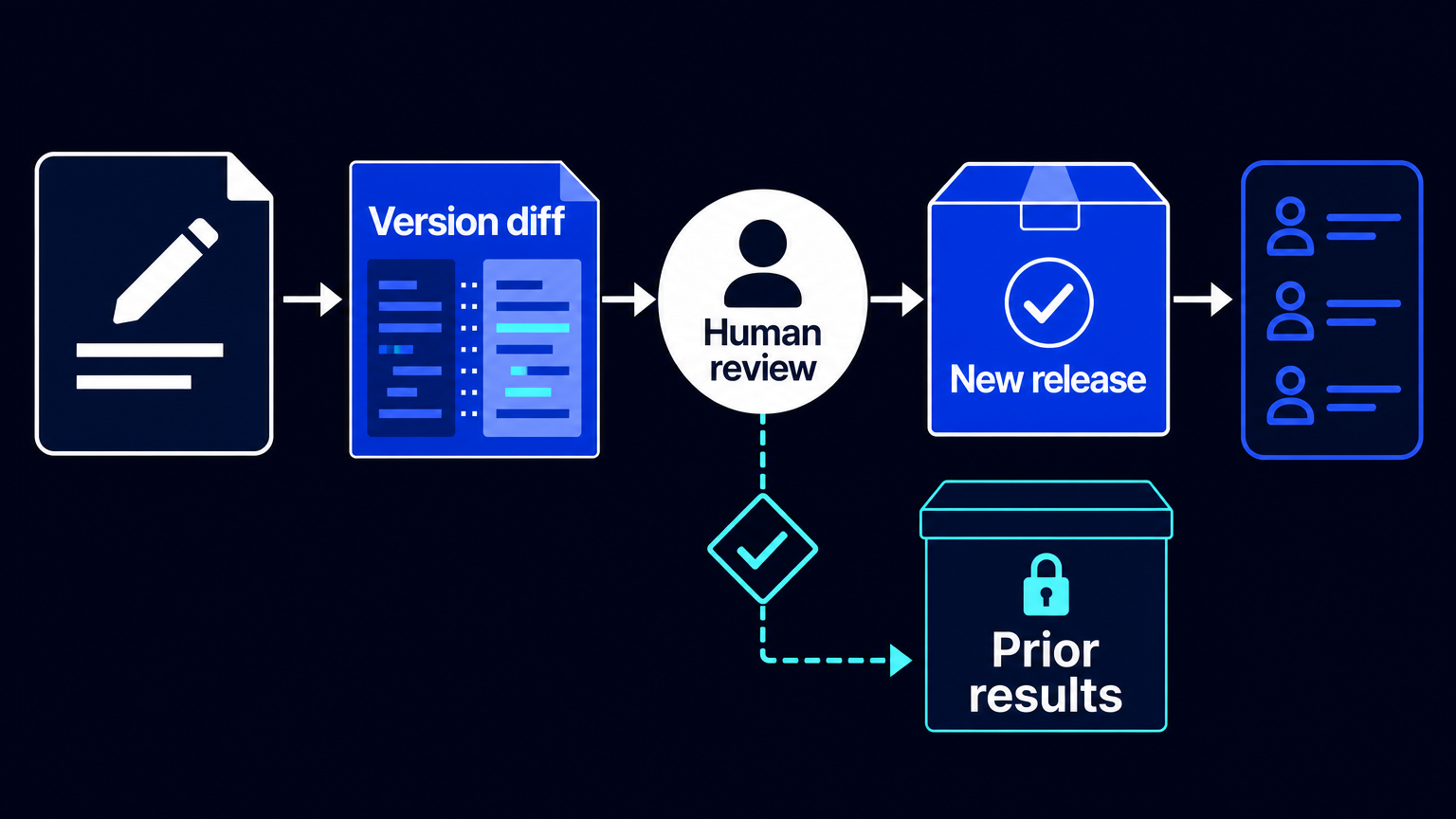
An L&D lead changes an accepted answer in a recurring certification quiz. A course owner clarifies a question. An assessment team adjusts a weight or pass rule after review. These can be sensible changes. The operational failure begins when the edit is made in the live test and the system treats the past as though the revised definition had always existed.
Then one report line may contain scores produced by different questions, keys, weights or passing rules. A learner can ask which version they actually took, and the team may not be able to reconstruct it. Worse, a regrade action can apply a newer question version to submitted attempts. What looked like routine maintenance has become a change to historical results.
The practical rule is simple: move the test forward through a new release. Alter history only through an explicit, reviewed correction decision. This is a workflow design for recurring internal assessments, learning programmes and certifications. It is not a claim that versioning alone establishes validity, fairness or comparability.
The problem is not every edit. It is losing the definition behind a score.
A test result is not just a number. It is the output of a particular set of questions, accepted answers, scoring rules, weights, pass rule and intended use at a particular time. If those components change, the organisation needs to know whether the score still has the same interpretation.
The 2014 Standards for Educational and Psychological Testing say that users should be informed when a test is revised, including what changed, whether the score scale changed and how comparable original and revised scores are. Revisions that affect score interpretation should be documented. The Standards also distinguish a materially revised test from a new form produced to the same specifications. That distinction matters: not every wording correction creates a different construct, but neither is every edit harmless maintenance. Source: https://www.testingstandards.net/uploads/7/6/6/4/76643089/standards_2014edition.pdf
The International Test Commission makes the managerial implication clear. Adopting a revised test requires case-by-case professional judgement: teams must balance improvements in the new version against continuity with the old one. Psychometric evidence is important, but it is not the only consideration. Source: https://www.intestcom.org/page/19
Before: one live object, several invisible definitions
In the weak process, the test owner opens the production quiz, edits a question or key, and saves. Reports continue to group attempts by test name or programme. No release record captures what was in force for each attempt. No one reviews whether the change affects a trend line, a benchmark, a completion decision or a credential.
The risk is not limited to high-stakes examinations. An internal knowledge check can drive access to advanced training, escalation to a manager, coaching, programme completion or an operational readiness decision. If a score is used to compare people or periods, its definition needs to be recoverable.
Some assessment platforms expose the technical ingredients for traceability. Questionmark documents item versioning and an audit trail that can show what changed and which question version a test taker saw. Moodle’s question bank includes question history, versions, authors, modifiers, review comments, usage and last-use information. These capabilities preserve evidence; they do not decide whether two releases are comparable for a particular use. Sources: https://www.questionmark.com/platform/flexible-authoring/ and https://docs.moodle.org/501/en/Question_Bank
The intervention: make the release, not the editable quiz, the unit of record
- Freeze every published release. Store its question versions, accepted-answer key, scoring method, weights, pass rule, intended use and effective date. Link every attempt and result to that release.
- Generate a structured diff for each proposed change. The diff should identify changed wording, answer options, keys, weights, scoring rules, pass rules and metadata—not merely say that the test was edited.
- Route the diff to a qualified test owner or methodologist. That person classifies the change as an error correction, minor maintenance or an interpretation-affecting revision, and records the reasoning.
- Review the proposed release before publication. Where relevant, use version-separated response data and an approved method for assessing comparability. A pilot may be appropriate, but its design depends on the intended decision and population.
- Publish the approved release for new attempts. Keep prior attempts attached to the release under which they were submitted. Do not merge results across releases into one trend or benchmark unless comparability has been established for that use.
- Open a separate correction procedure when historical results may need to change. Define the error, affected population, regrade method, notification, downstream decisions requiring review and accountable approver.
A regrade is a correction path, not a housekeeping button
Moodle documents an important implementation detail. For questions configured to use the latest version, the “Regrade all” function can reload that latest version into running and submitted quizzes. In other words, a regrade can change historical scoring through the current question definition. Source: https://docs.moodle.org/404/en/Quiz_FAQ
That function may be appropriate when a documented scoring error requires correction. But it should trigger a decision process, not an automatic cleanup. The owner needs to establish what was wrong, whose results are affected, whether participants must be notified, and which decisions based on the old scores must be reviewed. Automation can identify affected attempts, calculate proposed score changes and assemble an approval packet. It must not silently replace results or decide the consequences.
Use statistics as review inputs, not automatic verdicts
Item statistics can help a team decide where to look. Moodle’s statistics report includes attempt counts, response distributions, facility index and discriminative efficiency. Its documentation also warns that an anomalous discrimination value needs investigation; it does not prove that a question is broken. Source: https://docs.moodle.org/500/en/Quiz_statistics_report
The same discipline applies to a release comparison. A difference in response patterns may reveal ambiguity, changed difficulty, an implementation defect or a population shift. It does not, by itself, establish that old and new scores are equivalent—or that they are not. For high-stakes uses, the required evidence, representative population and measurement expertise should match the consequences of the decision.
What this changes for the process owner
The benefit is not a promised accuracy percentage or a claimed ROI. It is an operating model that keeps a score interpretable. A team can answer which release produced a result, reconstruct the rule set in force, investigate a scoring complaint and decide consciously whether historical records require correction. Period comparisons become cleaner because they are version-aware rather than accidentally blended.
Start with one recurring assessment. Define the release record, the required diff fields, the approver for each change class and the correction path. Then test a deliberately awkward scenario: an accepted answer was wrong after 400 people completed the quiz. If the team cannot identify affected attempts, explain the proposed correction and locate downstream decisions, the process is not ready to alter history.
AES can help map this workflow into the assessment and learning systems already in use: preserving version evidence, preparing review materials and routing approvals. The methodological judgement remains with the qualified owner.

