
News · 5 October 2026
Anthropic Is Training Enterprise AI Engineers Against Live Projects, Not Case Studies
Claude Frontier Academy ties training to a named enterprise deployment, a practical assessment and a 12-week supported residency. That changes the implementation option available to buyers—not yet the evidence on outcomes.
Anthropic is putting $100 million behind a different answer to a familiar enterprise AI problem: how to get from a promising use case to a deployment that someone inside the company can actually own.
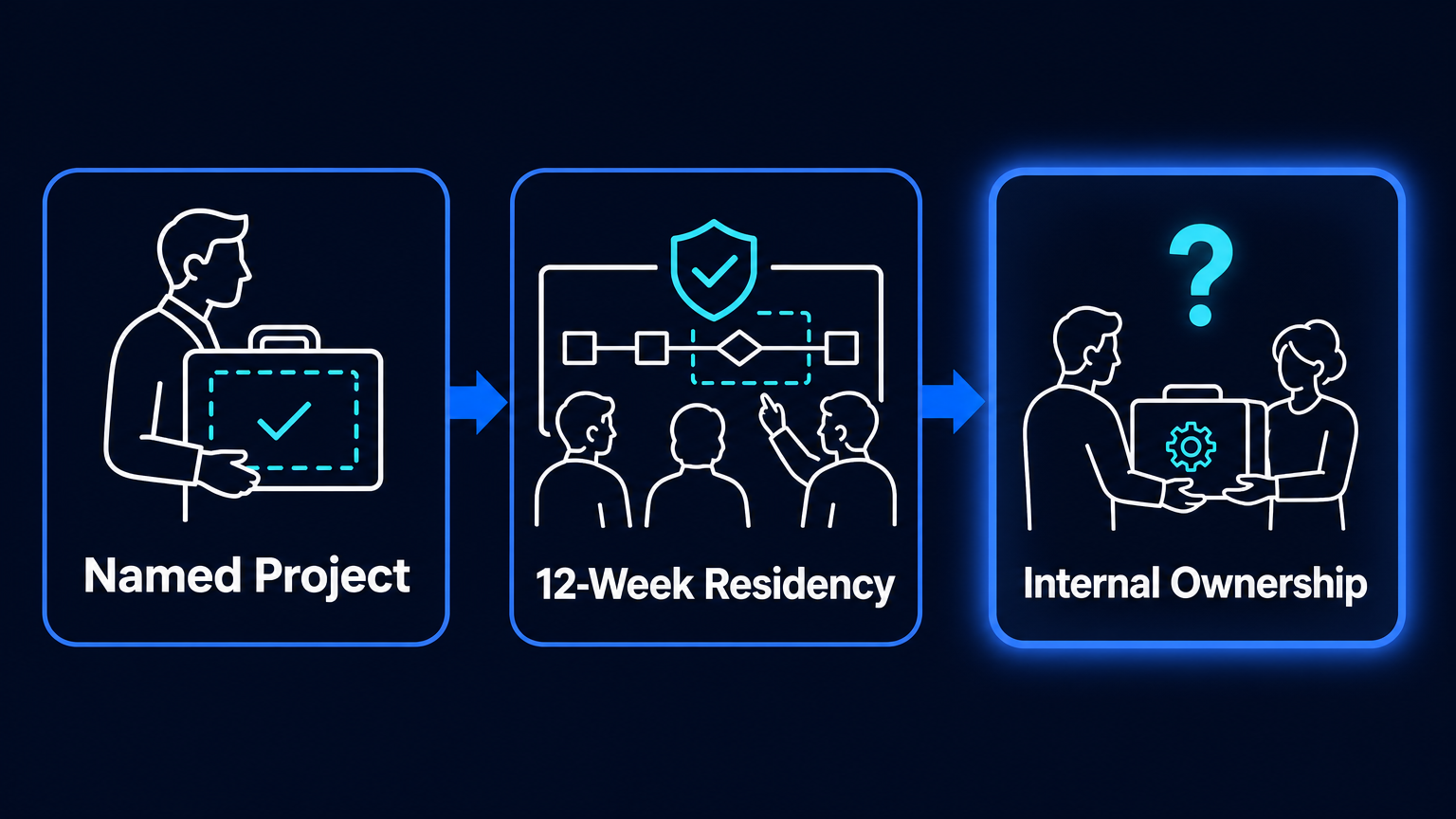
On 2 October, the company announced Claude Frontier Academy, with a stated goal of training 10,000 Frontier Deployed Engineers by the end of 2027. The consequential feature is not the future credential. It is the operating sequence around it. Participants are nominated by their employers, arrive with a named Claude project, complete a simulated enterprise deployment and graded practical, then lead that project at work during a 12-week residency supported by Anthropic engineers.
That structure turns education into a vendor-operated implementation pipeline. For enterprise buyers, it creates a middle path between trying to hire scarce internal specialists and handing an entire deployment to a consultancy. It also makes several questions urgent before a company nominates its first engineer: who owns the architecture, what remains usable outside Claude, and who carries the project once the residency ends?
What changed: training now begins with a deployment obligation
Most technical training asks learners to carry lessons back to an unspecified future project. Frontier Academy reverses that order. An engineer must enter with a specific Claude project that they will lead after the initial instruction. The project is not an optional capstone attached to the end of a course; it is the reason the participant is there.
The programme starts with a multi-day, in-person simulation of an enterprise deployment. Anthropic says it covers use-case selection, security review and handover, followed by a graded practical. Engineers who pass move into a 12-week residency while leading a real project for their employer, with support from Anthropic engineers. A second assessment determines the final credential.
This sequence places several activities that are often separated—training, solution design, security review, implementation and handover—on one path. That does not guarantee that the deployment will work. It does mean the participant is assessed against work resembling the organisational conditions that decide whether an AI initiative gets beyond a demonstration.
The first cohorts are already running in San Francisco, New York and London. Anthropic names participants from Accenture, Bain, Capgemini, Commonwealth Bank of Australia, Deloitte, McKinsey, Morgan Stanley and Novo Nordisk. The named organisations demonstrate early institutional participation, but Anthropic has not disclosed how many engineers or projects each is contributing, nor what commercial commitments they have made.
The real product is a staffed transition into production
A short course can transfer concepts. A consulting engagement can deliver a system. The Academy attempts to connect the two by making an employee lead a real implementation while receiving vendor support. That is the new implementation option.
The practical advantage is not simply that engineers learn more about Claude. A nominated employee can carry knowledge of the organisation’s process, data environment, stakeholders and constraints into the project. Anthropic engineers, in turn, can support the residency while the work is taking place. The intended result is an internal operator who has been trained through a deployment rather than trained before one.
For a buyer, that may be more appropriate than outsourcing a first project wholesale when the company needs to retain operating knowledge. It may also be more practical than waiting for a difficult hire. But it is not a substitute for the work surrounding deployment: selecting a bounded use case, assigning accountable owners, preparing security review, arranging integration work and deciding what happens when the supported period closes.
The Academy’s significant design choice is that a named enterprise project is an entry condition, not a graduation exercise.
This matters because enterprise AI capability is rarely only an individual skill deficit. Teams can understand prompting, model APIs or evaluation methods and still fail to deploy because the project lacks an owner, a security path, an integration plan or a handover. By making the project explicit at admission, the programme can expose those missing conditions earlier. It cannot supply them automatically.
What did not change: outcomes, portability and ownership remain unproven
The announcement is a commitment and an operating design, not evidence of deployment performance. Anthropic describes a $100 million commitment and a target of 10,000 trained engineers by the end of 2027. It has not reported Academy-driven production results, productivity gains, return on investment or completed residency outcomes. The first final credentials are expected in early 2027.
The programme is also explicitly Claude-focused. Buyers should not treat the credential as vendor-neutral proof of general enterprise AI deployment ability, or assume that its methods, artefacts and operational knowledge will transfer cleanly to another model provider. Some implementation skills will be broadly useful; the announcement does not establish the scope of that portability.
Nor does vendor support remove the ownership question. During a residency, a participant leads a real employer project with Anthropic engineers supporting them. That can accelerate progress. It can also make a company dependent on vendor expertise at a formative point in its implementation. The important test comes afterward: can the internal team operate, modify, assess and extend the deployed work under its own responsibility?
Questions to settle before nominating an engineer
Enterprises should treat Academy participation as a deployment decision, not as a learning benefit. Before enrolling, the sponsor should make the following conditions explicit:
- Name an executive and an operational owner for the project. The participant can lead implementation, but cannot personally supply organisational authority, access or business decisions.
- Define the post-residency handover. Specify who maintains integrations, evaluates changes, manages access and decides whether the work expands, pauses or stops.
- Separate durable internal assets from Claude-specific ones. Document the workflow, interfaces, data assumptions, evaluation approach and operating procedures in forms the organisation can retain and reuse.
- Agree the vendor-support boundary. Identify what Anthropic engineers will support during the residency, what the company’s own team must perform, and how unresolved work transfers at the end.
- Choose a project that can absorb real scrutiny. A named project should be sufficiently bounded to deliver during the residency, yet concrete enough to require the security, handover and operating decisions that a production deployment entails.
These are not objections to the model. They are the conditions that determine whether it builds internal capability or simply moves implementation work through a new channel.
A vendor’s training programme is becoming part of the deployment market
Anthropic has not merely announced a course. It has proposed a structured route through which enterprises can place employees into Claude implementations with vendor support, assessments and a stated credential at the end. That expands the set of ways a buyer can organise an initial deployment.
The model is potentially useful because it starts from a real project rather than generic instruction. Its limits are equally clear. No published cohort outcomes show whether the approach improves delivery, whether teams retain capability after support ends, or whether projects become durable production systems. Those are questions for the first completed residencies, not conclusions available today.
For now, the practical response is precise: if a company has a named Claude project, an internal person who can lead it and a credible post-residency operating owner, the Academy may be a serious implementation route. If those foundations are absent, a credential will not create them.

