
External case
Momentive Removed the Webinar List Wait. Sales Still Chose the Follow-Up.
A HubSpot customer case shows how moving webinar activity into CRM context in under an hour removed a day-long handoff delay—without automating sales judgment.
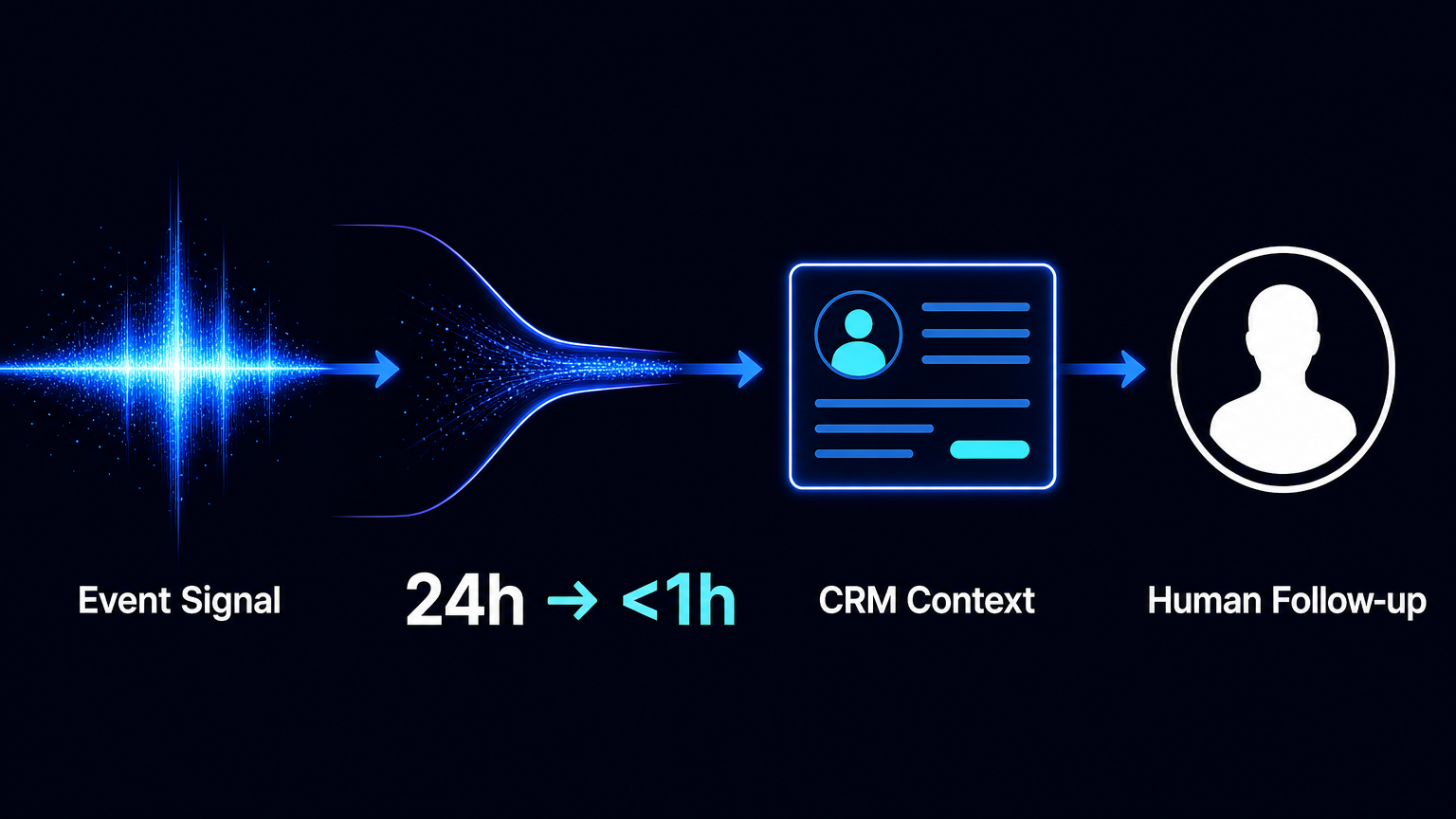
A webinar attendee should not become a spreadsheet waiting to be exported. By the time a sales representative receives a bare contact list the next day, the useful signal has already lost part of its value: the person registered, attended or did not attend, and interacted with a specific event. Those are facts that should be available when a person decides what to do next.
Momentive addressed that delay in its webinar handoff. In an undated HubSpot customer story accessed on November 2, 2026, the company reports that its sales teams had previously waited 24 hours for the contact information needed to follow up with webinar attendees. After an ON24–HubSpot integration, webinar leads reportedly became available to sales in less than one hour. HubSpot describes this as a 96% improvement in speed-to-lead.
This is a market case published by HubSpot, not an AES result or an independent audit. It measures elapsed time until leads from ON24 webinars became available to sales. The story does not disclose the sample size, observation period or calculation method. It also does not show that a salesperson responded within an hour, or that faster availability improved conversion, pipeline or revenue. Those distinctions matter.
The change was not faster emailing. It was a shorter handoff.
The useful operating change is easy to miss. A webinar platform and a CRM can each hold a contact record, but a contact record alone does not explain why this person is relevant now. The handoff has to preserve the event evidence: which event it was, whether the person registered or participated, and what status is appropriate for the next workflow.
Before the integration, Momentive’s sales team reportedly waited a day for the information required to act on webinar attendance. The wider organization also had inconsistent operating structures following the combination of three companies. HubSpot reports that Momentive reduced 20 lead-qualification processes to two categories and applied consistent process flows across the combined business. That broader standardization matters, but it is not the same claim as the webinar result.
After the integration, the working record could arrive sooner. The result is not that every attendee became a sales task. It is that the responsible team had a record with usable context before choosing whether a sales conversation, a nurture path, a suppression rule or no action was appropriate.
A workable event-to-CRM flow has five parts
- Synchronize registration and attendance activity from the event platform into the CRM. ON24 says its HubSpot integration can transfer contact information, registration and attendance history, engagement activity and timeline events that can trigger workflows.
- Match the event activity to the right contact and retain the event identity. ON24’s integration-flow documentation shows email matching and event-ID checks as distinct parts of this flow.
- Make the participation context visible in the CRM record. Current HubSpot documentation shows that records can expose event name, registration or participation status, registration date, participation date, cancellation and no-show status. That documentation confirms available product capabilities; it does not prove Momentive configured every field.
- Apply the approved qualification path. This is where marketing operations determines routing conditions, consent requirements, exclusions, account ownership and duplicate-handling rules.
- Place only eligible records in front of the responsible salesperson or approved nurture workflow. The salesperson then decides whether contact is appropriate and what a relevant, personal next step should be.
The human boundary is the point of the design
Automation is well suited to moving and classifying event evidence. It is not well suited to inferring that every registration deserves outreach. A no-show may need a different path from an attendee. An existing customer may belong with an account owner, not a prospecting queue. A duplicate email, an unmatched identity or missing consent may require no automated contact at all.
ON24’s published flow documentation makes this practical rather than theoretical. It distinguishes registrant and attendee paths, checks contacts and event IDs, and shows that some unmatched or duplicate conditions can lead to dropped records. That is a reason to design an exception queue and reconciliation routine, not a reason to assume the integration is complete because it is connected.
Marketing operations should own the rules: what constitutes an eligible lead, which consent basis is required, how ownership is assigned, how duplicates are resolved, and where failed syncs are reviewed. Sales should own the commercial interpretation: whether a person’s participation signals a timely conversation, what that conversation should address, and whether the next action should happen at all.
What changed—and what did not
What changed at Momentive, according to HubSpot, was the time between webinar activity and lead availability to sales: from 24 hours to under one hour for ON24 webinar leads. The event signal could reach the CRM as working context rather than remain isolated in the webinar system until a later list handoff.
What did not change is equally important. The reported result was not real-time availability, a guaranteed one-hour human response or an automated sales outcome. The case does not establish revenue impact. It does not authorize indiscriminate outreach. And the integration itself does not decide whether the contact is a fit, who should own the relationship or what a responsible message would say.
Measure the wait before automating the message
For a revenue leader or marketing operations owner, the first diagnostic is not “Can we send follow-up automatically?” It is “Where does demonstrated event interest wait before anyone can see it in the working record?” The delay may be an export, a manual upload, a reconciliation step, an owner assignment or an unclear qualification rule.
Map one recent event from registration to the moment a salesperson can see a qualified record. Separate availability from response. Then inspect the exceptions: no-shows, customers, duplicates, unmatched identities, missing consent and failed syncs. If the basic event evidence cannot move reliably, personalization only scales uncertainty faster.
Momentive’s reported result offers a narrow but useful standard. Remove dead time from the transfer and classification of event evidence. Keep the decision to contact—and the meaning of the follow-up—with the person accountable for the relationship. If your event-to-CRM handoff still waits for an export, reconciliation or owner assignment, it is a concrete process worth examining.
Sources and scope
Momentive result: HubSpot customer story, undated, accessed November 2, 2026: https://www.hubspot.com/case-studies/momentive. Integration capabilities: ON24, June 26, 2023: https://www.on24.com/blog/on24-enhances-hubspot-integration/. Integration flow and exceptions: ON24, November 2024: https://support.on24.com/hc/en-us/article_attachments/35962543262363. CRM event fields: HubSpot documentation, updated September 16, 2026: https://knowledge.hubspot.com/integrations/view-marketing-events-on-contact-records?external_link=true.

