
Infrastructure financing
Nscale Has More Financing on Paper. That Is Not More Compute in Production.
Nscale increased its initial pre-IPO convertible-note tranche to $2.36 billion. The update improves its funding position, but enterprise buyers still need to separate contracted capacity, financed construction and delivered compute.
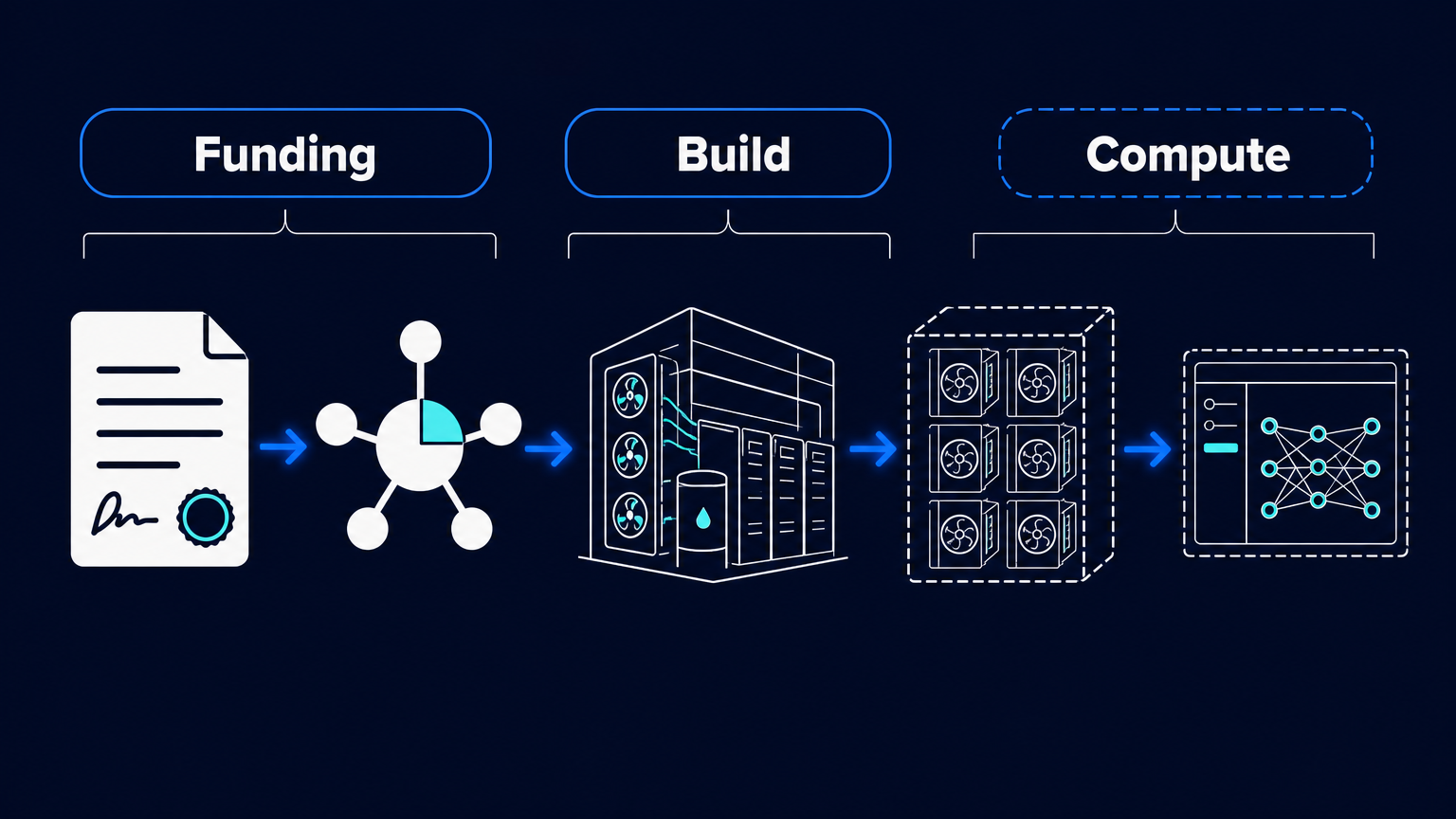
Nscale has increased the initial tranche of its pre-IPO convertible financing from the minimum described in its S-1 filing. That is a meaningful change in the company’s ability to fund an infrastructure build-out. It is not, however, the same thing as additional AI compute being available to customers today.
On September 25, Nscale announced a $2.36 billion initial tranche at closing, alongside a separate $1 billion commitment from NVIDIA that it expects to fund in mid-November 2026. Together, the package is described as $3.36 billion of pre-IPO convertible financing. The notes are intended to convert automatically into ordinary shares when Nscale completes its IPO; NVIDIA would receive non-voting shares.
The financing was not first disclosed on September 25. Nscale’s September 18 S-1 described a September 15 subscription agreement with a minimum $3.1 billion commitment: $2.1 billion in convertible notes and a separate $1 billion NVIDIA commitment in notes or non-voting shares. The new announcement raises the initial tranche by $260 million, or about 12.4%, above that minimum. The change is substantial precisely because it improves the capital scheduled for the initial closing—not because it converts future capacity into present supply.
The funding package has two different clocks
The announced $3.36 billion figure combines money with different expected funding dates. Nscale says the $2.36 billion initial tranche forms the amount at closing. NVIDIA’s separate $1 billion commitment is expected in mid-November. Treating the full headline number as cash already received would erase an important distinction in the transaction.
There is another distinction behind the structure. These are convertible instruments tied to an intended IPO, not ordinary operating revenue. Automatic conversion is specified for IPO completion; it does not establish that an IPO will occur. Nor does the financing announcement guarantee that individual data-center projects, power assets or customer deployments will be completed on a particular schedule.
Nscale says it intends to use the capital across power generation, liquid-cooled data centers and GPU clusters. Those are the physical layers required to turn financing into useful AI capacity. Each has its own dependencies: capital must be deployed, sites and power must support the build, equipment must be installed, and capacity must be brought into service. A financing announcement changes the first part of that chain. It does not complete the rest.
Contracted capacity is not delivered capacity
Nscale reports more than $103 billion in total contracted value. That number may indicate the scale of long-term capacity commitments around its infrastructure business. It should not be read as recognized revenue, cash collected, available compute or unconditional backlog. Its SEC filing describes the business in terms of long-term capacity delivery, which is exactly why the distinction matters.
For an enterprise team, a future capacity contract and a live serving environment are different assets. A contract may secure a place in a planned supply chain. A delivered environment supplies usable GPUs, network paths, cooling, operational support and the service conditions under which workloads can actually run. The first can be commercially valuable. The second is what supports production systems.
More capital can reduce one constraint on future capacity. It does not remove every constraint between a commitment and a running workload.
This is particularly important for teams planning model deployment around neocloud supply. Price, model access and a nominal allocation are incomplete procurement criteria when the capacity is still being built. Buyers need to understand when a provider is obligated to deliver, what conditions apply to delivery, what remedies exist if milestones move, and whether their own workloads have a defined place in the rollout sequence.
What enterprise buyers should examine now
The announcement is useful information for customers and prospective customers, but it should lead to a sharper diligence process rather than a looser one. The question is not whether the financing headline is large. It is where a promised unit of compute sits between contract, construction and operation.
- Separate funds expected at closing from commitments expected later. In this case, the $2.36 billion initial tranche and NVIDIA’s expected mid-November $1 billion funding have different timing.
- Map each planned deployment to construction and commissioning milestones: power availability, data-center readiness, cooling installation, GPU-cluster deployment and service activation.
- Review delivery conditions in capacity agreements. Identify start dates, acceptance conditions, service levels, allocation rights, delay remedies and termination rights.
- Keep financial claims separate from operating claims. Total contracted value, convertible financing and production capacity each describe a different part of the business.
- Assess NVIDIA’s role accurately. Its position as both an infrastructure ecosystem participant and a financing counterparty is a market-structure fact; it is not, by itself, proof of circular financing, independent demand or guaranteed capacity delivery.
This is not a reason to dismiss the update. A 12.4% increase in the initial financing tranche is material for a company seeking to expand power generation, liquid-cooled facilities and GPU clusters. It gives Nscale more initial capital than the minimum amount disclosed one week earlier. For counterparties whose plans depend on that build-out, that can improve the picture of available funding.
But the operating consequence is disciplined language and disciplined planning. Do not call contracted value revenue. Do not call a financing commitment available compute. Do not treat an expected funding date as a completed transfer. And do not treat an announced financing package as a guarantee of an IPO or a finished facility.
AI infrastructure is built in stages. The September 25 update materially changes Nscale’s financing stage. Enterprise customers should now test how that stage connects to the construction and delivery stages on which their own workloads depend.
Primary sources
- Nscale, “Pre-IPO Convertible Financing,” September 25, 2026: https://www.nscale.com/press-releases/pre-ipo-convertible-financing
- items
- Nscale S-1, filed September 18, 2026: https://www.sec.gov/Archives/edgar/data/2110365/000119312526395475/ck0002110365-20260918.htm

