
Infrastructure operations
Lambda Found Three More AI Nodes Inside the Same Power Budget
Lambda’s five-rack validation of NVIDIA DSX MaxLPS raised pure-inference throughput by 24% within a fixed 129-kW power budget. The result is not a general benchmark. It is operating evidence that dynamic power allocation belongs in AI capacity planning.
The first question in a power-constrained AI facility is usually physical: how much electricity can the building, rack and utility connection supply? Lambda’s latest validation suggests a more useful second question: how much of that capacity is being stranded by static power assumptions?
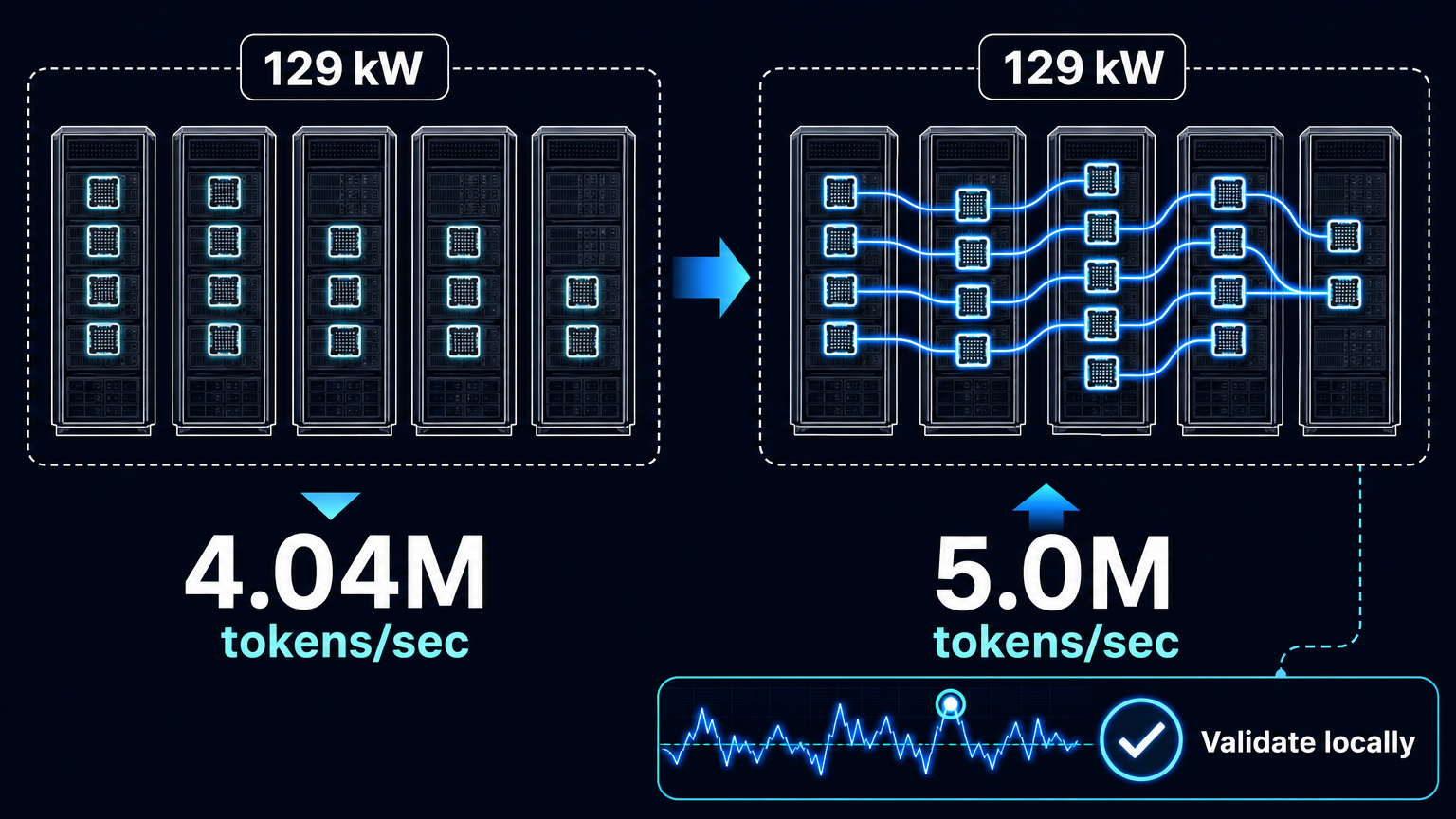
On September 15, NVIDIA published results from Lambda’s first deployment-environment validation of DSX MaxLPS on Blackwell servers. In a five-rack cluster, Lambda ran 19 NVIDIA HGX B200 nodes inside a power budget previously assigned to 16. On its pure-inference test, cluster throughput rose from approximately 4.04 million to 5 million tokens per second while remaining within a 129-kW ceiling. That is a 24% increase in throughput, alongside a reported 23% improvement in cluster-wide performance per watt and 19% more active GPU capacity.
What changed is not the facility envelope or the server generation. It is the way available power was allocated across the cluster. What did not change is equally important: this was a controlled proof of concept with specified MLPerf inference and training workloads, not a claim about fleet-wide production performance or a promise that every AI operator can obtain 24% more output.
Static limits protect the facility—and can waste its capacity
Conventional provisioning has a defensible logic. If every node can draw its peak power at once, the facility must reserve enough capacity for that simultaneous peak. Fixed per-node or per-rack limits make the envelope simple to enforce. They also assume that a heterogeneous AI workload behaves like a synchronized stress test.
Real clusters often do not behave that way. Training, inference, communication and idle periods produce changing demand across GPUs and racks. When one workload is below its assigned ceiling, its unused allocation cannot help another node under a static policy. The cluster stays within budget, but some usable headroom remains inaccessible.
DSX MaxLPS is designed to monitor GPU and rack consumption and reallocate that unused headroom across nodes. In Lambda’s pure-inference configuration, the cluster used an 85% power policy to run 19 nodes within the same 129-kW budget as the 16-node baseline. The practical result was not lower electricity use in absolute terms. It was more token throughput from the same facility-wide power envelope.
For a constrained AI site, the scarce resource may not be installed GPUs or contracted megawatts alone. It may be the ability to allocate the power already available according to actual workload demand.
The result is narrow. The planning implication is broad.
Lambda also tested concurrent training and inference. Under the fixed power budget, it reported 17% more training throughput and 20% more inference throughput. These figures reinforce the operating pattern: mixed workloads can create allocable headroom. They do not establish a universal uplift, a new cost-per-token figure or an absence of trade-offs.
Dynamic power management shifts contention rather than making it disappear. A policy can preserve priority work by slowing, pausing or rescheduling lower-priority jobs. That may be entirely appropriate for batch training, offline evaluation or deferrable tasks. It may be unacceptable for a latency-sensitive inference service, a tightly coupled training run or a workload with narrow stability margins. The relevant measure is therefore not peak throughput alone, but throughput at the latency, quality, reliability and power-compliance limits the operator actually has to meet.
NVIDIA’s own implementation guidance makes this point: adopters must validate the gains against their workloads, latency requirements and power-compliance limits. That qualification should be treated as a deployment requirement, not as a footnote to the benchmark.
Capacity planning now has a software variable
For infrastructure leaders, the immediate consequence is methodological. Before committing capital to another site, more electrical capacity or additional hardware, test whether workload-aware power allocation can safely increase useful output inside the existing envelope. This is not an argument against grid expansion or procurement. Many facilities will still need both. It is an argument against treating either as the only route to capacity.
The test should begin with a bounded cluster and a declared facility limit. Establish a baseline using the current fixed-power configuration. Then classify workloads by priority, latency tolerance, interruption tolerance and expected power shape. Run the dynamic policy against representative traffic—not merely a synthetic peak—and compare token throughput, tail latency, error and retry behavior, job completion, GPU utilization and compliance with the aggregate power ceiling.
Operators should also decide in advance what may yield when demand exceeds the envelope. If inference has priority over training, encode that operational choice and test its consequences. If no workload may slow down, then the available headroom is not genuinely available. Power allocation is a capacity policy, not just a tuning parameter.
- Keep a hard, facility-wide power ceiling rather than optimizing individual nodes in isolation.
- Measure workload-level outcomes: throughput, tail latency, stability, quality and completion time.
- Make priority and shedding rules explicit before a demand event forces an improvised choice.
- Treat results from a pilot as local operating evidence, then repeat them after changes to models, serving stacks, hardware or workload mix.
A separate grid demonstration supports the pattern, not this benchmark
NVIDIA also reported a commercial-scale demonstration at its Eos facility in which power fell from four megawatts to three in under a minute while high-priority workloads were preserved. NVIDIA says Silicon Valley Power subsequently sent more than 200 successful demand signals. This is relevant evidence that AI compute can respond to an external power signal through workload-aware management.
But it should not be merged with Lambda’s result. The Santa Clara demonstration used Emerald AI Conductor, not a production DSX Flex installation, and NVIDIA describes it as an earlier proof of the operating pattern that DSX Flex is intended to generalize. Its operating figures are reported by NVIDIA, not independently audited. Lambda’s measured 24% result belongs to a separate five-rack DSX MaxLPS validation.
The useful decision is to test before building
The significance of Lambda’s validation is neither that software has removed the need for power infrastructure nor that 24% more throughput is now an industry standard. It is that a familiar infrastructure constraint has become partly schedulable. In the tested configuration, software-controlled allocation made room for three additional nodes within a previously fixed budget and turned that room into measured throughput.
For operators facing a power ceiling, that is enough to change the sequence of decisions. First characterize the workload and its service limits. Then test dynamic allocation within a hard envelope. Only after measuring what can be recovered safely should the organization decide how much new electrical capacity, hardware or real estate it must buy. The physical constraint remains. The static assumption about how to use it does not.

